


Valorization of Agricultural Waste as a Chemiresistor H2S-Gas Sensor: A Composite of Biodegradable-Electroactive Polyurethane-Urea and Activated-Carbon Composite Derived from Coconut-Shell Waste
- PMID: 36771986
- PMCID: PMC9920131
- DOI: 10.3390/polym15030685
Valorization of Agricultural Waste as a Chemiresistor H2S-Gas Sensor: A Composite of Biodegradable-Electroactive Polyurethane-Urea and Activated-Carbon Composite Derived from Coconut-Shell Waste
Erratum in
-
Correction: Bibi et al. Valorization of Agricultural Waste as a Chemiresistor H2S-Gas Sensor: A Composite of Biodegradable-Electroactive Polyurethane-Urea and Activated-Carbon Composite Derived from Coconut-Shell Waste. Polymers 2023, 15, 685.Polymers (Basel). 2024 Sep 3;16(17):2504. doi: 10.3390/polym16172504. Polymers (Basel). 2024. PMID: 39274181 Free PMC article.
Abstract
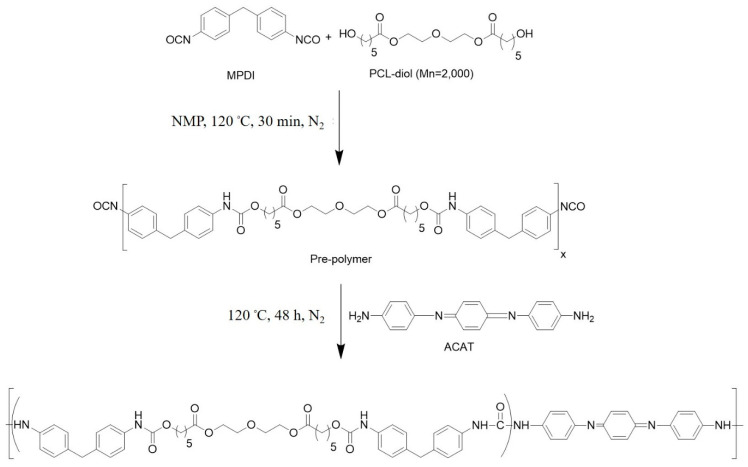
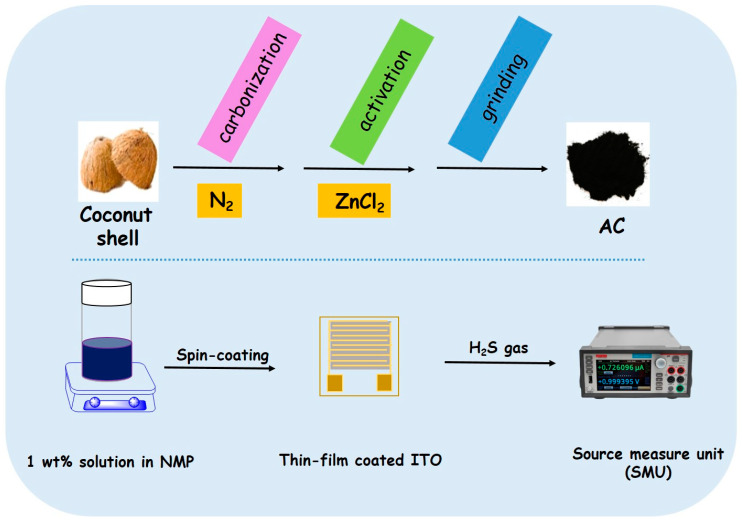
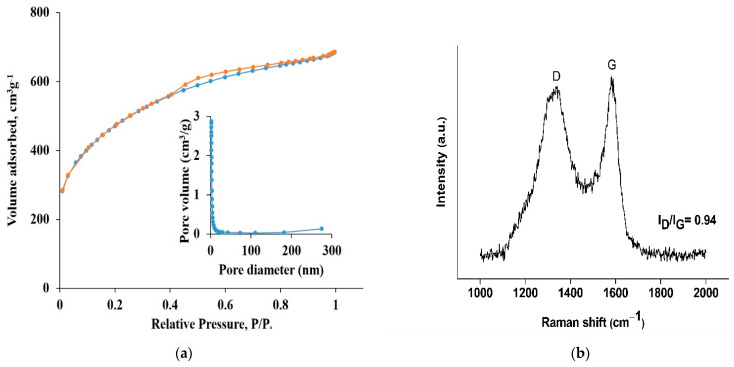
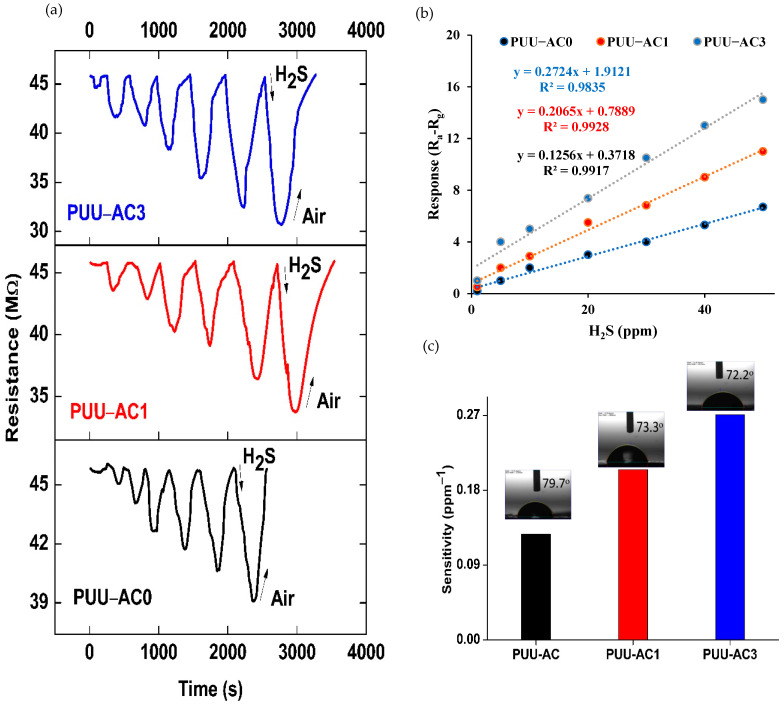
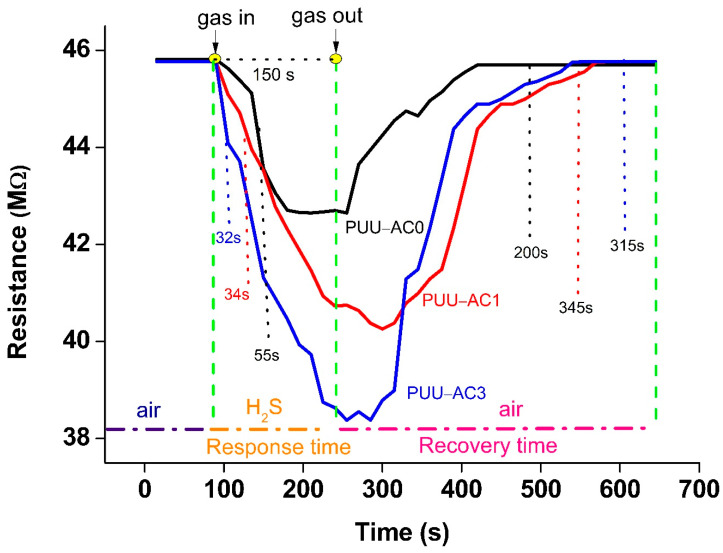
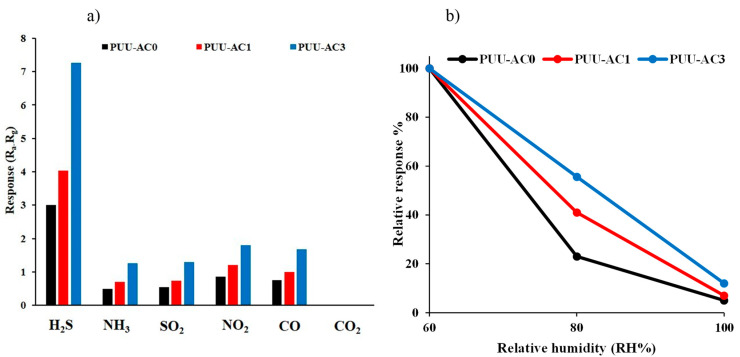
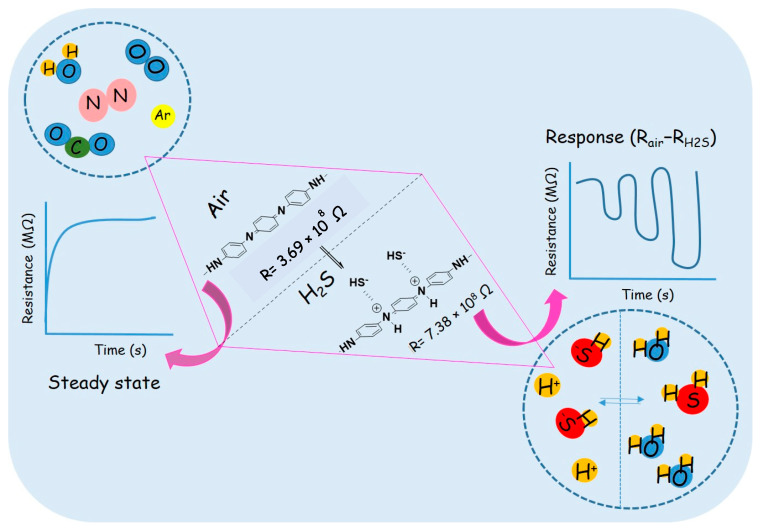
In this study, a high-performance H2S sensor that operates at RT was successfully fabricated using biodegradable electroactive polymer-polyurethane-urea (PUU) and PUU-activated-carbon (AC) composites as sensitive material. The PUU was synthesized through the copolymerization of biodegradable polycaprolactone diol and an electroactive amine-capped aniline trimer. AC, with a large surface area of 1620 m2/g and a pore diameter of 2 nm, was derived from coconut-shell waste. The composites, labeled PUU-AC1 and PUU-AC3, were prepared using a physical mixing method. The H2S-gas-sensing performance of PUU-AC0, PUU-AC1, and PUU-AC3 was evaluated. It was found that the PUU sensor demonstrated good H2S-sensing performance, with a sensitivity of 0.1269 ppm-1 H2S. The H2S-gas-sensing results indicated that the PUU-AC composites showed a higher response, compared with PUU-AC0. The enhanced H2S-response of the PUU-AC composites was speculated to be due to the high surface-area and abounding reaction-sites, which accelerated gas diffusion and adsorption and electron transfer. When detecting trace levels of H2S gas at 20 ppm, the sensitivity of the sensors based on PUU-AC1 and PUU-AC3 increased significantly. An observed 1.66 and 2.42 times' enhancement, respectively, in the sensors' sensitivity was evident, compared with PUU-AC0 alone. Moreover, the as-prepared sensors exhibited significantly high selectivity toward H2S, with minimal to almost negligible responses toward other gases, such as SO2, NO2, NH3, CO, and CO2.
Keywords: H2S gas sensor; PUU; activated carbon; biodegradable-electroactive; composite; room temperature.
Conflict of interest statement
The authors declare no conflict of interest.
Figures
References
-
- Verma G., Gupta A. Sensing performance of room temperature operated MEMS gas sensor for ppb level detection of hydrogen sulfide: A review. J. Micromechanics Microengineering. 2022;32:094002. doi: 10.1088/1361-6439/ac82f8. - DOI
-
- National Research Council. Committee on Acute Exposure Guideline Levels . Acute Exposure Guideline Levels for Selected Airborne Chemicals: Volume 9. National Academies Press; Washington, DC, USA: 1982. Hydrogen Sulfide Acute Exposure Guideline Levels.
-
- Verma G., Gupta A. Recent development in carbon nanotubes based gas sensors. [(accessed on 20 January 2023)];J. Mater. NanoSci. 2022 2022:3–12. Available online: https://pubs.thesciencein.org/journal/index.php/jmns/article/view/282.
-
- Tang X., Lahem D., Raskin J.-P., Gerard P., Geng X., Andre N., Debliquy M. A Fast and Room-Temperature Operation Ammonia Sensor Based on Compound of Graphene with Polypyrrole. IEEE Sens. J. 2018;18:9088–9096. doi: 10.1109/JSEN.2018.2869203. - DOI
Grants and funding
LinkOut - more resources
Full Text Sources
