


The Parkinson-Associated Toxin Paraquat Shifts Physiological α-Synuclein Tetramers toward Monomers That Can Be Calpain-Truncated and Form Oligomers
- PMID: 36773784
- PMCID: PMC10155269
- DOI: 10.1016/j.ajpath.2023.01.010
The Parkinson-Associated Toxin Paraquat Shifts Physiological α-Synuclein Tetramers toward Monomers That Can Be Calpain-Truncated and Form Oligomers
Abstract
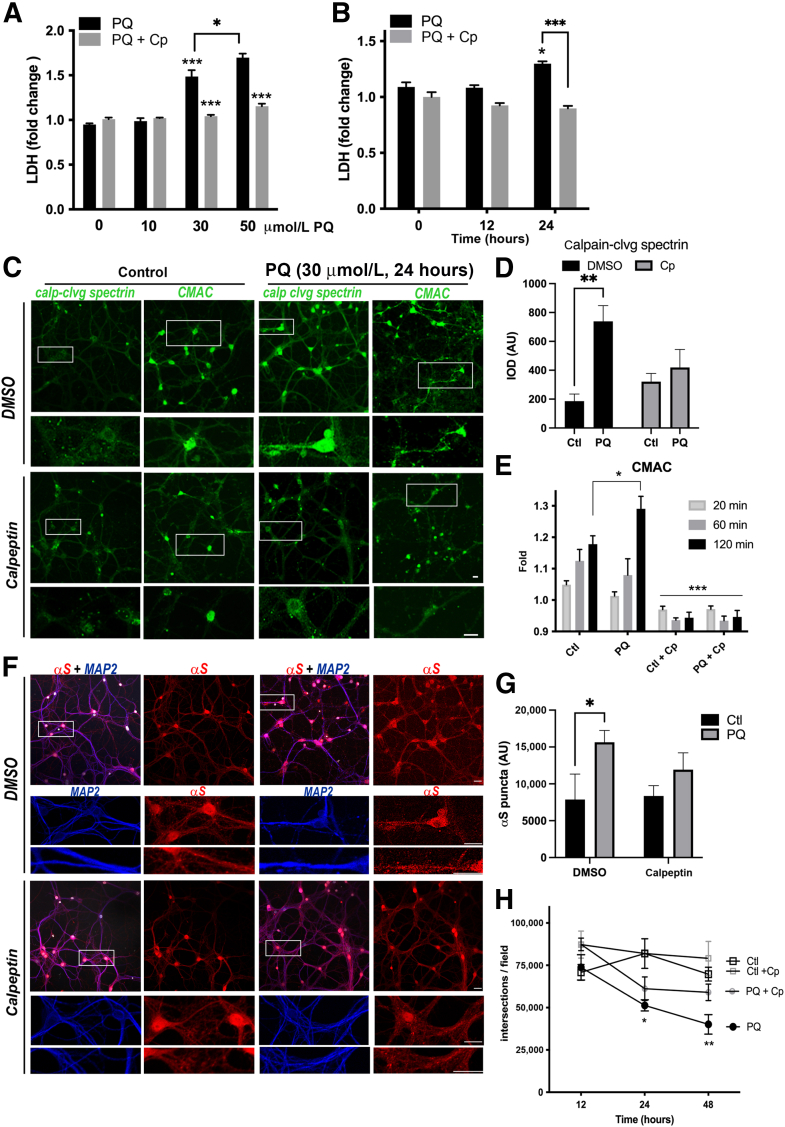
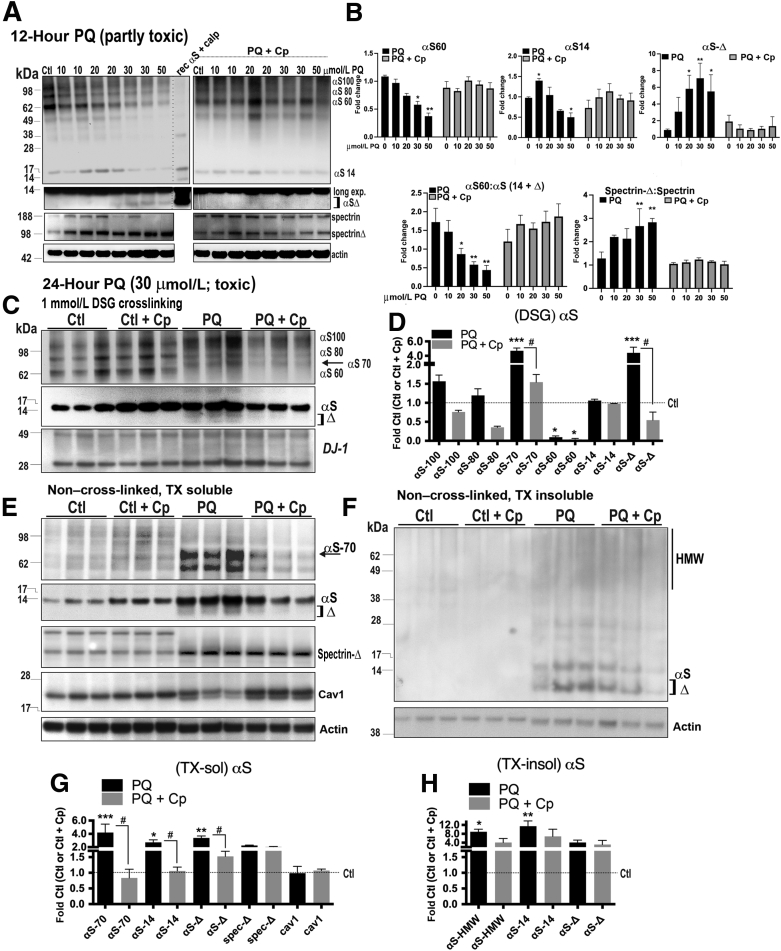
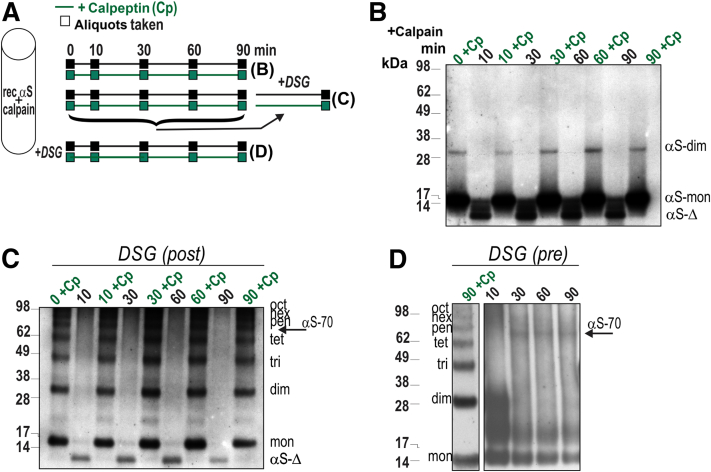
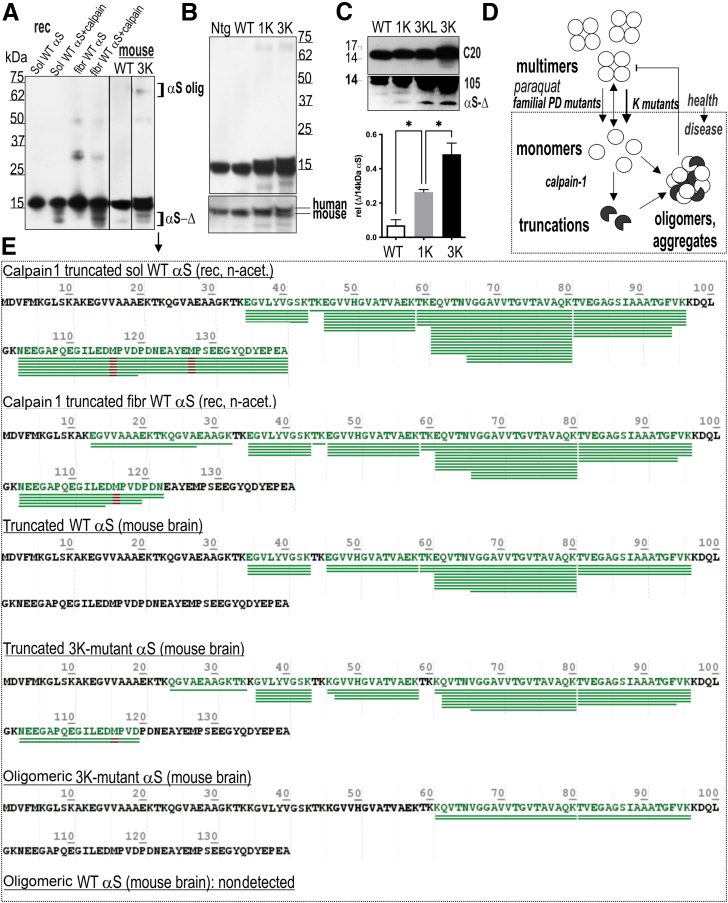
Abnormal aggregation of α-synuclein (αS) is thought to initiate neuronal dysfunction and death in Parkinson disease (PD). In addition to higher-molecular-weight, oligomeric, and polymeric forms of αS associated with neurotoxicity and disease, recent findings indicate the occurrence of physiological tetrameric assemblies in healthy neurons in culture and in brain. Herein, the PD-associated neurotoxin paraquat reduced physiological tetramers and led to calpain-truncated monomers and an approximately 70-kDa apparent oligomer different in size from physiological αS multimers. These truncated and oligomeric forms could also be generated by calpain cleavage of pure, recombinant human αS in vitro. Moreover, they were detected in the brains of tetramer-abrogating, E46K-amplified (3K) mice that model PD. These results indicate that paraquat triggers membrane damage and aberrant calpain activity that can induce a pathologic shift of tetramers toward an excess of full-length and truncated monomers, the accumulation of αS oligomers, and insoluble cytoplasmic αS puncta. The findings suggest that an environmental precipitant of PD can alter αS tetramer/monomer equilibrium, as already shown for several genetically caused forms of PD.
Copyright © 2023 American Society for Investigative Pathology. Published by Elsevier Inc. All rights reserved.
Figures
References
-
- Koprich J.B., Kalia L.V., Brotchie J.M. Animal models of alpha-synucleinopathy for Parkinson disease drug development. Nat Rev Neurosci. 2017;18:515–529. - PubMed
-
- El-Gamal M., Salama M., Collins-Praino L.E., Baetu I., Fathalla A.M., Soliman A.M., Mohamed W., Moustafa A.A. Neurotoxin-induced rodent models of Parkinson's disease: benefits and drawbacks. Neurotox Res. 2021;39:897–923. - PubMed
-
- Nuber S., Tadros D., Fields J., Overk C.R., Ettle B., Kosberg K., Mante M., Rockenstein E., Trejo M., Masliah E. Environmental neurotoxic challenge of conditional alpha-synuclein transgenic mice predicts a dopaminergic olfactory-striatal interplay in early PD. Acta Neuropathol. 2014;127:477–494. - PMC - PubMed
-
- Schlachetzki J.C., Grimm T., Schlachetzki Z., Ben Abdallah N.M., Ettle B., Vohringer P., Ferger B., Winner B., Nuber S., Winkler J. Dopaminergic lesioning impairs adult hippocampal neurogenesis by distinct modification of alpha-synuclein. J Neurosci Res. 2016;94:62–73. - PubMed
-
- Wang W., Nguyen L.T., Burlak C., Chegini F., Guo F., Chataway T., Ju S., Fisher O.S., Miller D.W., Datta D., Wu F., Wu C.X., Landeru A., Wells J.A., Cookson M.R., Boxer M.B., Thomas C.J., Gai W.P., Ringe D., Petsko G.A., Hoang Q.Q. Caspase-1 causes truncation and aggregation of the Parkinson's disease-associated protein alpha-synuclein. Proc Natl Acad Sci U S A. 2016;113:9587–9592. - PMC - PubMed
Publication types
MeSH terms
Substances
Grants and funding
LinkOut - more resources
Full Text Sources
Medical
