


Association Between Birthplace and Time in the United States With Diet Quality in US Adolescents: Findings from the National Health and Nutrition Examination Survey, 2007 to 2018
- PMID: 36774116
- PMCID: PMC11745199
- DOI: 10.1093/jn/nxac117
Association Between Birthplace and Time in the United States With Diet Quality in US Adolescents: Findings from the National Health and Nutrition Examination Survey, 2007 to 2018
Abstract
Background: During adolescence, diet quality reaches its lowest point compared to other childhood life stages. Acculturation is associated with decreased diet quality among many groups of US immigrant adults, but research is limited among adolescents.
Objectives: We investigated the associations between birthplace and length of time living in the United States, 2 proxy measures of acculturation, and diet quality among adolescents (12-19 years old).
Methods: Data were from the NHANES (2007-2018), which included two 24-hour dietary recalls (n = 6113) to estimate Healthy Eating Index 2015 (HEI-2015) total scores and component scores. Multivariate linear regression and generalized linear models were performed to compare HEI-2015 total scores and component scores between US-born adolescents (n = 5342) and foreign-born adolescents with <5 years (n = 244), 5 to <10 years (n = 201), and ≥10 years (n = 290) of US residency.
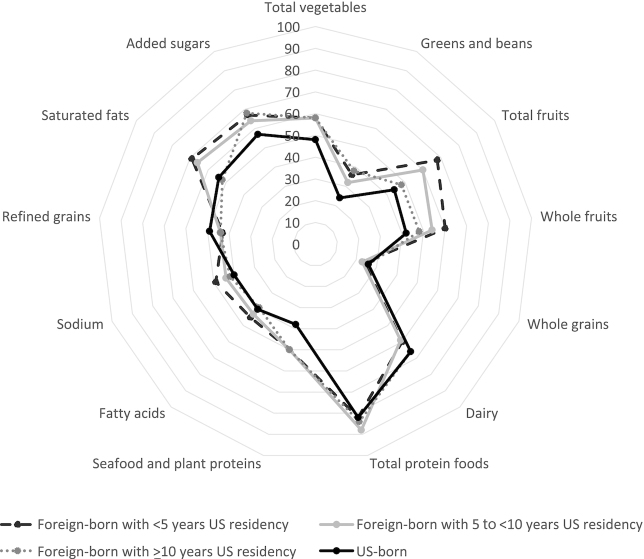
Results: Foreign-born adolescents with <5 years (53.3 ± 1.2), 5 to <10 years (51.4 ± 1.5), and ≥10 years of US residency (49.9 ± 0.8) had higher HEI-2015 total scores than US-born adolescents (47.0 ± 0.3; P < 0.0001) and higher component scores for total vegetables, seafood and plant proteins, and added sugars (P values ≤ 0.0001). Foreign-born adolescents with more years of US residency had higher component scores for total fruits, whole fruits, and saturated fats than those with fewer years of US residency. A sensitivity analysis revealed this pattern held for Mexican-American and other Hispanic adolescents.
Conclusions: Being born outside the United States and living in the United States for less time (among foreign-born adolescents) are associated with higher diet quality. Culturally informed health promotion programs may help to reduce diet-related disparities related to acculturation among adolescents.
Keywords: Healthy Diet; Healthy Eating Index 2015; National Health and Nutrition Examination Survey; adolescent; dietary acculturation.
Copyright © 2022 American Society for Nutrition.
Figures

References
-
- Budiman A. Pew Research Center; Washington, DC: 2020. Key findings about U.S. immigrants. [Internet]. [cited 13 January 2022]. Available from: https://www.pewresearch.org/fact-tank/2020/08/20/key-findings-about-u-s-...
-
- Child Trends . Child Trends; Bethesda, MD: 2018. Immigrant children. [Internet]. [cited 17 December 2021]. Available from: https://www.childtrends.org/indicators/immigrant-children#:∼:text=Trends....
-
- Flores G, Brotanek J. The healthy immigrant effect. Arch Pediatr Adolesc Med. 2005;159(3):295–297. - PubMed
-
- Berry JW, Phinney JS, Sam DL, Vedder P. Immigrant youth: Acculturation, identity and adaptation. Appl Psychol. 2010;55:17–43.
-
- Satia-Abouta J. Dietary acculturation: Definition, process, assessment, and implications. Int J Hum Ecol. 2003;4:71–86.
MeSH terms
LinkOut - more resources
Full Text Sources
