


Psychiatric emergencies among urban youth during COVID-19: Volume and acuity in a multi-channel program for the publicly insured
- PMID: 36774833
- PMCID: PMC9893801
- DOI: 10.1016/j.jpsychires.2023.01.047
Psychiatric emergencies among urban youth during COVID-19: Volume and acuity in a multi-channel program for the publicly insured
Abstract
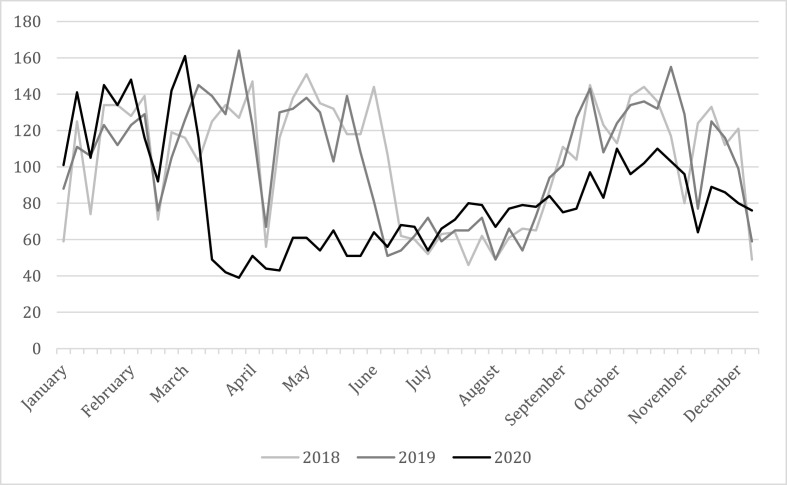
This study sought to characterize changes in the utilization of psychiatric emergency services among children and adolescents during distinct phases of 2020, as compared with prior years. We conducted a retrospective review of electronic health records from January 2018 through December 2020 that included all encounters made by patients under age 21. We then analyzed data for the 15,045 youth psychiatric encounters during the study period. Encounter volume in 2020 was significantly lower than prior years in March through May (IRR, 0.44; 95% CI, 0.40-0.49), May through July (IRR, 0.63; 95% CI, 0.56-0.71), and October through December (IRR, 0.76; 95% CI, 0.70-0.83). Encounters for youth with primary psychotic disorders remained at typical levels throughout 2020. Among older adolescents and youth with anxiety disorders, pervasive developmental disorders, and substance use disorders, encounter volume was significantly lower than prior years only during the initial lockdown period. There were significantly more encounters than normal conducted by mobile crisis units, including via telehealth, in July through October (IRR, 1.31; 95% CI, 1.06-1.62) and October through December (IRR, 1.28; 95% CI, 1.05-1.55) of 2020. Differences in patterns of encounter volume based on sociodemographic and clinical characteristics highlight subgroups of youth who may have been particularly vulnerable to acute mental health problems during periods of social distancing and isolation. Proactive efforts to engage vulnerable youth in outpatient treatment during periods of increased infectivity may help prevent increasing symptoms from reaching the point of crisis.
Keywords: COVID-19; Child and adolescent mental health; Mental health services utilization; Psychiatric emergency services.
Copyright © 2023 Elsevier Ltd. All rights reserved.
Conflict of interest statement
Declaration of competing interest The author(s) have declared that they have no competing or potential conflicts of interest.
References
-
- Burns B.J., Costello E.J., Angold A., Tweed D., Stangl D., Farmer E.M.Z., Erklani A. Children's mental health service use across service sectors. Health Aff. 1995;14:147–159. - PubMed
-
- Chahal R., Kirshenbaum J.S., Miller J.G., Ho T.C., Gotlib I.H. Higher executive control network coherence buffers against puberty-related increases in internalizing symptoms during the COVID-19 pandemic. Biological Psychiatry. Cognitive Neuroscience and Neuroimaging. 2021;6(1):79–88. doi: 10.1016/j.bpsc.2020.08.010. - DOI - PMC - PubMed
Publication types
MeSH terms
Grants and funding
LinkOut - more resources
Full Text Sources
Medical
