


Anatomical Variations of the Pectoralis Muscle and Its Importance for Breast Implant Surgery
- PMID: 36776587
- PMCID: PMC9911194
- DOI: 10.1097/GOX.0000000000004761
Anatomical Variations of the Pectoralis Muscle and Its Importance for Breast Implant Surgery
Abstract
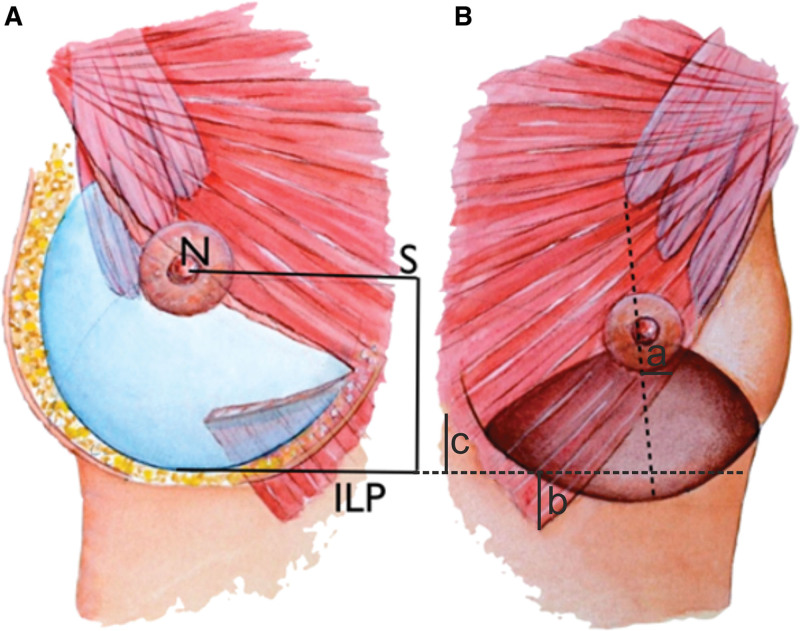
In breast augmentation, during submuscular or dual plane dissection, anatomical variations of the inferior and costal origin of the pectoralis major muscle (PMM) play a key role to ensure optimal implant coverage. Especially, a short and narrow muscle or surgical release along the sternum increases the risk of irregularities and animation deformities of the implant.
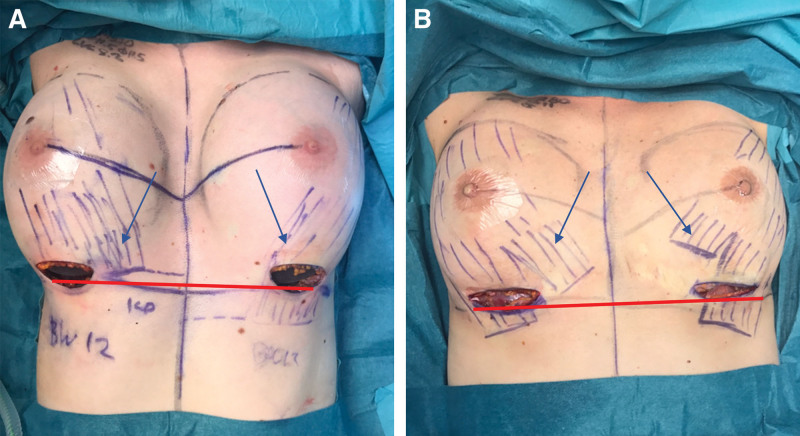
Methods: In 84 consecutive aesthetic breast augmentations intraoperatively, measurement of PMM dimensions was performed bilaterally. These PMM measurements were then correlated with the preoperative breast width, the inframammary fold, and the placement of the implant's lower pole.
Results: One hundred sixty-eight PMMs of 84 patients were dissected with a dual plane II or III technique for primary aesthetic breast augmentation. In 88% of breasts, the calculated implants' lower pole was below the inferiomedial origin of the pectoralis muscle. In 10% of patients, a separation (more than 1 cm wide and 2 cm wide) in the inferior-medial origin of the PMM was noted. An asymmetry more than 0.5 cm in length between the left and right pectoralis major was noted in 36% of patients.
Conclusions: In this series, the anatomy of the PMM demonstrates a substantial variability in width and length and a considerable asymmetry in its dimensions. These findings emphasize the importance of good access and visualization of the origin of the PMM fibers before its division.
Copyright © 2023 The Authors. Published by Wolters Kluwer Health, Inc. on behalf of The American Society of Plastic Surgeons.
Figures
References
-
- Tebbetts JB. Dual plane breast augmentation: optimizing implant-soft-tissue relationships in a wide range of breast types. Plast Reconstr Surg. 2006;118:81S–98S. - PubMed
-
- Hedén P, Jernbeck J, Hober M. Breast augmentation with anatomical cohesive gel implants: the world’s largest current experience. Clin Plast Surg. 2001;28:531–552. - PubMed
-
- Baek WY, Byun IH, Seok Kim Y, et al. Variance of the pectoralis major in relation to the inframammary fold and the pectoralis minor and its application to breast surgery. Clin Anat. 2017;30:357–361. - PubMed
-
- Maclin MM, II, Deigni OA, Bengtson BP. The laminated nature of the pectoralis major muscle and the redefinition of the inframammary fold: clinical implications in aesthetic and reconstructive breast surgery. Clin Plast Surg. 2015;42:465–479. - PubMed
-
- Hakelius L, Ohlsén L. Tendency to capsular contracture around smooth and textured gel-filled silicone mammary implants: a five-year follow-up. Plast Reconstr Surg. 1997;100:1566–1569. - PubMed
LinkOut - more resources
Full Text Sources