


Impacts of stress hyperglycemia ratio on early neurological deterioration and functional outcome after endovascular treatment in patients with acute ischemic stroke
- PMID: 36777360
- PMCID: PMC9910688
- DOI: 10.3389/fendo.2023.1094353
Impacts of stress hyperglycemia ratio on early neurological deterioration and functional outcome after endovascular treatment in patients with acute ischemic stroke
Abstract
Background and purpose: Hyperglycemia has been associated with unfavorable outcome of acute ischemic stroke, but this association has not been verified in patients with endovascular thrombectomy treatment. This study aimed to assess the impact of stress hyperglycemia ratio on early neurological deterioration and favorable outcome after thrombectomy in patients with acute ischemic stroke.
Methods: Stroke patients with endovascular thrombectomy in two comprehensive centers were enrolled. Early neurological deterioration was defined as ≥4 points increase of National Institutes of Health Stroke Scale (NIHSS) at 24 hours after endovascular procedure. Favorable outcome was defined as modified Rankin Scale (mRS) score of 0-2 at 90 days of stroke onset. Multivariate regression analysis was used to identify the predictors for early neurological deterioration and favorable outcome.
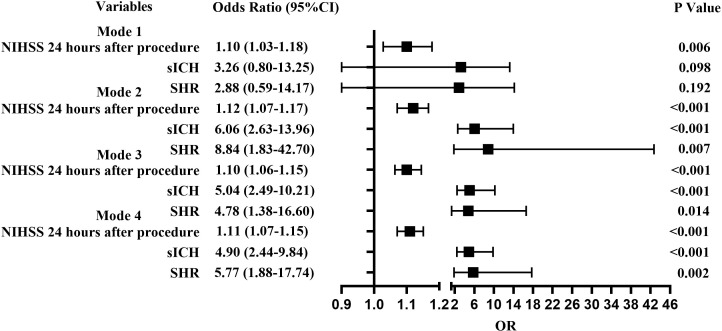
Results: Among the 559 enrolled, 74 (13.2%) patients developed early neurological deterioration. The predictors for early neurological deterioration were high stress hyperglycemia ratio at baseline (OR =5.77; 95% CI, 1.878-17.742; P =0.002), symptomatic intracranial hemorrhage (OR =4.90; 95% CI, 2.439-9.835; P <0.001) and high NIHSS score after 24 hours (OR =1.11; 95% CI, 1.071-1.151; P <0.001). The predictors for favorable outcome were stress hyperglycemia ratio (OR =0.196, 95% CI, 0.077-0.502; P =0.001), age (OR =0.942, 95% CI, 0.909-0.977; P =0.001), NIHSS score 24 hours after onset (OR =0.757, 95% CI =0.693-0.827; P <0.001), groin puncture to recanalization time (OR =0.987, 95% CI, 0.975-0.998; P =0.025), poor collateral status before treatment (ASITN/SIR grade 0-3, OR =62.017, 95% CI, 25.920-148.382; P <0.001), successful recanalization (mTICI 2b or 3, OR =7.415, 95% CI, 1.942-28.313; P =0.001).
Conclusion: High stress hyperglycemia ratio may be related to early neurological deterioration and decreased likelihood of favourable outcomes after endovascular thrombectomy in patients with acute ischemic stroke.
Keywords: acute ischemic stroke; early neurological deterioration; endovascular thrombectomy; large artery occlusion; stress hyperglycemia ratio.
Copyright © 2023 Dai, Cao, Wang, Li, Guo, Zhang, Jiang, Zhu, Jiang, Liu and Xu.
Conflict of interest statement
The authors declare that the research was conducted in the absence of any commercial or financial relationships that could be construed as a potential conflict of interest.
Figures
References
-
- Powers WJ, Rabinstein AA, Ackerson T, Adeoye OM, Bambakidis NC, Becker K, et al. . Guidelines for the early management of patients with acute ischemic stroke: 2019 update to the 2018 guidelines for the early management of acute ischemic stroke: A guideline for healthcare professionals from the American heart Association/American stroke association. Stroke (2019) 50:e344–418. doi: 10.1161/STR.0000000000000211 - DOI - PubMed
-
- Turc G, Bhogal P, Fischer U, Khatri P, Lobotesis K, Mazighi M, et al. . European Stroke organisation (ESO) - European society for minimally invasive neurological therapy (ESMINT) guidelines on mechanical thrombectomy in acute ischaemic stroke endorsed by stroke alliance for Europe (SAFE). Eur Stroke J (2019) 4:6–12. doi: 10.1177/2396987319832140 - DOI - PMC - PubMed
Publication types
MeSH terms
LinkOut - more resources
Full Text Sources
Medical
