


Residential mobility predicts COVID-19 and seasonal flu vaccination behaviors in the United States
- PMID: 36777774
- PMCID: PMC9911524
- DOI: 10.3389/fpubh.2022.1064962
Residential mobility predicts COVID-19 and seasonal flu vaccination behaviors in the United States
Abstract
Aim: Vaccination is one of the most effective strategies to contain the transmission of infectious diseases; however, people's intentions and behavior for vaccination vary across different regions and countries around the world. It is not clear how socioecological factors such as residential mobility influence people's vaccination behaviors for infectious diseases.
Methods: We analyzed public data on residential mobility and vaccination rates for COVID-19 and seasonal flu in the United States and explored how residential mobility in the previous year influenced vaccination rates for COVID-19 and seasonal flu (2011-2018) across 50 states of the US. The data were accessed and analyzed in 2021.
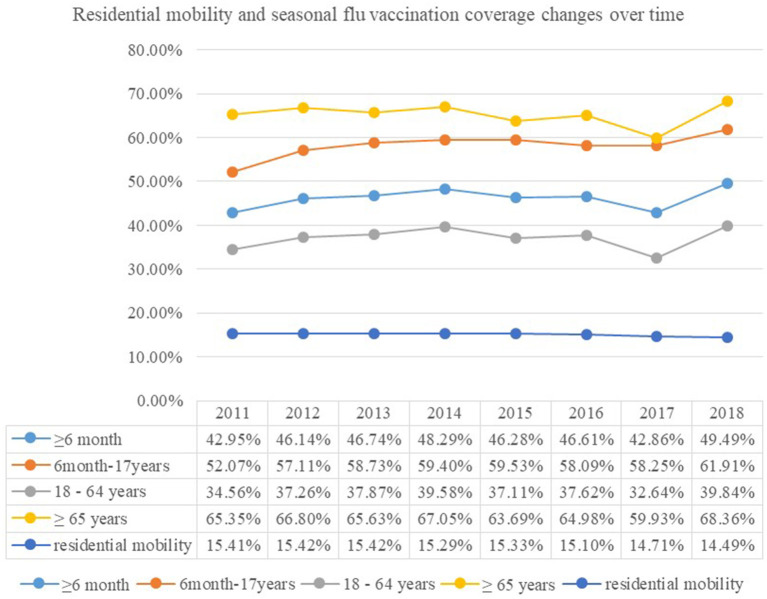
Results: Study 1 demonstrated that collective-level residential mobility predicted COVID-19 vaccination rates across the United States (B = -168.162, 95% CI [-307.097, -29.227], adjusted R 2 = 0.091, p = 0.019). Study 2 corroborated this finding by documenting that collective-level residential mobility predicted vaccination rates for seasonal flu from 2011 to 2018 across the United States (B = -0.789, 95% CI = [-1.018, -0.56], adjusted R 2 = 0.222, p < 0.001). The link between residential mobility and vaccination behavior was robust after controlling relevant variables, including collectivism, cultural tightness-looseness, and sociodemographic variables.
Conclusions: Our research demonstrated that residential mobility is an important socioecological factor that influences people's vaccination behaviors for COVID-19 and seasonal flu. The results enrich our understanding of the socioecological factors that influence vaccination behaviors and have implications for developing tailored interventions to promote vaccination during pandemics of infectious diseases.
Keywords: COVID-19; public health; residential mobility; seasonal flu; vaccination behaviors.
Copyright © 2023 Zhang, Jiang, Zhang and Zhao.
Conflict of interest statement
The authors declare that the research was conducted in the absence of any commercial or financial relationships that could be construed as a potential conflict of interest.
Figures
Similar articles
-
Association of Online Search Trends With Vaccination in the United States: June 2020 Through May 2021.Front Immunol. 2022 Apr 20;13:884211. doi: 10.3389/fimmu.2022.884211. eCollection 2022. Front Immunol. 2022. PMID: 35514956 Free PMC article.
-
[Technical guidelines for seasonal influenza vaccination in China (2021-2022)].Zhonghua Liu Xing Bing Xue Za Zhi. 2021 Oct 10;42(10):1722-1749. doi: 10.3760/cma.j.cn112338-20210913-00732. Zhonghua Liu Xing Bing Xue Za Zhi. 2021. PMID: 34814607 Chinese.
-
Association of dual COVID-19 and seasonal influenza vaccination with COVID-19 infection and disease severity.Vaccine. 2023 Jan 23;41(4):875-878. doi: 10.1016/j.vaccine.2022.12.043. Epub 2022 Dec 23. Vaccine. 2023. PMID: 36567142 Free PMC article.
-
[The seasonal flu vaccination among caregivers in geriatric units: Up-to-date].Rev Epidemiol Sante Publique. 2016 Dec;64(6):415-423. doi: 10.1016/j.respe.2016.06.333. Epub 2016 Nov 2. Rev Epidemiol Sante Publique. 2016. PMID: 27816309 Review. French.
-
[Consideration on implementation of co-administration of Seasonal Influenza and COVID-19 vaccines during pandemic in China].Zhonghua Yu Fang Yi Xue Za Zhi. 2022 Feb 6;56(2):103-107. doi: 10.3760/cma.j.cn112150-20211203-01117. Zhonghua Yu Fang Yi Xue Za Zhi. 2022. PMID: 34954956 Review. Chinese.
References
-
- Wang P,. (2021). Key characteristics of the migrant population in china. Available online at: https://news.cssn.cn/zx/bwyc/202108/t20210804_5351758.shtml (accessed August 31, 2021).
-
- Frost R,. (2020). Who is moving and why? Seven questions about residential mobility. Available online at: https://www.jchs.harvard.edu/blog/who-is-moving-and-why-seven-questions-... (accessed August 31, 2021).
-
- International Organization for Migration. (2021). Data and research. Available online at: https://www.iom.int/data-and-research (accessed August 31, 2021).
Publication types
MeSH terms
Substances
LinkOut - more resources
Full Text Sources
Medical
