


Effect of home visits by community health workers on complementary feeding practices among caregivers of children aged 6-23 months in 10 districts of Bangladesh
- PMID: 36777779
- PMCID: PMC9912980
- DOI: 10.3389/fpubh.2022.1014281
Effect of home visits by community health workers on complementary feeding practices among caregivers of children aged 6-23 months in 10 districts of Bangladesh
Abstract
Background: Suboptimal complementary feeding contributes to undernutrition in children aged 6-23 months in low- and middle-income countries like Bangladesh. Multifaceted interventions have been taken to improve complementary feeding practices, but there is limited evidence about the effect of home visits by community health workers (CHWs) on complementary feeding practices of the caregivers of children.
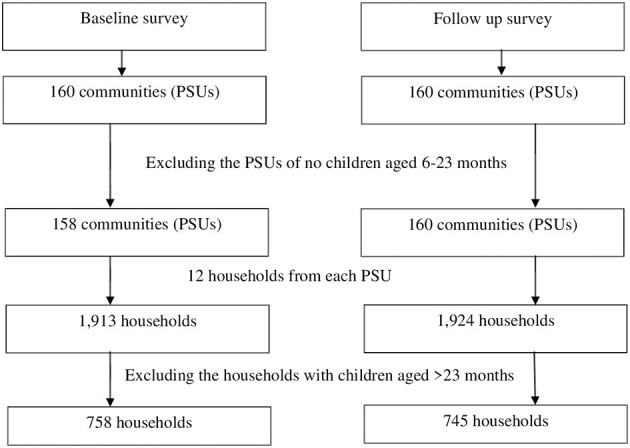
Methods: We collated data from the baseline and the corresponding follow-up survey done as part of an evaluation of Bangladesh Maternal, Infant and Young Child Nutrition (MIYCN) programme. We collected data on complementary feeding practices using a 24-h recall questionnaire. Age-appropriate dietary diversity, minimum meal frequency, and minimum acceptable diet were assessed based on recommended food consumption as per child's age. To understand the effect of CHWs' visits on complementary feeding practices, we performed Generalized Estimating Equation (GEE) procedure for dealing with correlated data and adjusted other covariates.
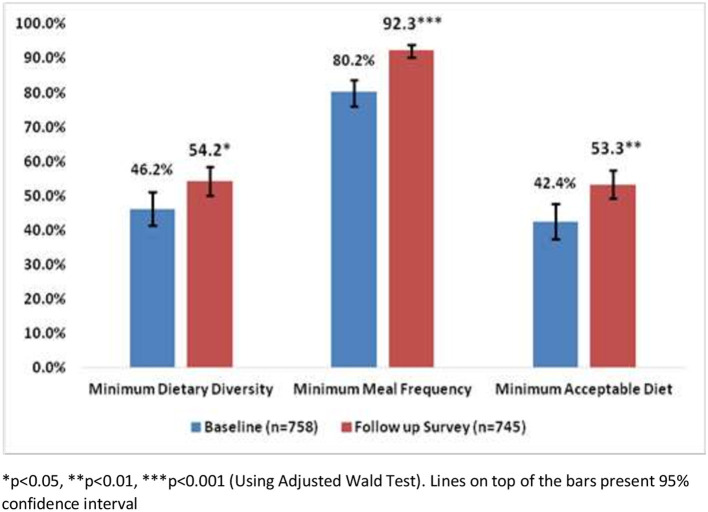
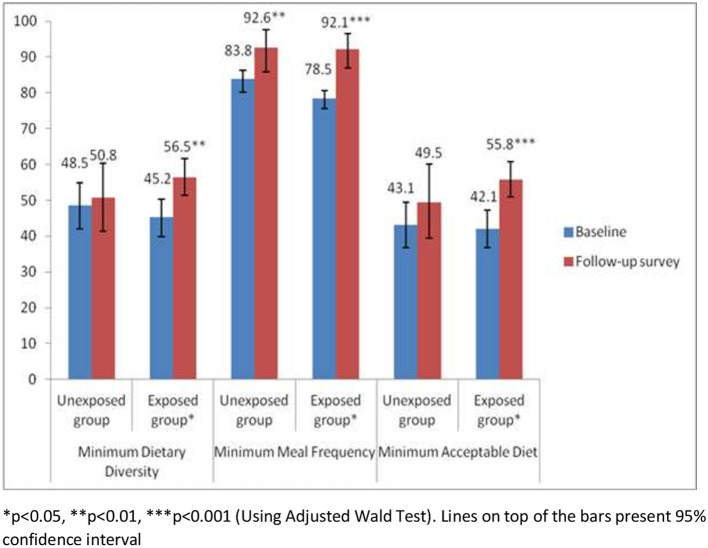
Results: A total of 758 and 745 caregivers of children aged 6-23 months participated in the baseline and follow-up survey, respectively. Complementary feeding practices were improved in 1 year of programme implementation; dietary diversity increased from 46 to 54%, minimum meal frequency from 82 to 91%, and minimum acceptable diet from 41 to 53%. Caregivers of children who had received the visit of CHWs in the last 12 months prior to the day of the follow-up survey were more likely (AOR 1.51; 95% CI 1.10-2.10) to maintain dietary diversity in their children's feeding practices than the caregivers who had not received a CHW visit in the last 12 months. The likelihood of maintaining a minimum acceptable diet in feeding practices was 1.57 times higher (AOR 1.57; 95% CI 1.14-2.17) among the caregivers who were exposed to the visits of the CHWs in the last 12 months compared to the caregivers who were not exposed to the CHW's visits in the last 12 months.
Conclusion: Integration of promotional activities of complementary feeding practices into the mainstream nutrition programme can be instrumental in optimizing complementary feeding practices among the caregivers of the under-five children. However, home visits by CHWs should be prioritized in such an integrated programme.
Keywords: Bangladesh; children; community volunteer; complementary feeding; promotional intervention.
Copyright © 2023 Rahman, Tariqujjaman, Ahmed and Sarma.
Conflict of interest statement
The authors declare that the research was conducted in the absence of any commercial or financial relationships that could be construed as a potential conflict of interest.
Figures
References
-
- National National Institute of Population Research and Training (NIPORT) and ICF . Bangladesh Demographic and Health Survey 2017-18. < city>Dhaka < /city>, Bangladesh, and Rockville, Maryland, USA: NIPORT and ICF. (2020).
-
- Caulfield LE, Huffman SL, Piwoz EG. Interventions to improve intake of complementary foods by infants 6 to 12 months of age in developing countries: impact on growth and on the prevalence of malnutrition and potential contribution to child survival. Food Nutr Bull. (1999) 20:183–200. 10.1177/156482659902000203 - DOI
-
- Ministry of Health Family Welfare Government Government of the People's Republic of Bangladesh 4th Health Nutrition Population Sector Program (HNPSP). (2017). Available online at: http://www.mohfw.gov.bd/index.php?option=com_content&view=article&id=78&... (accessed November 20, 2022).
Publication types
MeSH terms
LinkOut - more resources
Full Text Sources
Medical
