[Preprint]. 2023 Sep 17:2023.02.03.527061.
doi: 10.1101/2023.02.03.527061.

Archaic Introgression Shaped Human Circadian Traits

Affiliations

Archaic Introgression Shaped Human Circadian Traits

Keila Velazquez-Arcelay et al. bioRxiv. .

Update in

  • Archaic Introgression Shaped Human Circadian Traits.
    Velazquez-Arcelay K, Colbran LL, McArthur E, Brand CM, Rinker DC, Siemann JK, McMahon DG, Capra JA. Velazquez-Arcelay K, et al. Genome Biol Evol. 2023 Dec 1;15(12):evad203. doi: 10.1093/gbe/evad203. Genome Biol Evol. 2023. PMID: 38095367 Free PMC article.

Abstract

Introduction: When the ancestors of modern Eurasians migrated out of Africa and interbred with Eurasian archaic hominins, namely Neanderthals and Denisovans, DNA of archaic ancestry integrated into the genomes of anatomically modern humans. This process potentially accelerated adaptation to Eurasian environmental factors, including reduced ultra-violet radiation and increased variation in seasonal dynamics. However, whether these groups differed substantially in circadian biology, and whether archaic introgression adaptively contributed to human chronotypes remains unknown.

Results: Here we traced the evolution of chronotype based on genomes from archaic hominins and present-day humans. First, we inferred differences in circadian gene sequences, splicing, and regulation between archaic hominins and modern humans. We identified 28 circadian genes containing variants with potential to alter splicing in archaics (e.g., CLOCK, PER2, RORB, RORC), and 16 circadian genes likely divergently regulated between present-day humans and archaic hominins, including RORA. These differences suggest the potential for introgression to modify circadian gene expression. Testing this hypothesis, we found that introgressed variants are enriched among eQTLs for circadian genes. Supporting the functional relevance of these regulatory effects, we found that many introgressed alleles have associations with chronotype. Strikingly, the strongest introgressed effects on chronotype increase morningness, consistent with adaptations to high latitude in other species. Finally, we identified several circadian loci with evidence of adaptive introgression or latitudinal clines in allele frequency.

Conclusions: These findings identify differences in circadian gene regulation between modern humans and archaic hominins and support the contribution of introgression via coordinated effects on variation in human chronotype.

Keywords: Neanderthals; adaptive evolution; adaptive introgression; chronotype; circadian biology; gene expression.


Conflict of interest statement

DECLARATION OF INTERESTS The authors declare that they have no competing interests.

Figures
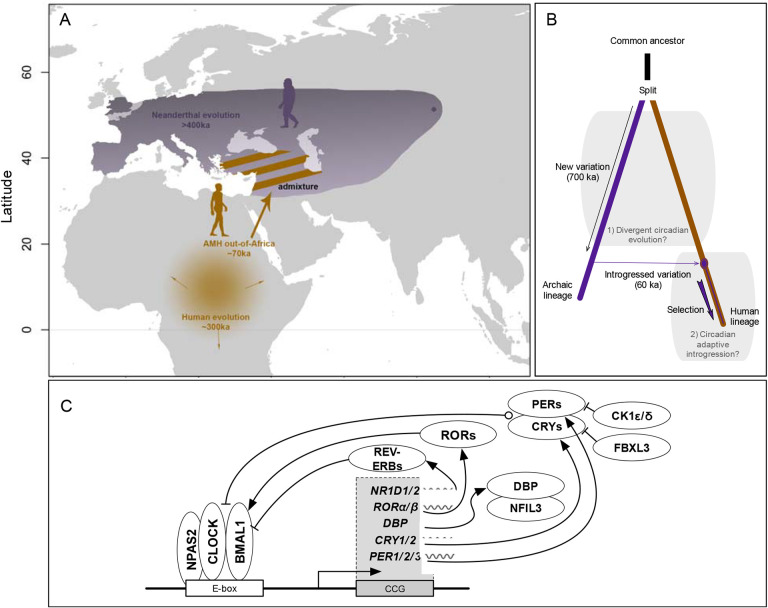
Figure 1.
Figure 1.. Did the sharing of functionally diverged alleles from archaic hominins influence human circadian biology?
A) Anatomically modern humans and archaic hominins evolved separately at different latitudes for hundreds of thousands of years. The ancestors of modern Eurasian humans left Africa approximately 70 thousand years ago (ka) and admixed with archaics, likely in southwestern Asia. The shaded purple range represents the approximate Neanderthal range. The purple dot represents the location of the sequenced Denisovan individual in the Altai Mountains; the full range of Denisovans is currently unknown. Silhouettes from phylopic.org. B) After the split between the human and archaic lineages, each group accumulated variation and evolved in their respective environments for approximately 700 ka. We first test for evidence for divergent circadian evolution during this time. Humans acquired introgressed alleles from Neanderthals and from Denisovans around 60 and 45 ka, respectively. These alleles experienced strong selective pressures; however, ~40% of the genome retains archaic ancestry in some modern populations. The second question we explore is whether introgression made contributions to human circadian biology. C) The core circadian clock machinery is composed of several transcription factors (ovals) that dimerize and interact with E-box enhancer elements and each other to create a negative feedback loop. We defined a set of 246 circadian genes through a combination of literature search, expert knowledge, and existing annotations (Table S1; Figure S1; Methods). Lines with arrows represent activation, and lines with bars represent suppression.
Figure 2.
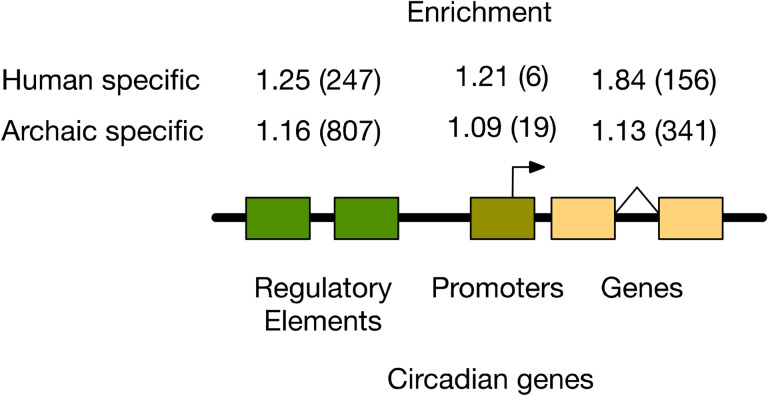
Figure 2.. Human- and archaic-specific fixed variants are enriched in circadian regulatory, promoter, and gene regions.
Human-specific fixed variants are significantly enriched compared to variants that are not fixed in circadian regulatory elements (Fisher’s exact: OR=1.25, P=8.39e-4) and gene regions (Fisher’s exact: OR=1.84, P=7.06e-12). Promoters show a similar enrichment, but the higher p-value is the result of the small number of variants (Fisher’s exact test: OR=1.21, P=0.65). Likewise, archaic-specific variants are enriched in circadian regulatory regions (Fisher’s exact: OR=1.16, P=6.15e-5) and gene regions (Fisher’s exact: OR=1.13, P=0.023), with the promoters showing a similar trend (Fisher’s exact test: OR=1.09, P=0.63). The numbers in parentheses give the counts of fixed variants observed in each type of element. Regulatory elements were defined based on the ENCODE candidate cis-regulatory elements.
Figure 3.
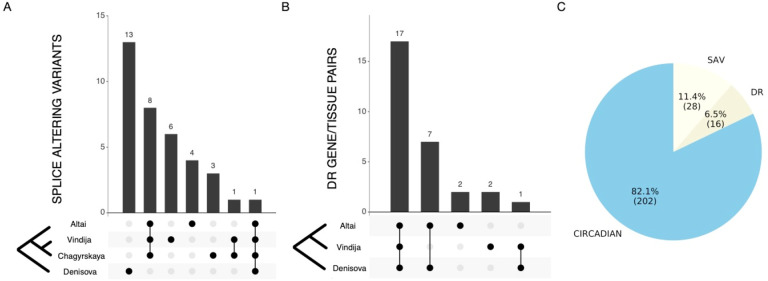
Figure 3.. Many circadian genes have evidence of alternative splicing and divergent regulation between modern and archaic hominins.
A) The distribution of the 28 predicted archaic-specific splice-altering variants (SAV) in circadian genes across archaic individuals. Most are specific to either the Denisovan or Neanderthal lineage (Table S3). B) The sharing of predicted divergently regulated (DR) gene/tissue pairs across three archaic individuals. (Predictions were not available for the Chagyrskaya Neanderthal.) Seventeen divergently regulated gene/tissue pairs were present in all three archaics (representing 16 unique genes). Additionally, 7 gene/tissue DR pairs are shared between the Altai Neanderthal and the Denisovan individual. One pair is shared between the Vindija Neanderthal and the Denisovan (Table S4). C) The proportion of circadian genes containing archaic splice-altering variants predicted by SpliceAI (SAV; 11.4%) or divergently regulated circadian genes predicted by PrediXcan (DR; 6.5%). Thus, 17.9% of the circadian genes are predicted to contain differences to AMH via these mechanisms.
Figure 4.
Figure 4.. Many circadian genes are divergently regulated between modern humans and archaic hominins.
Comparison of the imputed regulation of core circadian genes between 2504 humans in 1000 Genomes Phase 3 (gray bars) and three archaic individuals (vertical lines). For each core circadian gene, the tissue with the lowest average P-value for archaic difference from humans is plotted. Archaic gene regulation is at the extremes of the human distribution for several core genes: CRY1, PER2, NPAS2, NR1D1 RORA. See Figure S2 for all core clock genes and Figure S3 for all divergently regulated circadian genes.
Figure 5.
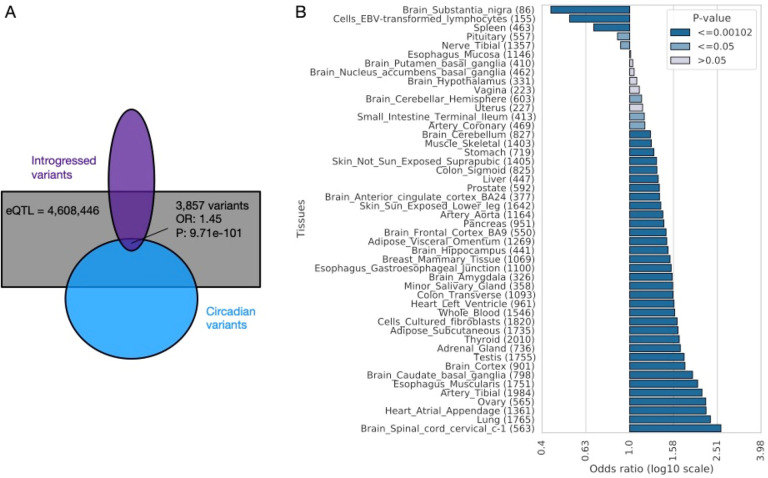
Figure 5.. Circadian genes are enriched for introgressed eQTL.
A) Archaic introgressed variants are more likely to be eQTL for circadian genes in GTEx than for non-circadian genes (Fisher’s exact test: OR=1.45, P=9.71e-101). Purple represents the set of introgressed variants, and blue represents the set of circadian variants. 3,857 are introgressed eQTL in circadian genes. Gray represents the universe of all GTEx eQTLs lifted over to hg19. The overlaps are not to scale. B) The enrichment for circadian genes among the targets of introgressed eQTLs in each GTEx tissue. Introgressed eQTL in most tissues show significant enrichment for circadian genes (Fisher’s exact test; Table S7). Kidney cortex did not have any circadian introgressed eQTLs and thus is not shown. Numbers inside the parenthesis indicate the count of variants in each tissue. Gray bars indicate lack of statistical significance; light blue bars indicate nominal significance (p <= 0.05); and dark blue bars indicate significance at the 0.05 level after Bonferroni multiple testing correction (p <= 0.00102).
Figure 6.
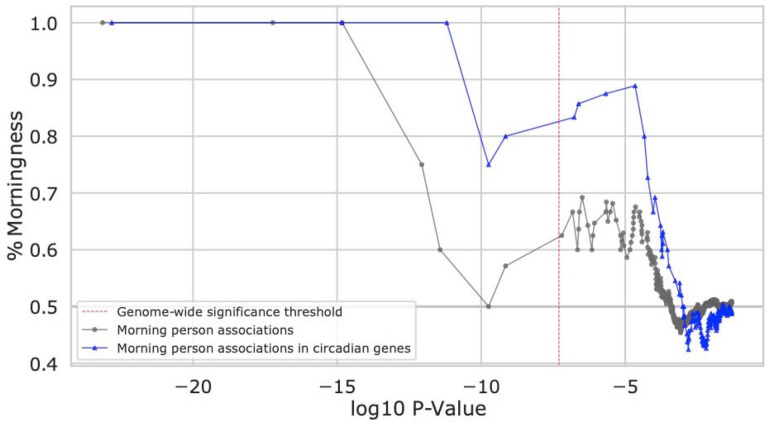
Figure 6.. Introgressed variants associate with increased morningness.
The cumulative fraction of introgressed loci significantly associated with the morning vs. evening person trait in the UK Biobank that increase morningness (y-axis) at a given p-value threshold (x-axis). Introgressed loci associated with chronotype are biased towards increasing morningness, and this effect is greatest at the most strongly associated loci. Introgressed variants nearby (<1 Mb) circadian genes (blue) are even more strongly biased towards increasing morningness than introgressed variants overall (gray). Each dot (triangle) represents an associated locus; variants were clumped by LD for each set (R2>0.5 in EUR).

References

    1. 1000 Genomes Project Consortium (2010) ‘A map of human genome variation from population-scale sequencing’, Nature, 467(7319), p. 1061. Available at: 10.1038/nature09534. - DOI - PMC - PubMed
    1. Arnold L.J. et al. (2014) ‘Luminescence dating and palaeomagnetic age constraint on hominins from Sima de los Huesos, Atapuerca, Spain’, Journal of Human Evolution, 67(1), pp. 85–107. Available at: 10.1016/j.jhevol.2013.12.001. - DOI - PubMed
    1. Bae C.J., Douka K. and Petraglia M.D. (2017) ‘On the origin of modern humans: Asian perspectives’, Science, 358(6368), p. eaai9067. Available at: 10.1126/science.aai9067. - DOI - PubMed
    1. Benton M.L. et al. (2021) ‘The influence of evolutionary history on human health and disease’, Nature Reviews Genetics. Nature Research, pp. 269–283. Available at: 10.1038/s41576-020-00305-9. - DOI - PMC - PubMed
    1. Brand C.M., Colbran L.L. and Capra J.A. (2023) ‘Resurrecting the alternative splicing landscape of archaic hominins using machine learning’, Nature Ecology and Evolution, 7(6), pp. 939–953. Available at: 10.1038/s41559-023-02053-5. - DOI - PMC - PubMed

Publication types