


Reproductive ability in survivors of childhood, adolescent, and young adult Hodgkin lymphoma: a review
- PMID: 36779325
- PMCID: PMC10320502
- DOI: 10.1093/humupd/dmad002
Reproductive ability in survivors of childhood, adolescent, and young adult Hodgkin lymphoma: a review
Abstract
Background: Owing to a growing number of young and adolescent Hodgkin lymphoma (HL) survivors, awareness of (long-term) adverse effects of anticancer treatment increases. The risk of impaired reproductive ability is of great concern given its impact on quality of life. There is currently no review available on fertility after childhood HL treatment.
Objective and rationale: The aim of this narrative review was to summarize existing literature on different aspects of reproductive function in male and female childhood, adolescent, and young adult HL survivors.
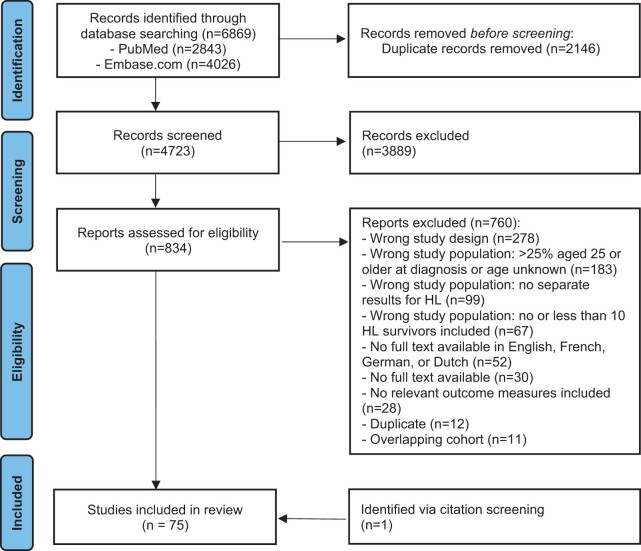
Search methods: PubMed and EMBASE were searched for articles evaluating fertility in both male and female HL survivors aged <25 years at diagnosis. In females, anti-Müllerian hormone (AMH), antral follicle count, premature ovarian insufficiency (POI), acute ovarian failure, menstrual cycle, FSH, and pregnancy/live births were evaluated. In males, semen-analysis, serum FSH, inhibin B, LH, testosterone, and reports on pregnancy/live births were included. There was profound heterogeneity among studies and a lack of control groups; therefore, no meta-analyses could be performed. Results were presented descriptively and the quality of studies was not assessed individually.
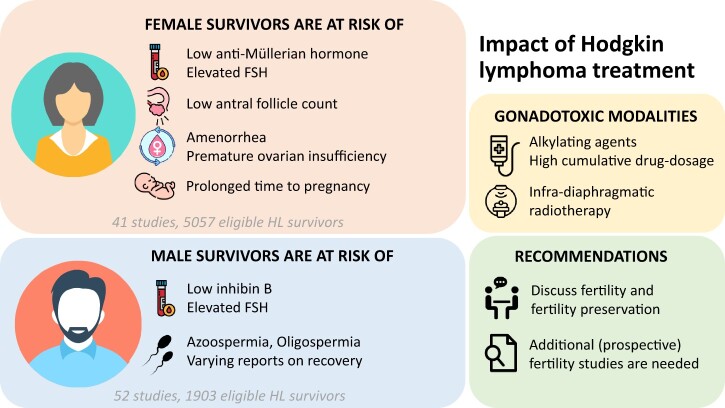
Outcomes: After screening, 75 articles reporting on reproductive markers in childhood or adolescent HL survivors were included. Forty-one papers reported on 5057 female HL survivors. The incidence of POI was 6-34% (median 9%; seven studies). Signs of diminished ovarian reserve or impaired ovarian function were frequently seen (low AMH 55-59%; median 57%; two studies. elevated FSH 17-100%; median 53%; seven studies). Most survivors had regular menstrual cycles. Fifty-one studies assessed fertility in 1903 male HL survivors. Post-treatment azoospermia was highly prevalent (33-100%; median 75%; 29 studies). Long-term follow-up data were limited, but reports on recovery of semen up to 12 years post-treatment exist. FSH levels were often elevated with low inhibin B (elevated FSH 0-100%; median 51.5%; 26 studies. low inhibin B 19-50%; median 45%; three studies). LH and testosterone levels were less evidently affected (elevated LH 0-57%, median 17%; 21 studies and low testosterone 0-43%; median 6%; 15 studies). In both sexes, impaired reproductive ability was associated with a higher dose of cumulative chemotherapeutic agents and pelvic radiotherapy. The presence of abnormal markers before treatment indicated that the disease itself may also negatively affect reproductive function (Females: AMH<p10 9%; one study and Males: azoospermia 0-50%; median 10%; six studies). Reports on chance to achieve pregnancy during survivorship are reassuring, although studies had their limitations and the results are difficult to evaluate. In the end, a diminished ovarian reserve does not exclude the chance of a live birth, and males with aberrant markers may still be able to conceive.
Wider implications: This review substantiates the negative effect of HL treatment on gonadal function and therefore young HL survivors should be counseled regarding their future reproductive life, and fertility preservation should be considered. The current level of evidence is insufficient and additional trials on the effects of HL and (current) treatment regimens on reproductive function are needed. In this review, we make a recommendation on reproductive markers that could be assessed and the timing of (repeated) measurements.
Trial registration: ClinicalTrials.gov NCT02684708.
Keywords: (future) fertility; Hodgkin lymphoma; adverse effects; azoospermia; childhood cancer; gonadotoxicity; premature ovarian insufficiency; reproductive ability.
© The Author(s) 2023. Published by Oxford University Press on behalf of European Society of Human Reproduction and Embryology.
Conflict of interest statement
The authors are involved in the ongoing fertility add-on study, nested within the EuroNet-PHL-C2 study (Clinicaltrials NCT02684708; EudraCT number 2012-004053-88). This study evaluates gonadal function and fertility in children treated according to the EuroNet-PHL-C2 protocol.
Figures
References
-
- Adam C, Deffert C, Leyvraz C, Primi MP, Simon JP, Beck Popovic M, Bénard J, Bouthors T, Girardin C, Streuli I. et al. Use and effectiveness of sperm cryopreservation for adolescents and young adults: a 37-year bicentric experience. J Adolesc Young Adult Oncol 2020;10:78–84. - PubMed
-
- Agarwal A, Allamaneni SS.. Disruption of spermatogenesis by the cancer disease process. J Natl Cancer Inst Monogr 2005;34:9–12. - PubMed
-
- Aleman BMP, van den Belt-Dusebout AW, De Bruin ML, van 't Veer MB, Baaijens MHA, de Boer JP, Hart AAM, Klokman WJ, Kuenen MA, Ouwens GM. et al. Late cardiotoxicity after treatment for Hodgkin lymphoma. Blood 2007;109:1878–1886. - PubMed
