


Association between an oxidative balance score and mortality: a prospective analysis in the SUN cohort
- PMID: 36781422
- PMCID: PMC10195723
- DOI: 10.1007/s00394-023-03099-8
Association between an oxidative balance score and mortality: a prospective analysis in the SUN cohort
Abstract
Purpose: We aimed to prospectively investigate the association of an overall oxidative balance score (OBS) with all-cause death and cause-specific mortality among participants in the Seguimiento Universidad de Navarra (SUN) Study, a Mediterranean cohort of Spanish graduates.
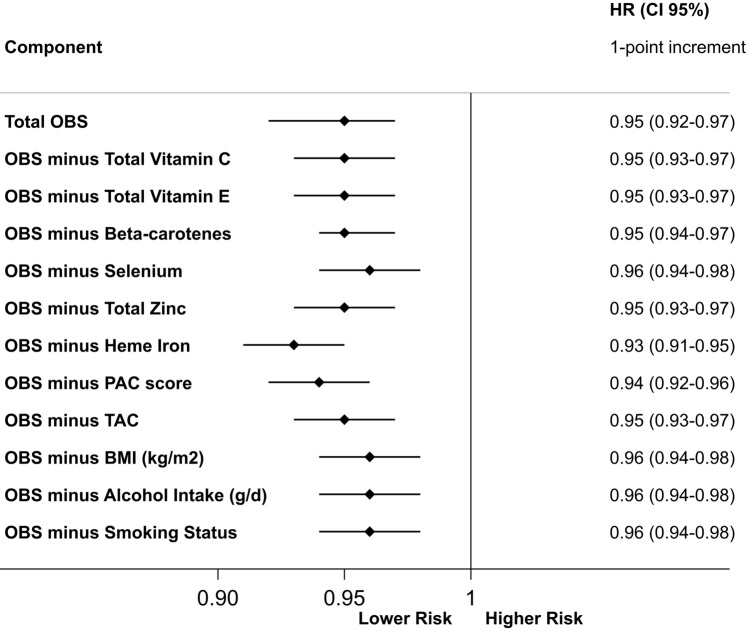
Methods: Using baseline information on 12 a priori selected dietary and non-dietary lifestyle pro- and antioxidants exposures-vitamins C and E, β-carotenes, selenium, zinc, heme iron, polyphenols, total antioxidant capacity, body mass index, alcohol, smoking, and physical activity-we constructed an equally weighted OBS categorized into quartiles, with higher scores representing greater antioxidant balance. Cox proportional hazards models were fitted to evaluate the association between the OBS and mortality.
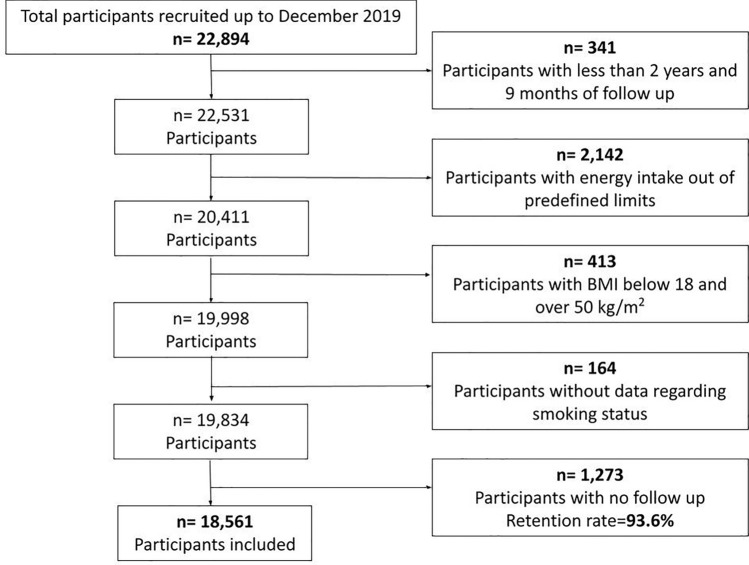
Results: A total of 18,561 participants (mean [SD] age, 38.5 [12.4] years; 40.8% males) were included in the analysis. During a median follow-up of 12.2 years (interquartile range 8.3-14.9), 421 deaths were identified, including 80 deaths from cardiovascular disease (CVD), 215 from cancer, and 126 from other causes. After adjustment for potential confounders, the hazard ratios and 95% confidence interval (CIs) between the highest quartile (predominance of antioxidants) vs. the lowest quartile (reference category) were 0.35 (95% CI 0.22-0.54, P-trend < 0.001) for all-cause mortality, 0.18 (95% CI 0.06-0.51, P-trend = 0.001) for CVD mortality, 0.35 (95% CI 0.19-0.65, P-trend = 0.002) for cancer mortality, and 0.45 (95% CI 0.20-1.02, P-trend = 0.054) for other-cause mortality.
Conclusion: Our findings suggest a strong inverse association between the OBS and all-cause, CVD, and cancer mortality. Individuals exposed to both antioxidant dietary and lifestyle factors may potentially experience the lowest mortality risk.
Study registry number: Dynamic Mediterranean Prospective Cohort: the SUN Project; NCT02669602. https://clinicaltrials.gov/ct2/show/NCT02669602 . https://proyectosun.es.
Keywords: Diet; Dietary antioxidants; Lifestyle; Mortality; Oxidative balance score; Oxidative stress.
© 2023. The Author(s).
Conflict of interest statement
The authors declare that there is no conflict of interest regarding the publication of this article.
Figures
References
-
- World Health Organization. Noncommunicable diseases: Key Facts (2021). https://www.who.int/news-room/fact-sheets/detail/noncommunicable-diseases. Accessed 14 Feb 2022
Publication types
MeSH terms
Substances
Associated data
Grants and funding
- PI10/02658/Instituto de Salud Carlos III
- PI10/02293/Instituto de Salud Carlos III
- PI13/00615/Instituto de Salud Carlos III
- PI14/01668/Instituto de Salud Carlos III
- PI14/01798/Instituto de Salud Carlos III
- PI14/01764/Instituto de Salud Carlos III
- PI17/01795/Instituto de Salud Carlos III
- G03/140/Instituto de Salud Carlos III
- (RD 06/0045/European Regional Development Fund
- 27/2011/Departamento de Salud, Gobierno de Navarra
- 45/2011/Departamento de Salud, Gobierno de Navarra
- 122/2014/Departamento de Salud, Gobierno de Navarra
LinkOut - more resources
Full Text Sources
Medical
