


Effects of sex and APOE ε4 genotype on brain mitochondrial high-energy phosphates in midlife individuals at risk for Alzheimer's disease: A 31Phosphorus MR spectroscopy study
- PMID: 36787293
- PMCID: PMC9928085
- DOI: 10.1371/journal.pone.0281302
Effects of sex and APOE ε4 genotype on brain mitochondrial high-energy phosphates in midlife individuals at risk for Alzheimer's disease: A 31Phosphorus MR spectroscopy study
Abstract
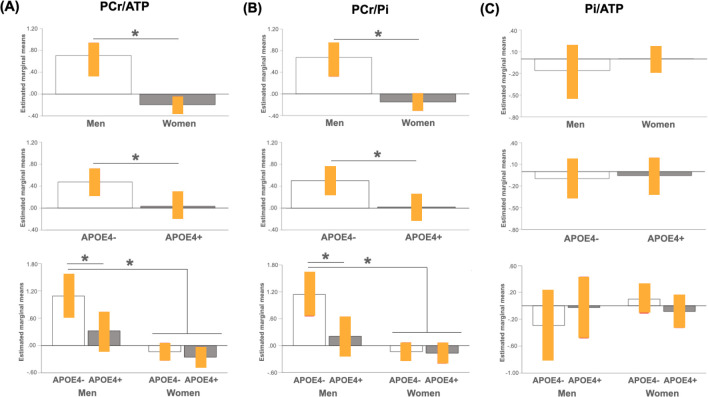
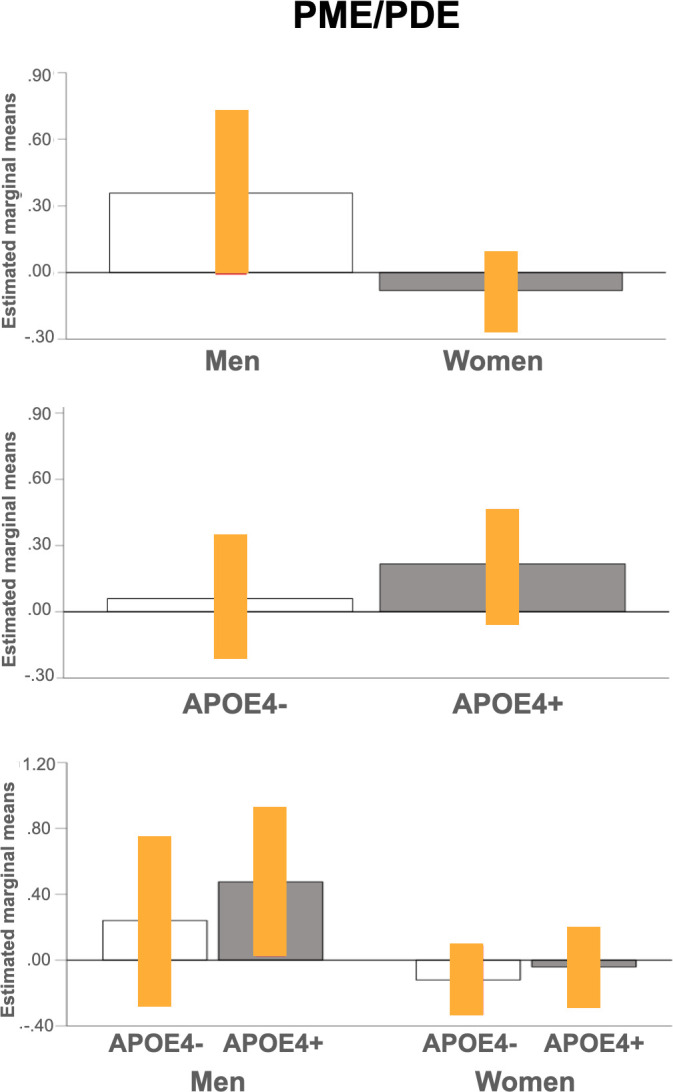
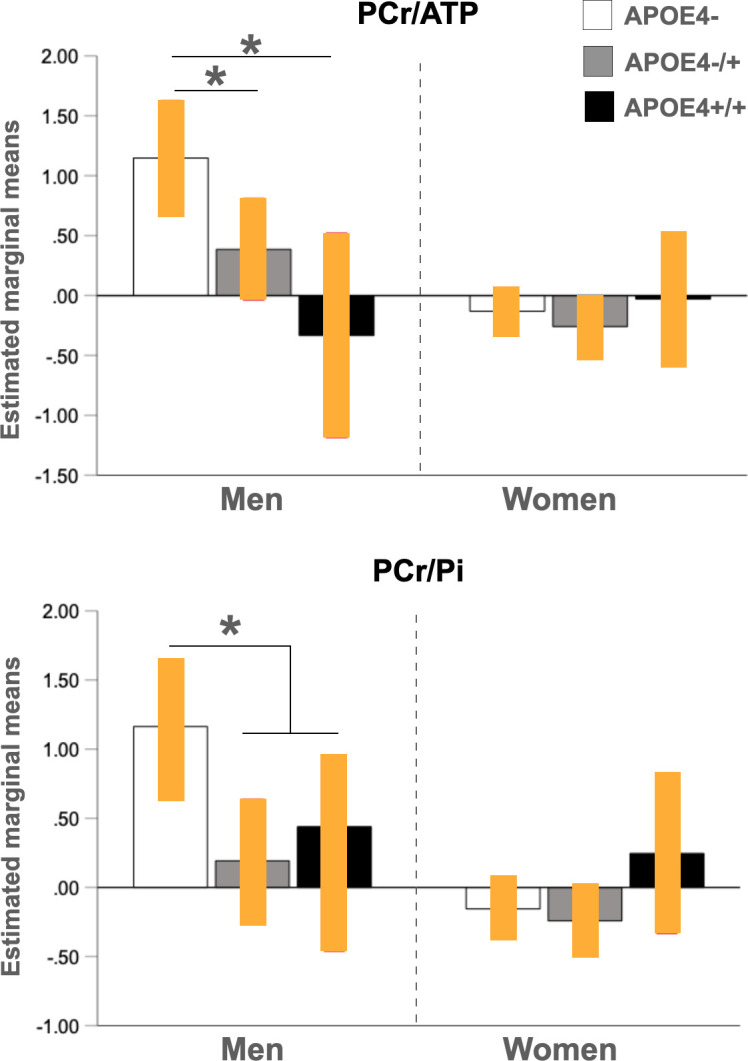
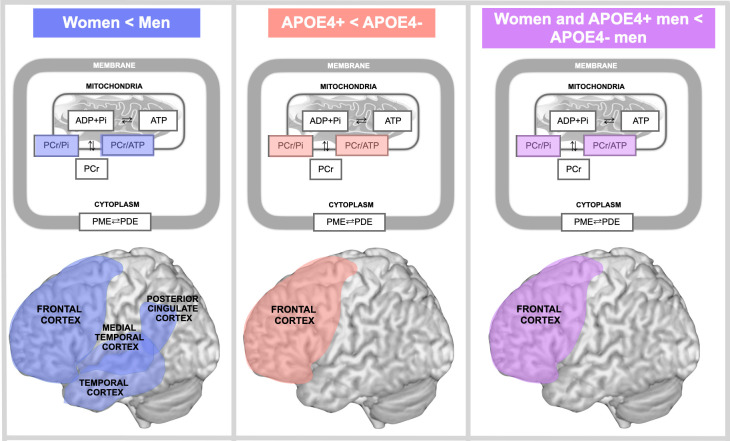
Age, female sex, and APOE epsilon 4 (APOE4) genotype are the three greatest risk factors for late-onset Alzheimer's disease (AD). The convergence of these risks creates a hypometabolic AD-risk profile unique to women, which may help explain their higher lifetime risk of AD. Less is known about APOE4 effects in men, although APOE4 positive men also experience an increased AD risk. This study uses 31Phosphorus Magnetic Resonance Spectroscopy (31P-MRS) to examine effects of sex and APOE4 status on brain high-energy phosphates [adenosine triphosphate (ATP), phosphocreatine (PCr), inorganic phosphate (Pi)] and membrane phospholipids [phosphomonoesters (PME), phosphodiesters (PDE)] in 209 cognitively normal individuals at risk for AD, ages 40-65, 80% female, 46% APOE4 carriers (APOE4+). Women exhibited lower PCr/ATP and PCr/Pi levels than men in AD-vulnerable regions, including frontal, posterior cingulate, lateral and medial temporal cortex (multi-variable adjusted p≤0.037). The APOE4+ group exhibited lower PCr/ATP and PCr/Pi in frontal regions as compared to non-carriers (APOE4-) (multi-variable adjusted p≤0.005). Sex by APOE4 status interactions were observed in frontal regions (multi-variable adjusted p≤0.046), where both female groups and APOE4+ men exhibited lower PCr/ATP and PCr/Pi than APOE4- men. Among men, APOE4 homozygotes exhibited lower frontal PCr/ATP than heterozygotes and non-carriers. There were no significant effects of sex or APOE4 status on Pi/ATP and PME/PDE measures. Among midlife individuals at risk for AD, women exhibit lower PCr/ATP (e.g. higher ATP utilization) and lower PCr/Pi (e.g. higher energy demand) than age-controlled men, independent of APOE4 status. However, a double dose of APOE4 allele shifted men's brains to a similar metabolic range as women's brains. Examination of brain metabolic heterogeneity can support identification of AD-specific pathways within at-risk subgroups, further advancing both preventive and precision medicine for AD.
Copyright: © 2023 Jett et al. This is an open access article distributed under the terms of the Creative Commons Attribution License, which permits unrestricted use, distribution, and reproduction in any medium, provided the original author and source are credited.
Conflict of interest statement
The authors have declared that no competing interests exist.
Figures
References
-
- Farrer LA, Cupples LA, Haines JL, Hyman B, Kukull WA, Mayeux R, et al. Effects of age, sex, and ethnicity on the association between apolipoprotein E genotype and Alzheimer disease: a meta-analysis. Jama. 1997;278(16):1349–56. - PubMed
Publication types
MeSH terms
Substances
Grants and funding
LinkOut - more resources
Full Text Sources
Medical
Research Materials
Miscellaneous
