. 2023 Feb 14;13(1):2635.
doi: 10.1038/s41598-023-29659-w.

Graft rejection episodes after keratoplasty in Japanese eyes

Affiliations

Graft rejection episodes after keratoplasty in Japanese eyes

Haguku Wajima et al. Sci Rep. .

Abstract

We aimed to investigate the clinical characteristics and risk factors for graft rejection after keratoplasty in Japanese patients. We enrolled 730 cases (566 patients) of penetrating keratoplasty (PK, N = 198), Descemet's stripping automated endothelial keratoplasty (DSAEK, N = 277), non-Descemet's stripping automated endothelial keratoplasty (nDSAEK, N = 138), and Descemet membrane endothelial keratoplasty (DMEK, N = 117). The incidence, clinical characteristics, and possible risk factors for graft rejection were analyzed. Graft rejection occurred in 65 cases (56 patients, 8.9%). The incidence rate of rejection was highest with PK (3.45/100 person-years), followed by DSAEK (2.34), nDSAEK (1.55), and DMEK (0.24). Cox regression analysis revealed keratoplasty type, younger age, indications (such as failed keratoplasty and infection), and steroid eyedrop use as possible risk factors. In the multivariate model adjusting baseline characteristics, PK and DSAEK had significantly higher hazard ratios (HRs) than DMEK (HR = 13.6, 95% confidence interval [CI] [1.83, 101] for PK, 7.77 [1.03, 58.6] for DSAEK). Although not statistically significant, the HR estimate of nDSAEK to DMEK (HR = 7.64, 95% CI [0.98, 59.6]) indicated higher HR in nDSAEK than in DMEK. DMEK is the favorable option among the four surgical procedures to avoid graft rejection after keratoplasty.


Conflict of interest statement

The authors declare no competing interests.

Figures
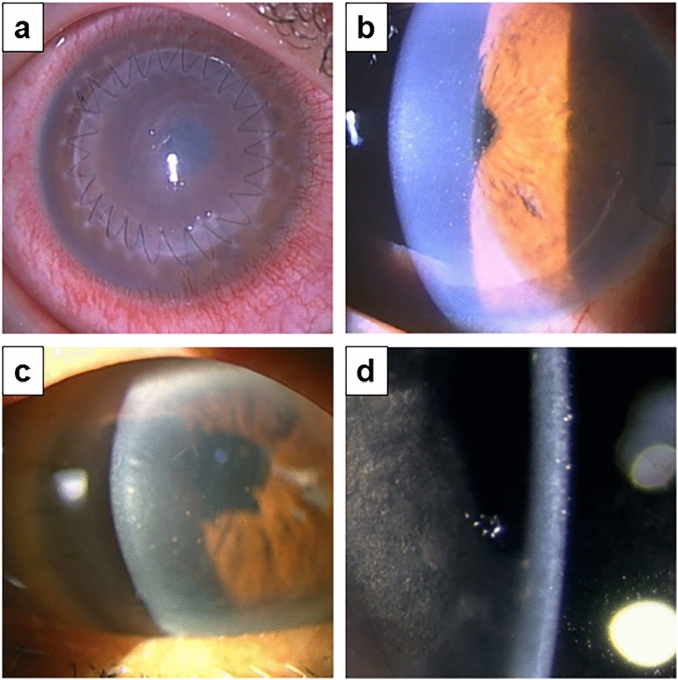
Figure 1
Figure 1
Representative slit-lamp photos of graft rejection after keratoplasty. (a) Graft rejection after PK for keratoconus in an 18-year-old male patient. The patient had been treated with 0.1% betamethasone eyedrop at the onset of rejection. Endothelial rejection with decreased visual acuity, conjunctival hyperemia, corneal edema, and keratic precipitates were observed 214 days postoperatively. Additionally, despite topical and oral steroid therapy, the graft failed. (b) Graft rejection after DSAEK for bullous keratopathy due to trabeclectomy in a 67-year-old male patient. Endothelial rejection with decreased visual acuity, conjunctival hyperemia, and keratic precipitates with pigments were observed after 164 days postoperatively. He discontinued 0.1% fluorometholone eye drop one month before. The rejection was cured with steroid eyedrop after one month. (c) Graft rejection after nDSAEK for PBK in a 75-year-old female patient. Despite betamethasone eye drops treatment after surgery, rejection occurred on day 138 postoperatively. The patient had decreased vision, corneal edema, and keratic precipitates, rather than conjunctival hyperemia. Topical and oral steroid treatment improved corneal clarity and rejection reaction after 3 weeks. (d) Graft rejection after DMEK for bullous keratopathy due to argon laser iridotomy in a 62-year-old female patient. Endothelial rejection with decreased visual acuity, conjunctival hyperemia, and keratic precipitates with pigments were observed 2031 days postoperatively. She used 0.1% fluorometholone eye drop at the time of rejection. The rejection was cured with a steroid eyedrop after one month. DMEK descemet membrane endothelial keratoplasty, DSAEK descemet’s stripping automated endothelial keratoplasty, nDSAEK non-Descemet’s stripping automated endothelial keratoplasty, PK penetrating keratoplasty, PBK pseudophakic bullous keratopathy.
Figure 2
Figure 2
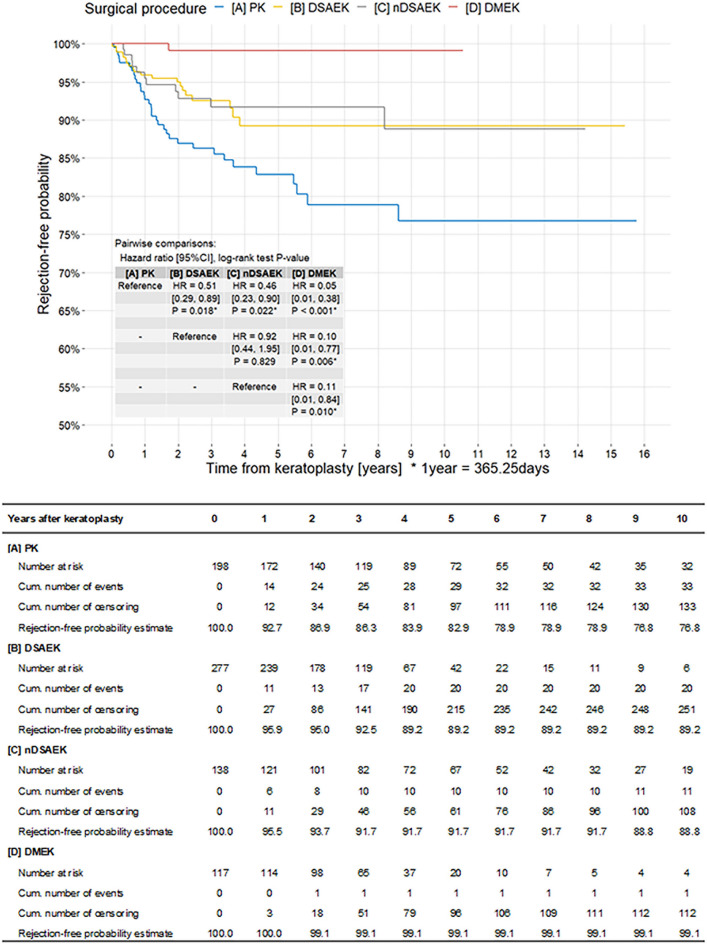
Kaplan–Meier survival curves of rejection episode by surgical procedure groups (N = 730). The PK group has the highest hazard estimate of rejection, with significant differences between this group and the other three groups (P = 0.018 for DSAEK, P = 0.022 for nDSAEK, and P < 0.001 for DMEK). No significant difference was observed between DSAEK and nDSAEK (HR = 0.92, 95% CI [0.44, 1.95], P = 0.829). The DMEK group has the lowest hazard estimate of rejection, with significant differences between this group and the other three groups (P < 0.001, PK; P = 0.006, DSAEK; and P = 0.010, nDSAEK). DMEK descemet membrane endothelial keratoplasty, DSAEK descemet’s stripping automated endothelial keratoplasty, nDSAEK non-descemet’s stripping automated endothelial keratoplasty, PK penetrating keratoplasty.

References

    1. Tan DTH, Dart JKG, Holland EJ, Kinoshita S. Corneal transplantation. Lancet. 2012;379:1749–1761. doi: 10.1016/S0140-6736(12)60437-1. - DOI - PubMed
    1. Anshu A, Price MO, Tan DTH, Price FW. Endothelial keratoplasty: A revolution in evolution. Surv. Ophthalmol. 2012;57:236–252. doi: 10.1016/j.survophthal.2011.10.005. - DOI - PubMed
    1. Melles GRJ, et al. A surgical technique for posterior lamellar keratoplasty. Cornea. 1998;17:618–626. doi: 10.1097/00003226-199811000-00010. - DOI - PubMed
    1. Price FW, Price MO. Descemet’s stripping with endothelial keratoplasty in 200 eyes: Early challenges and techniques to enhance donor adherence. J. Cataract Refract. Surg. 2006;32:411–418. doi: 10.1016/j.jcrs.2005.12.078. - DOI - PubMed
    1. Gorovoy MS. Descemet-stripping automated endothelial keratoplasty. Cornea. 2006;25:886–889. doi: 10.1097/01.ico.0000214224.90743.01. - DOI - PubMed

MeSH terms