


Early diagnosis of ovarian cancer based on methylation profiles in peripheral blood cell-free DNA: a systematic review
- PMID: 36788585
- PMCID: PMC9926627
- DOI: 10.1186/s13148-023-01440-w
Early diagnosis of ovarian cancer based on methylation profiles in peripheral blood cell-free DNA: a systematic review
Abstract
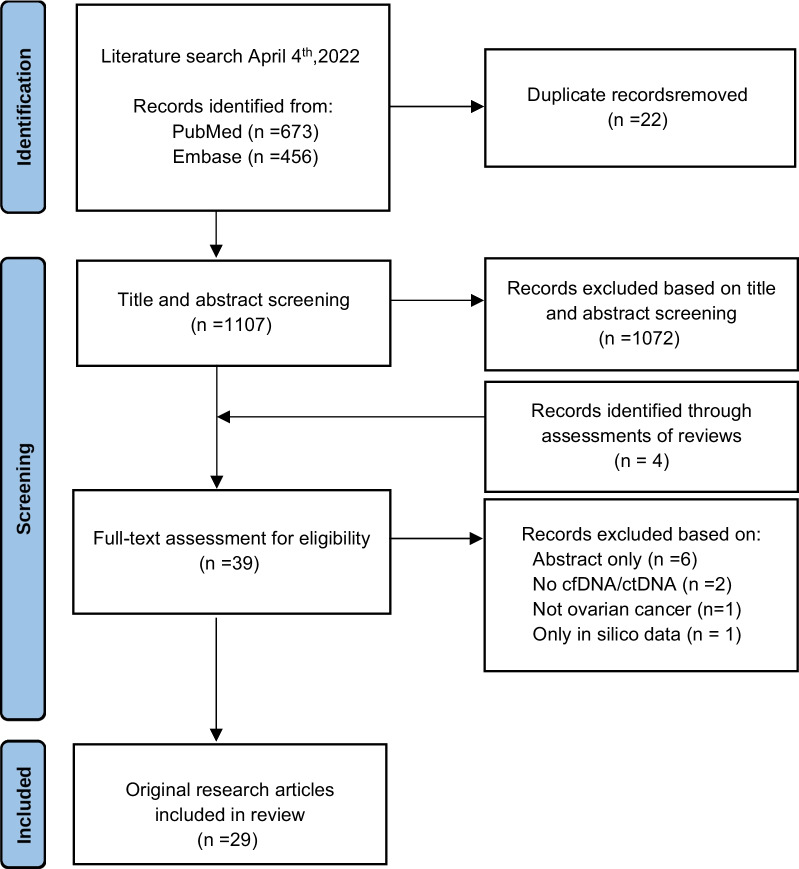
Patients diagnosed with epithelial ovarian cancer (OC) have a 5-year survival rate of 49%. For early-stage disease, the 5-year survival rate is above 90%. However, advanced-stage disease accounts for most cases as patients with early stages often are asymptomatic or present with unspecific symptoms, highlighting the need for diagnostic tools for early diagnosis. Liquid biopsy is a minimal invasive blood-based approach that utilizes circulating tumor DNA (ctDNA) shed from tumor cells for real-time detection of tumor genetics and epigenetics. Increased DNA methylation of promoter regions is an early event during tumorigenesis, and the methylation can be detected in ctDNA, accentuating the promise of methylated ctDNA as a biomarker for OC diagnosis. Many studies have investigated multiple methylation biomarkers in ctDNA from plasma or serum for discriminating OC patients from patients with benign diseases of the ovaries and/or healthy females. This systematic review summarizes and evaluates the performance of the currently investigated DNA methylation biomarkers in blood-derived ctDNA for early diagnosis of OC. PubMed's MEDLINE and Elsevier's Embase were systematically searched, and essential results such as methylation frequency of OC cases and controls, performance measures, as well as preanalytical factors were extracted. Overall, 29 studies met the inclusion criteria for this systematic review. The most common method used for methylation analysis was methylation-specific PCR, with half of the studies using plasma and the other half using serum. RASSF1A, BRCA1, and OPCML were the most investigated gene-specific methylation biomarkers, with OPCML having the best performance measures. Generally, methylation panels performed better than single gene-specific methylation biomarkers, with one methylation panel of 103,456 distinct regions and 1,116,720 CpGs having better performance in both training and validation cohorts. However, the evidence is still limited, and the promising methylation panels, as well as gene-specific methylation biomarkers highlighted in this review, need validation in large, prospective cohorts with early-stage asymptomatic OC patients to assess the true diagnostic value in a clinical setting.
Keywords: Biomarker; Cell-free DNA; Circulating tumor DNA; DNA methylation; Diagnosis; Epigenetics; Liquid biopsy; Ovarian cancer; Systematic review.
© 2023. The Author(s).
Conflict of interest statement
The authors declare that they have no competing interests.
Figures
References
-
- National Cancer Institute. Cancer Stat Facts: Ovarian Cancer [Internet]. 2022 [cited 2022 Oct 3]. https://seer.cancer.gov/statfacts/html/ovary.html.
-
- American Cancer Society. Cancer Facts & Figures [Internet]. 2022 [cited 2022 Jul 19]. https://www.cancer.org/research/cancer-facts-statistics/all-cancer-facts....
-
- Bell R, Petticrew M, Luengo S, Sheldon TA. Screening for ovarian cancer: a systematic review. Heal Technol Assess (Rockv). 1998;2(2):1–84. - PubMed
-
- Buys SS, Partridge E, Black A, Johnson CC, Lamerato L, Isaacs C, et al. Effect of screening on ovarian cancer mortality: The Prostate, Lung, Colorectal and Ovarian (PLCO) cancer screening randomized controlled trial. JAMA J Am Med Assoc. 2011;305(22):2295–2302. doi: 10.1001/jama.2011.766. - DOI - PubMed
Publication types
MeSH terms
Substances
LinkOut - more resources
Full Text Sources
Medical
Miscellaneous
