Development of hepatocellular carcinoma in treated and untreated patients with chronic hepatitis B virus infection
- PMID: 36788759
- PMCID: PMC10366811
- DOI: 10.3350/cmh.2022.0342
Development of hepatocellular carcinoma in treated and untreated patients with chronic hepatitis B virus infection
Abstract
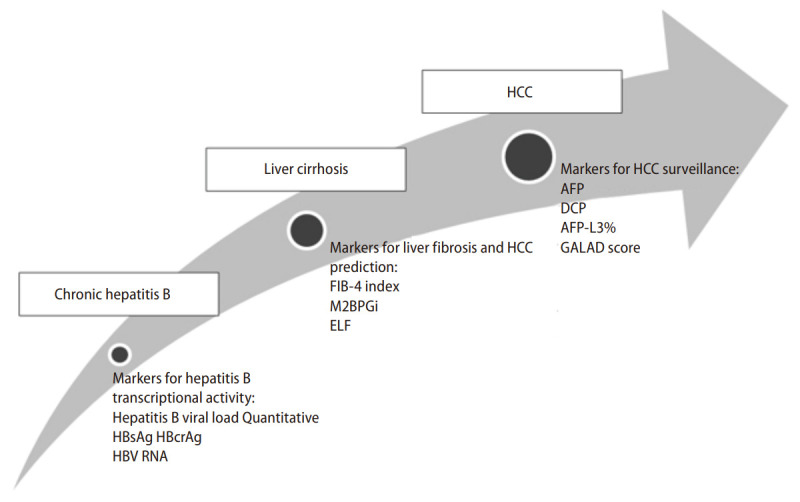
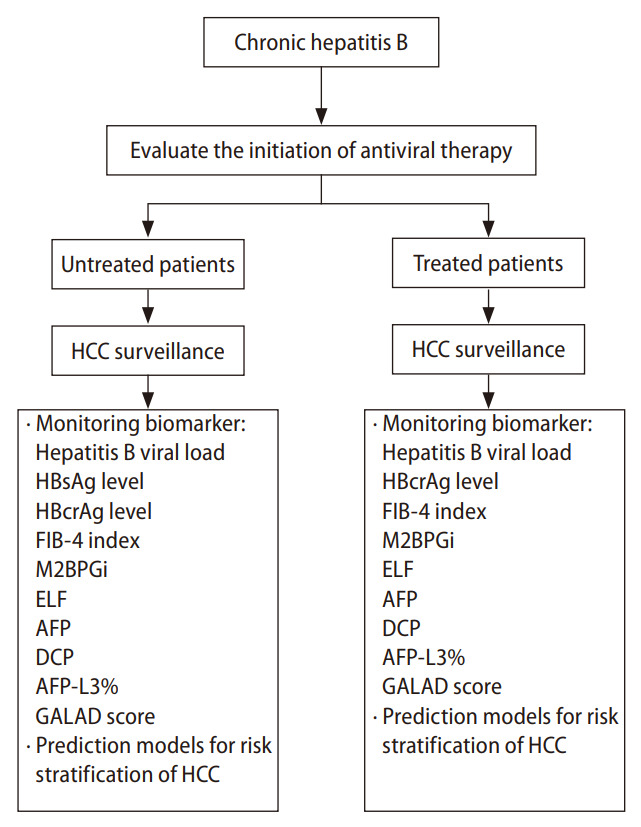
Hepatitis B virus (HBV) is responsible for more than 50% of hepatocellular carcinoma (HCC) in HBV hyperendemic areas, such as the Asia-Pacific region. Several hepatitis B viral factors are involved in HBV-related hepatocarcinogenesis. Hepatitis B viral load is the most important risk factor of HCC development. In addition, HBV integration, HBV genotype C, and core-promoter mutations are also associated with a risk of HCC development. For untreated chronic hepatitis B (CHB) patients, the estimated HCC incidence rates per 100 patient-years were 0.03-0.17 in inactive carriers, 0.07-0.42 in asymptomatic carriers, 0.12-0.49 in chronic hepatitis, and 2.03-3.37 in cirrhosis. Complementary to HBV DNA, serum levels of the hepatitis B surface antigen and hepatitis B core-related antigen (HBcrAg) can predict the occurrence of HCC for untreated patients with low and intermediate viral loads, respectively. For patients receiving antiviral therapy, the risks of HCC occurrence 40-60% lower than those for untreated patients. Patients treated with residual detectable HBV DNA or intrahepatic cccDNA still have a risk of HCC. Serum levels of HBcrAg, M2BPGi and fibrosis-4 are predictive of the risk of HCC development in treated patients. Several well-developed HCC risk scores can help clinicians identify high-risk CHB patients for HCC surveillance, regardless of treatment status. These strategies can help minimize the threat of HCC and prolong survival in CHB patients.
Keywords: Chronic hepatitis B; Cirrhosis; Hepatocellular carcinoma.
Conflict of interest statement
The authors have no conflicts to disclose.
Figures

References
-
- Sung H, Ferlay J, Siegel RL, Laversanne M, Soerjomataram I, Jemal A, et al. Global cancer statistics 2020: GLOBOCAN estimates of incidence and mortality worldwide for 36 cancers in 185 countries. CA Cancer J Clin. 2021;71:209–249. - PubMed
-
- Kao JH, Chen PJ, Chen DS. Recent advances in the research of hepatitis B virus-related hepatocellular carcinoma: epidemiologic and molecular biological aspects. Adv Cancer Res. 2010;108:21–72. - PubMed
-
- World Health Organization. Hepatitis B. WHO web site, < https://www.who.int/news-room/fact-sheets/detail/hepatitis-b>. Accessed Dec 2022.
-
- World Health Organization. Global hepatitis report, 2017. WHO web site, < https://www.who.int/publications/i/item/9789241565455>. Accessed Dec 2022.
Publication types
MeSH terms
Substances
Grants and funding
LinkOut - more resources
Full Text Sources
Medical