


Influence of the Social Environment on Ideal Cardiovascular Health
- PMID: 36789849
- PMCID: PMC10111502
- DOI: 10.1161/JAHA.122.026790
Influence of the Social Environment on Ideal Cardiovascular Health
Abstract
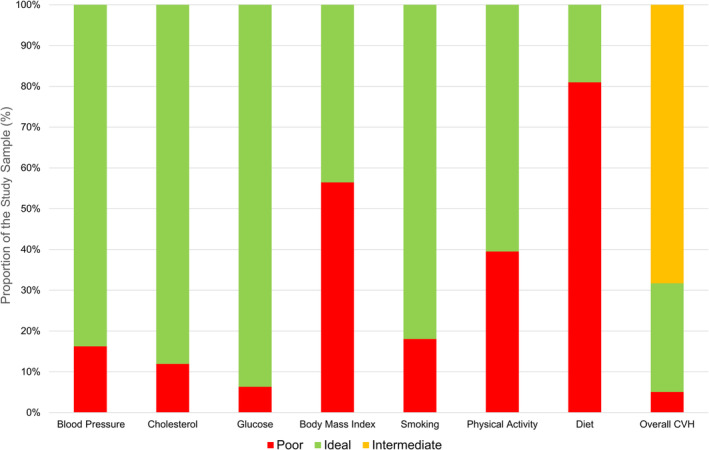
Background The environment plays a large role in the health of individuals; however, more research is needed to better understand aspects of the environment that most influence health. Specifically, our study examines how the social environment influences cardiovascular health (CVH). Methods and Results The social environment was characterized using measures of belonging and life and work stress in individuals, as well as nationally derived measures of marginalization, deprivation, economic status, and community well-being in neighborhoods. CVH was defined by the American Heart Association's Cardiovascular Health Index-a summed score of 7 clinical and behavioral components known to have the greatest impact on CVH. Data were obtained from the Canadian Community Health Survey 2015 to 2016 and multiple national data sources. Multilevel regression models were used to analyze the associations between CVH and the social environment. Overall, 27% of Canadians reported ideal CVH (6-7 score points), 68% reported intermediate CVH (3-5 score points), and 5% reported poor CVH (0-2 score points). The neighborhood environment contributed up to 7% of the differences in CVH between individuals. Findings indicated that residing in a neighborhood with greater community well-being (odds ratio [OR], 1.33 [95% CI, 1.26-1.41]) was associated with achieving higher odds of ideal CVH, while weaker community belonging (OR, 0.67 [95% CI, 0.62-0.72]) and residing in a neighborhood with greater marginalization (OR, 0.87 [95% CI, 0.82-0.91]) and deprivation (OR, 0.67 [95% CI, 0.64-0.69]) were associated with achieving lower odds of ideal CVH. Conclusions Aspects of individual-level social environment and residing in a neighborhood with a more favorable social environment were both independently and significantly associated with achieving ideal CVH.
Keywords: cardiovascular health; determinants of health; multilevel modeling; population health; social environment.
Figures

References
-
- Murray CJ, Aravkin AY, Zheng P, Abbafati C, Abbas KM, Abbasi‐Kangevari M, Abd‐Allah F, Abdelalim A, Abdollahi M, Abdollahpour I. Global burden of 87 risk factors in 204 countries and territories, 1990–2019: a systematic analysis for the global burden of disease study 2019. Lancet. 2020;396:1223–1249. doi: 10.1016/S0140-6736(20)30752-2 - DOI - PMC - PubMed
-
- Zoghbi WA, Duncan T, Antman E, Barbosa M, Champagne B, Chen D, Gamra H, Harold JG, Josephson S, Komajda M, et al. Sustainable development goals and the future of cardiovascular health. A statement from the global cardiovascular disease taskforce. Eur Heart J. 2014;35:3238–3239. - PubMed
-
- Younus A, Aneni EC, Spatz ES, Osondu CU, Roberson L, Ogunmoroti O, Malik R, Ali SS, Aziz M, Feldman T, et al. A systematic review of the prevalence and outcomes of ideal cardiovascular health in US and non‐US populations. Mayo Clin Proc. 2016;91:649–670. doi: 10.1016/j.mayocp.2016.01.019 - DOI - PubMed
-
- Ramírez‐Vélez R, Saavedra JM, Lobelo F, Celis‐Morales CA, del Pozo‐Cruz B, García‐Hermoso A. Ideal cardiovascular health and incident cardiovascular disease among adults: a systematic review and meta‐analysis. Paper/Poster presented at: Mayo Clinic Proceedings. 2018. - PubMed
Publication types
MeSH terms
LinkOut - more resources
Full Text Sources
