


Sleep Irregularity and Subclinical Markers of Cardiovascular Disease: The Multi-Ethnic Study of Atherosclerosis
- PMID: 36789869
- PMCID: PMC10111477
- DOI: 10.1161/JAHA.122.027361
Sleep Irregularity and Subclinical Markers of Cardiovascular Disease: The Multi-Ethnic Study of Atherosclerosis
Abstract
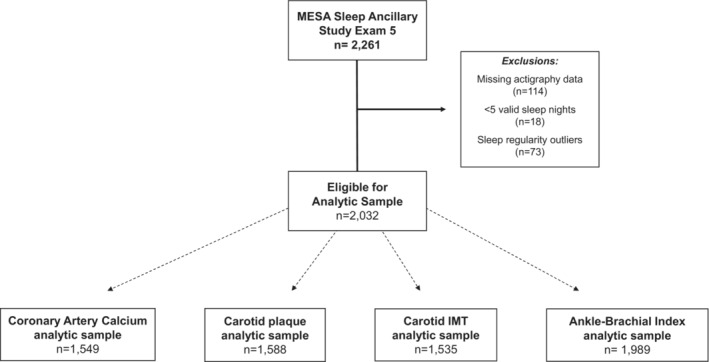
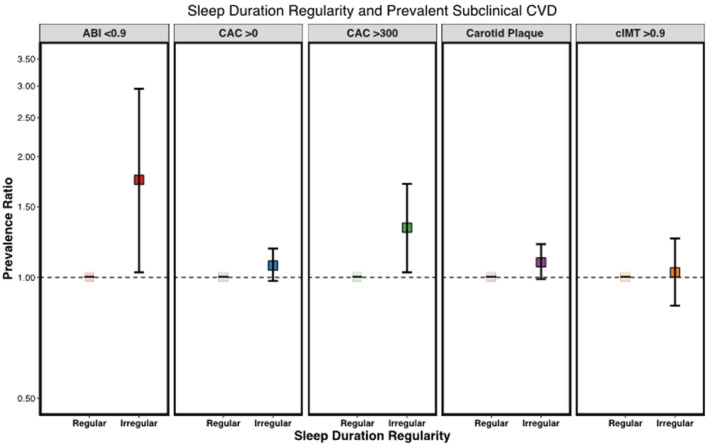
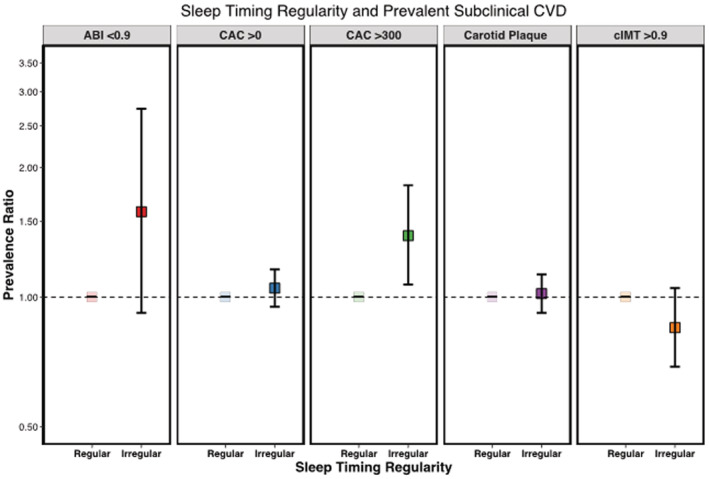
Background Sleep irregularity has been linked to incident cardiovascular disease. Less is known about associations of sleep regularity with atherosclerosis. We examined cross-sectional associations of actigraphy-assessed sleep duration and sleep timing regularity with subclinical atherosclerosis in the community-based MESA (Multi-Ethnic Study of Atherosclerosis). Methods and Results MESA Sleep Ancillary Study participants (N=2032; mean age, 68.6±9.2 years; 37.9% White) completed 7-day wrist actigraphy. Participants underwent assessments of coronary artery calcium, carotid plaque presence, carotid intima-media thickness, and the ankle-brachial index. Sleep regularity was quantified by the 7-day with-in person SD of sleep duration and sleep onset timing. Relative risk regression models were used to calculate prevalence ratios and 95% CIs. Models are adjusted for demographics, cardiovascular disease risk factors, and other objectively assessed sleep characteristics including obstructive sleep apnea, sleep duration, and sleep fragmentation. After adjustment, compared with participants with more regular sleep durations (SD ≤60 minutes), participants with greater sleep duration irregularity (SD >120 minutes) were more likely to have high coronary artery calcium burden (>300; prevalence ratio, 1.33 [95% CI, 1.03-1.71]) and abnormal ankle-brachial index (<0.9; prevalence ratio, 1.75 [95% CI, 1.03-2.95]). Compared with participants with more regular sleep timing (SD ≤30 minutes), participants with irregular sleep timing (SD >90 minutes) were more likely to have high coronary artery calcium burden (prevalence ratio, 1.39 [95% CI, 1.07-1.82]). Associations persisted after adjustment for cardiovascular disease risk factors and average sleep duration, obstructive sleep apnea, and sleep fragmentation. Conclusions Sleep irregularity, particularly sleep duration irregularity, was associated with several measures of subclinical atherosclerosis. Sleep regularity may be a modifiable target for reducing atherosclerosis risk. Future investigation into cardiovascular risk reduction interventions targeting sleep irregularity may be warranted.
Keywords: cardiovascular disease; circadian rhythms; lifestyle; risk factors.
Figures
References
-
- Gottlieb DJ, Yenokyan G, Newman AB, O'Connor GT, Punjabi NM, Quan SF, Redline S, Resnick HE, Tong EK, Diener‐West M, et al. Prospective study of obstructive sleep apnea and incident coronary heart disease and heart failure. Circulation. 2010;122:352–360. doi: 10.1161/CIRCULATIONAHA.109.901801 - DOI - PMC - PubMed
-
- St‐Onge M‐P, Grandner MA, Brown D, Conroy MB, Jean‐Louis G, Coons M, Bhatt DL. Sleep duration and quality: impact on lifestyle behaviors and cardiometabolic health: a scientific statement from the American Heart Association. Circulation. 2016;134:e367–e386. doi: 10.1161/CIR.0000000000000444 - DOI - PMC - PubMed
-
- Azarbarzin A, Sands SA, Stone KL, Taranto‐Montemurro L, Messineo L, Terrill P, Ancoli‐Israel S, Ensrud K, Purcell S, White DP, et al. The hypoxic burden of sleep apnoea predicts cardiovascular disease‐related mortality: the osteoporotic fractures in men study and the sleep heart health study. Eur Heart J. 2019;40:1149–1157. doi: 10.1093/eurheartj/ehy624 - DOI - PMC - PubMed
Publication types
MeSH terms
Substances
Grants and funding
- K12 AR084232/AR/NIAMS NIH HHS/United States
- HHSN268201500003C/HL/NHLBI NIH HHS/United States
- P50 HL056984/HL/NHLBI NIH HHS/United States
- N01HC95161/HL/NHLBI NIH HHS/United States
- R01 AG070867/AG/NIA NIH HHS/United States
- N01HC95162/HL/NHLBI NIH HHS/United States
- UL1 TR001420/TR/NCATS NIH HHS/United States
- T32 HL007779/HL/NHLBI NIH HHS/United States
- K24 HL159246/HL/NHLBI NIH HHS/United States
- N01HC95163/HL/NHLBI NIH HHS/United States
- K01 HL143034/HL/NHLBI NIH HHS/United States
- UL1 TR001079/TR/NCATS NIH HHS/United States
- UL1 TR000040/TR/NCATS NIH HHS/United States
- N01HC95160/HL/NHLBI NIH HHS/United States
- R01 HL155395/HL/NHLBI NIH HHS/United States
- N01HC95165/HL/NHLBI NIH HHS/United States
- R35 HL135818/HL/NHLBI NIH HHS/United States
- N01HC95164/HL/NHLBI NIH HHS/United States
- HHSN268201500003I/HL/NHLBI NIH HHS/United States
- K12 HD043483/HD/NICHD NIH HHS/United States
