


Incidence of obesity across adulthood in the United States, 2001-2017-a national prospective analysis
- PMID: 36789933
- PMCID: PMC10196588
- DOI: 10.1016/j.ajcnut.2022.10.012
Incidence of obesity across adulthood in the United States, 2001-2017-a national prospective analysis
Abstract
Background: In the United States, the prevalence of obesity among adults has increased 3-fold since the 1980s, but patterns of incidence of new cases of obesity are not known.
Objectives: To examine the incidence of new cases of obesity: overall, by demographic and educational subgroups, by weight status, and changes during this century.
Methods: We analyzed adult (≥20 y) anthropometric records from the US nationally representative Panel Study of Income Dynamics from 2001 to 2017. Among those not having obesity (body mass index, BMI, ≥30 kg/m2) at first observation, we used Poisson models to estimate the incidence of obesity [cases/1000 person-years (PYs)] and incidence rate ratio (IRR).
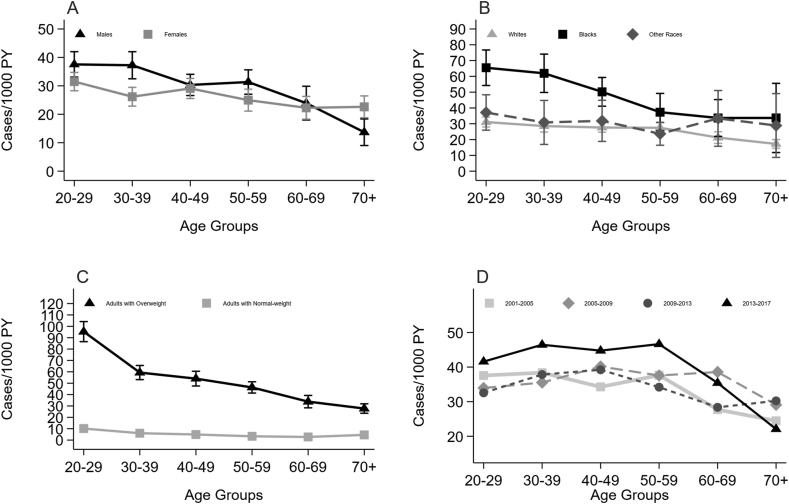
Results: Among 13,888 adults followed for 115,797 PYs, the incidence of obesity in 2001-2017 was 28.1/1000 PYs (95% CI: 26.7, 29.7). Over the periods 2001-2005, 2005-2009, and 2009-2013, the incidence of obesity was stable, but in 2013-2017 the incidence increased by 18% compared to 2009-2013 [IRR: 1.18 (95% CI: 1.06, 1.30)]. Blacks had higher obesity incidence [47.9/1000 PYs (95% CI: 42.7, 53.1)] than Whites [26.2/1000 PYs (95% CI: 24.6, 27.9)]. Risk was particularly high among Black females [57.9/1000 PYs (95% CI: 49.1, 66.8)] and Black young adults (20-29 y) [65.5/1000 PYs (95% CI: 54.2, 76.7)]. Across race, obesity incidence was highest in young adults (20-29 y) [34.1/1000 PYs (95% CI: 31.5, 36.7)] and declined with age [age 70+ y: 18.9/1000 PYs (95% CI: 16.6, 21.8)]. Those with overweight had an obesity risk 7 times higher than those with normal weight [62.1/1000 PYs (95% CI: 58.8, 65.3) vs. 8.8/1000 PYs (95% CI: 8.1, 9.6)]. Those with less than high-school education had higher obesity incidence than those with education beyond high-school [39.4/1000 PYs (95% CI: 34.4, 44.4) vs. 24.7/1000 PYs (95% CI: 23.1, 26.3)].
Conclusions: Incidence of obesity was stable over the first 13 y of the last 2 decades but increased by 18% in 2013-2017. Blacks and younger adults were at highest risk, and those with overweight were also at high risk for developing obesity.
Keywords: United States; adults; disparities; incidence; obesity; trends.
Copyright © 2022 American Society for Nutrition. Published by Elsevier Inc. All rights reserved.
Figures
References
-
- Ng M., Fleming T., Robinson M., Thomson B., Graetz N., Margono C., et al. Global, regional, and national prevalence of overweight and obesity in children and adults during 1980–2013: a systematic analysis for the Global Burden of Disease Study 2013. Lancet. 2014;384(9945):766–781. doi: 10.1016/s0140-6736(14)60460-8. - DOI - PMC - PubMed
-
- Emerging Risk Factors Collaboration. Wormser D., Kaptoge S., Di Angelantonio E., Wood A.M., Pennells L., et al. Separate and combined associations of body-mass index and abdominal adiposity with cardiovascular disease: collaborative analysis of 58 prospective studies. Lancet. 2011;377(9771):1085–1095. doi: 10.1016/s0140-6736(11)60105-0. - DOI - PMC - PubMed
Publication types
MeSH terms
Grants and funding
LinkOut - more resources
Full Text Sources
Medical
