


Clarifying the role of Cortico-Cortical and Amygdalo-Cortical brain dysconnectivity associated with Conduct Problems
- PMID: 36791489
- PMCID: PMC9958059
- DOI: 10.1016/j.nicl.2023.103346
Clarifying the role of Cortico-Cortical and Amygdalo-Cortical brain dysconnectivity associated with Conduct Problems
Abstract
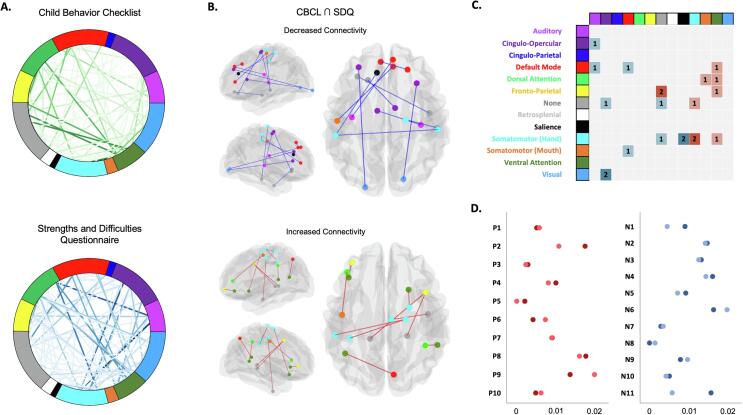
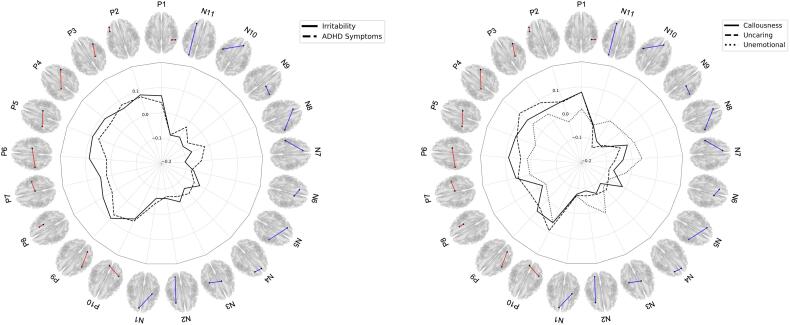
A recent meta-analysis of resting-state functional connectivity studies revealed that individuals exhibiting antisocial behaviors or conduct problems may show disrupted brain connectivity in networks underpinning socio-affective and attentional processes. However, studies included in the meta-analysis generally rely on small sample sizes and substantially differ in terms of psychometric scales and neuroimaging methodologies. Therefore, we aimed to identify reliable functional brain connectivity alterations associated with severity of conduct problems using a large sample of adolescents and two measures of conduct problems. In a sample of 1416 children and adolescents, mass-univariate analyses of connectivity measures between 333 cortical parcels were conducted to examine the relationship between resting-state functional cortical-cortical connectome and the severity of conduct problems using the Child Behavior Checklist (CBCL) and the Strengths and Difficulties Questionnaire (SDQ). At a liberal threshold, results showed that the functional brain connectivity significantly associated with conduct problems largely differ between the two scales. Indeed, only 21 pairs of brain regions overlapped between the CBCL and SDQ. Permutation feature importance of these 21 brain connectivity measures revealed that connectivity between precentral/postcentral gyri and lateral prefrontal cortex (both ventral and dorsal) were the most important features in explaining variance in conduct problems. The current study highlights that psychometric measures may yield distinct functional connectivity results. Moreover, severity of conduct problems in children and adolescents was mainly associated with deficient functional connectivity of somatomotor and ventral attention networks indicating potential alterations in motor, cognitive and reward processes.
Keywords: Antisocial behaviors; Conduct disorder; Functional connectivity; Somatomotor.
Copyright © 2023 The Author(s). Published by Elsevier Inc. All rights reserved.
Conflict of interest statement
Declaration of Competing Interest The authors declare that they have no known competing financial interests or personal relationships that could have appeared to influence the work reported in this paper.
Figures

References
-
- Achenbach, T.M., Rescorla, L.A., 2001. Manual for the ASEBA school-age forms & profiles: child behavior checklist for ages 6-18, teacher's report form, youth self-report: an integrated system of multi-informant assessment. University of Vermont, research center for children youth & families.
-
- Afzali M.H., Dagher A., Edalati H., Bourque J., Spinney S., Sharkey R.J., Conrod P. Adolescent resting-state brain networks and unique variability of conduct problems within the externalizing dimension. J. Pers. Disord. 2020;34:609–627. - PubMed
-
- Alegria A.A., Radua J., Rubia K. Meta-analysis of fMRI studies of disruptive behavior disorders. Am. J. Psychiatry. 2016;173:1119–1130. - PubMed
-
- Alexander L.M., Escalera J., Ai L., Andreotti C., Febre K., Mangone A., Vega-Potler N., Langer N., Alexander A., Kovacs M., Litke S., O'Hagan B., Andersen J., Bronstein B., Bui A., Bushey M., Butler H., Castagna V., Camacho N., Chan E., Citera D., Clucas J., Cohen S., Dufek S., Eaves M., Fradera B., Gardner J., Grant-Villegas N., Green G., Gregory C., Hart E., Harris S., Horton M., Kahn D., Kabotyanski K., Karmel B., Kelly S.P., Kleinman K., Koo B., Kramer E., Lennon E., Lord C., Mantello G., Margolis A., Merikangas K.R., Milham J., Minniti G., Neuhaus R., Levine A., Osman Y., Parra L.C., Pugh K.R., Racanello A., Restrepo A., Saltzman T., Septimus B., Tobe R., Waltz R., Williams A., Yeo A., Castellanos F.X., Klein A., Paus T., Leventhal B.L., Craddock R.C., Koplewicz H.S., Milham M.P. An open resource for transdiagnostic research in pediatric mental health and learning disorders. Sci. Data. 2017;4 - PMC - PubMed
-
- American Psychiatric Association, 2013. Diagnostic and statistical manual of mental disorders (5th ed.). Arlington, VA: Author.
Publication types
MeSH terms
LinkOut - more resources
Full Text Sources
Medical
