


How we treat esophageal squamous cell carcinoma
- PMID: 36791637
- PMCID: PMC9958251
- DOI: 10.1016/j.esmoop.2023.100789
How we treat esophageal squamous cell carcinoma
Abstract
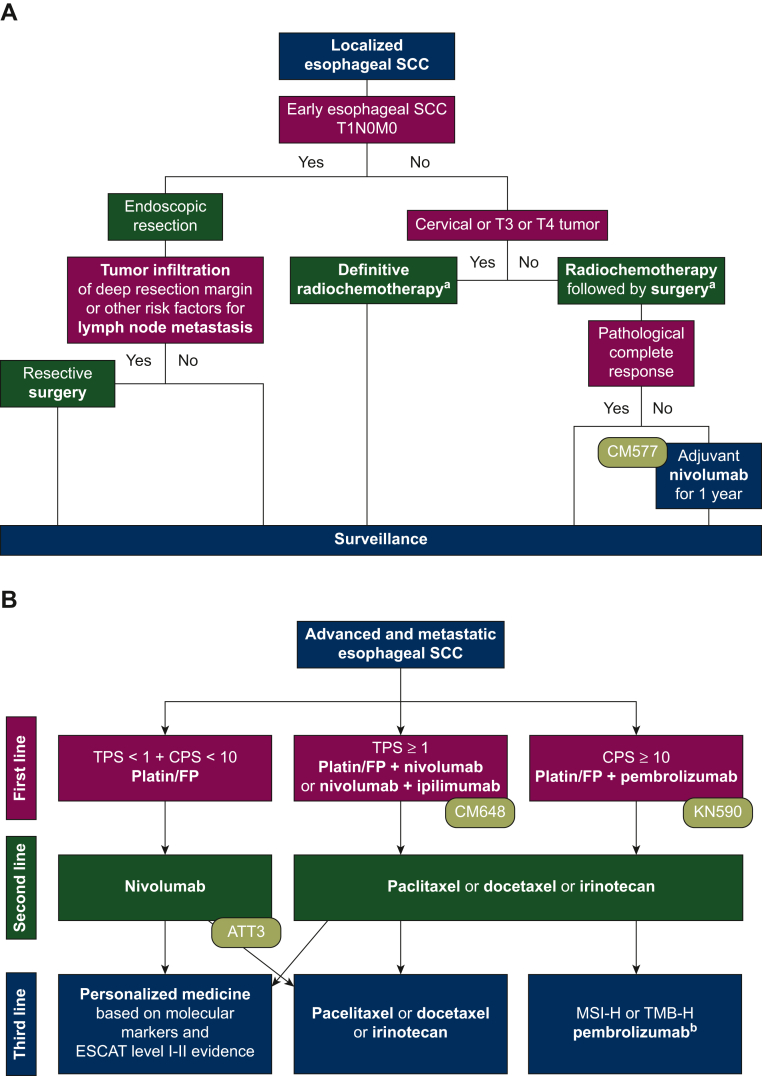
Esophageal squamous cell carcinoma (ESCC) poses a major challenge for clinicians as the prognosis is poor and treatment options are limited. However, recent advances in immunotherapy have significantly changed the treatment algorithm of ESCC. Patients with early ESCC should undergo an endoscopic resection. If histological margins are infiltrated with tumor cells or other risk factors for lymph node metastasis are present, further resective surgery should be offered. In a locally advanced setting, radiochemotherapy with or without resection remains the standard of care. In the absence of pathological complete response after neoadjuvant radiochemotherapy and R0 resection, adjuvant immunotherapy for 1 year should be administered to improve disease-free survival. In metastatic first-line setting, combination of platin/fluoropyrimidine-based systemic chemotherapy with checkpoint inhibitors is the novel standard of care for all-comers in the United States and for patients with programmed death-ligand 1 positivity in Europe. Immunotherapy has also been approved in a second-line setting. However, the benefit from immunotherapy reinduction is still unknown and, therefore, standard second-line chemotherapy with taxanes or irinotecan is still the treatment of choice after progression on immunochemotherapy. It is of highest importance that treatment decisions are based on informed patient wishes and are discussed in an interdisciplinary tumor board. This review summarizes how to manage, in our opinion, patients with ESCC and gives a practical overview of the treatment strategies in Europe.
Keywords: cancer; esophageal; squamous cell carcinoma; treatment.
Copyright © 2023 The Author(s). Published by Elsevier Ltd.. All rights reserved.
Figures
References
-
- Sung H., Ferlay J., Siegel R.L., et al. Global cancer statistics 2020: GLOBOCAN estimates of incidence and mortality worldwide for 36 cancers in 185 countries. CA Cancer J Clin. 2021;71(3):209–249. - PubMed
-
- Obermannová R., Alsina M., Cervantes A., et al. Oesophageal cancer: ESMO Clinical Practice Guideline for diagnosis, treatment and follow-up. Ann Oncol. 2022;33(10):992. - PubMed
-
- Food and Drug Administration. FDA grants accelerated approval to pembrolizumab for first tissue/site agnostic indication. 2017. Available at https://www.fda.gov/drugs/resources-information-approved-drugs/fda-grant.... Accessed June 30, 2021.
Publication types
MeSH terms
LinkOut - more resources
Full Text Sources
Medical
Research Materials
