Review
. 2023 Feb 14;56(2):256-271.
doi: 10.1016/j.immuni.2023.01.022.

Learning from the nexus of autoimmunity and cancer

Affiliations
Review

Learning from the nexus of autoimmunity and cancer

Davide Mangani et al. Immunity. .

Abstract

The immune system plays critical roles in both autoimmunity and cancer, diseases at opposite ends of the immune spectrum. Autoimmunity arises from loss of T cell tolerance against self, while in cancer, poor immunity against transformed self fails to control tumor growth. Blockade of pathways that preserve self-tolerance is being leveraged to unleash immunity against many tumors; however, widespread success is hindered by the autoimmune-like toxicities that arise in treated patients. Knowledge gained from the treatment of autoimmunity can be leveraged to treat these toxicities in patients. Further, the understanding of how T cell dysfunction arises in cancer can be leveraged to induce a similar state in autoreactive T cells. Here, we review what is known about the T cell response in autoimmunity and cancer and highlight ways in which we can learn from the nexus of these two diseases to improve the application, efficacy, and management of immunotherapies.


Conflict of interest statement

Declaration of interests A.C.A. is a member of the SAB for Tizona Therapeutics, Trishula Therapeutics, Compass Therapeutics, Zumutor Biologics, ImmuneOncia, and Nekonal Sarl. A.C.A. is also a paid consultant for iTeos Therapeutics, Larkspur Biosciences, and Excepgen. A.C.A.’s interests were reviewed and managed by the Brigham and Women’s Hospital and Partners Healthcare in accordance with their conflict-of-interest policies.

Figures
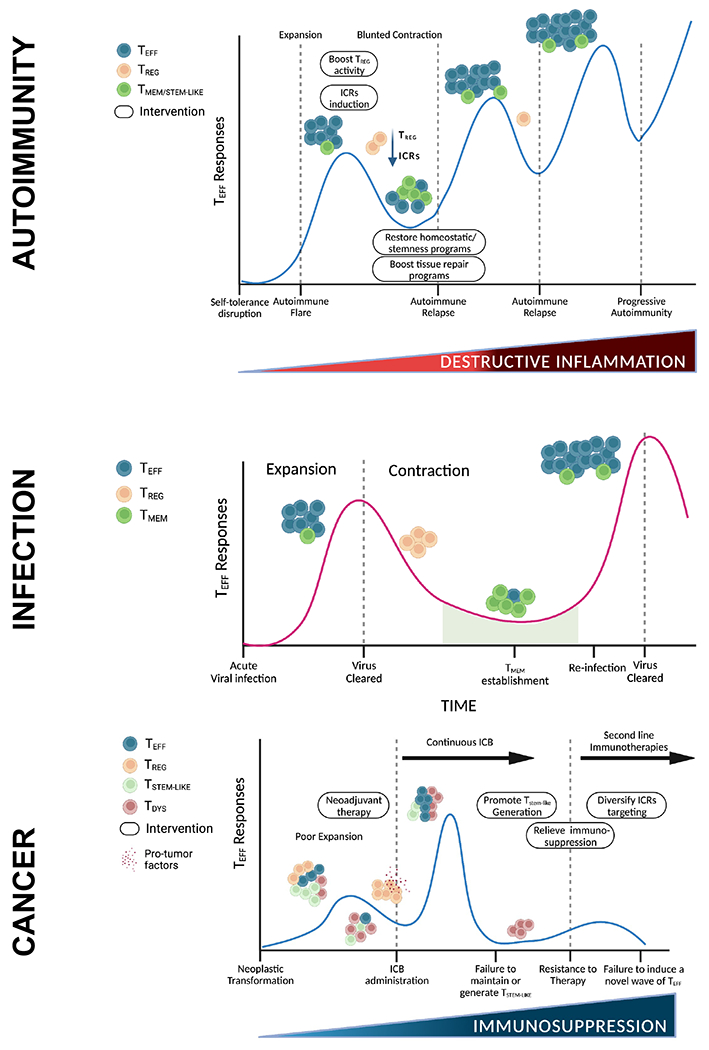
Figure 1.
Figure 1.. T cell response cycles in autoimmunity, infection, and cancer.
Upper panel, autoimmunity: Disruption of self-tolerance initiates the expansion of self-reactive effector T cells that comprise the first autoimmune flare. The inflammatory state is further accentuated by reduced regulatory T cell suppressive capacity and low immune checkpoint expression by self-reactive effector T cells. At the peak of the flare, therapeutic strategies should be aimed at boosting Treg activity and immune checkpoint expression in self-reactive T cells. Eventually, the effector T cell response undergoes contraction; however, this is blunted compared to acute infection because of the continued presence of the triggering antigen and/or persistence of tissue inflammation. In this phase, restoration of T cell homeostasis programs and tissue repair programs may provide a viable strategy to tone down overall inflammation. Even though current therapeutic strategies are able to keep autoimmune responses at bay for extended periods of time, eventually autoimmune TMEM/STEM-LIKE cells from the periphery expand again, leading to autoimmune relapses and development of progressive autoimmunity. Middle panel, infection: Acute viral infections trigger a swift effector T cell expansion. Upon virus clearance, the effector T cell pool contracts because of the reduced presence of viral antigens and the activity of Tregs, leading to re-establishment of homeostasis. A small population of T memory (TMEM) cells is established and persists long term. Additional encounters with the same pathogen trigger a response that is faster and of a higher magnitude, leading to prompt viral clearance. Lower panel, cancer: Upon neoplastic transformation, tumor antigens are presented within a poorly inflamed environment, leading to poor expansion of tumor-reactive effector T cells. Tregs further dampen effector T cell responses and secrete pro-tumor factors (e.g. TGFβ, IL-10, IL-35, amphiregulin), promoting tumor outgrowth. Immune checkpoint blockade (ICB) re-invigorates anti-tumor responses by eliciting a wave of T effector cells, which is sustained by a small pool of stem-like precursor cells. Neoadjuvant therapies elicit such immune responses prior to surgical resection of the primary tumor. However, continuous ICB post-surgery may hinder the establishment of long-term memory and lead to the reduction of the stem-like pool, which in turn may result in a sharp decline in the effector T cell population and hinder the generation of novel waves of effector T cells upon second-line immunotherapies, such as therapies targeting different immune checkpoint receptors (ICRs). The remaining T cells are in a terminal dysfunctional state, unable to control tumor growth. Therapeutic interventions should aim at the re-establishment of a cyclic T cell response by promoting the maintenance and generation of the T stem-like pool (e.g. implement a period of time in which patients are off ICB treatment). Also, dysfunction is induced by chronic antigen stimulation within the immunosuppressive TME. Thus, concomitant strategies to relieve local immunosuppression (e.g. co-stimulatory agonists, TGFβ pathway blockade, steroid blockade, reduced hypoxia) should be leveraged to promote anti-tumor immunity. Abbreviations: TMEM-STEM-LIKE, T memory/stem-like; TREG, T regulatory cells; TEFF, T effector cells; TDYS, T dysfunctional cells; ICRs, immune checkpoint receptors.
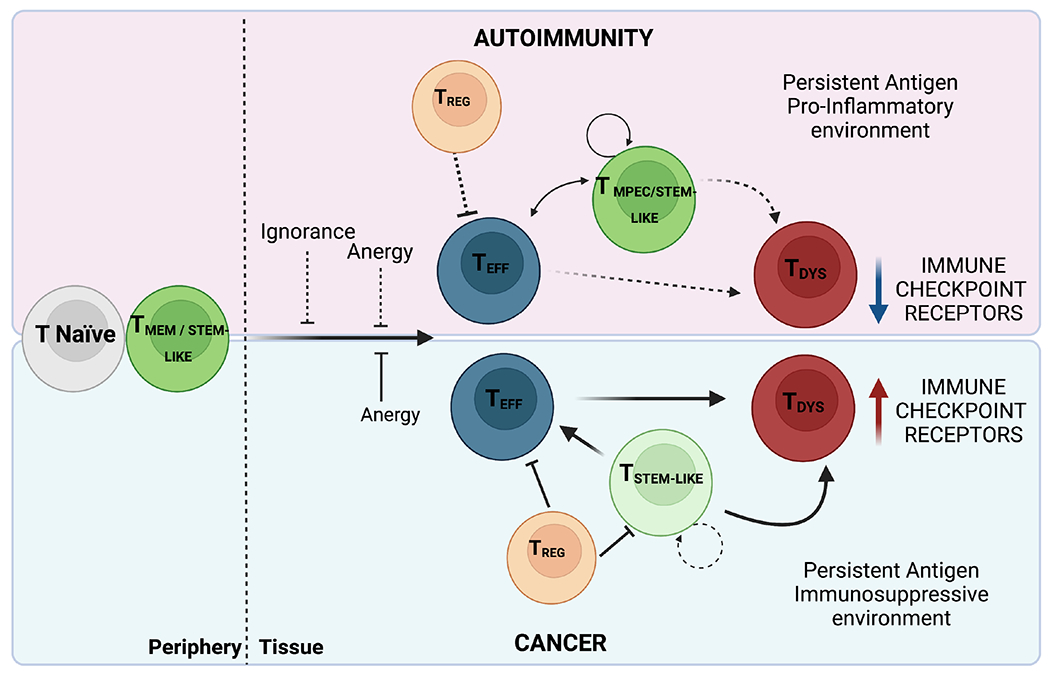
Figure 2.
Figure 2.. T cell trajectory in autoimmunity and cancer.
Upper panel, autoimmunity: Self-reactive naïve T or memory T cells overcome the barrier posed by ignorance and anergy (dashed lines) and differentiate into pro-inflammatory effector T cells. These effector T cells are efficiently maintained and replaced at each disease flare by a pool of T memory precursor/stem-like cells that can self-renew. Persistent self-antigen within a highly pro-inflammatory tissue environment reduces Treg capacity (dashed lines) to contain effector T cell responses. Low expression or defective function of immune checkpoint receptors on effector T cells prevents their acquisition of dysfunctional T cell phenotype (dashed lines). Lower panel, cancer: Differentiation of naïve T or stem-like T cells into effector T cells is dampened by the poor co-stimulatory environment in which antigens are presented early on during tumorigenesis, promoting T cell anergy. Stem-like T cells that have limited self-renewal potential compared to long-lived memory cells can differentiate into effector T cells but chronic antigen stimulation in the context of a highly immunosuppressive environment will push the differentiation trajectory toward dysfunction, resulting in failure to control tumor growth. The immunosuppressive environment is further heightened by the activity of Treg, which inhibit tumor-specific CD8+ effector T cells and stem-like T cells. Abbreviations: TMPEC: T memory precursors; TREG: T regulatory cells; TEFF: T effector cells; TDYS: T dysfunctional cells
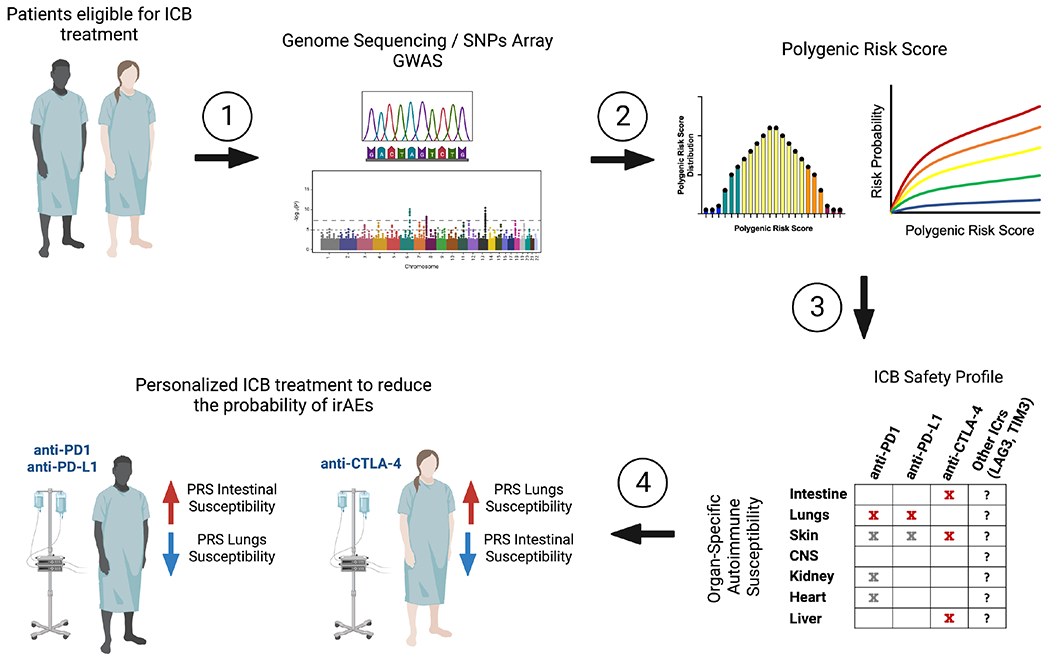
Figure 3.
Figure 3.. Pipeline to identify patients at high-risk to develop immune-related adverse events.
(1) Genome sequencing or single nucleotide polymorphisms (SNPs) arrays of patients eligible for immune checkpoint blockade (ICB). (2) The sequenced genome or SNPs arrays are compared to available GWAS for different autoimmune diseases and a polygenic risk score for each autoimmune condition is calculated. (3) The susceptibility of an individual patient to organ-specific autoimmunity is compared with the available data regarding the safety profile of the different ICB therapies. (4) The individual’s genetic susceptibilities guides the choice of ICB therapy with the goal of significantly lowering the incidence of irAEs, thereby maximizing treatment duration and potentially increasing the feasibility of applying combinatorial strategies.

References

    1. Bouneaud C, Kourilsky P, Bousso P. Impact of negative selection on the T cell repertoire reactive to a self-peptide: a large fraction of T cell clones escapes clonal deletion. Immunity. 2000;13(6):829–40. - PubMed
    1. ElTanbouly MA, Noelle RJ. Rethinking peripheral T cell tolerance: checkpoints across a T cell’s journey. Nat Rev Immunol. 2021;21(4):257–67. - PubMed
    1. Yu W, Jiang N, Ebert PJ, Kidd BA, Muller S, Lund PJ, et al. Clonal Deletion Prunes but Does Not Eliminate Self-Specific alphabeta CD8(+) T Lymphocytes. Immunity. 2015;42(5):929–41. - PMC - PubMed
    1. Hsieh CS, Liang Y, Tyznik AJ, Self SG, Liggitt D, Rudensky AY. Recognition of the peripheral self by naturally arising CD25+ CD4+ T cell receptors. Immunity. 2004;21(2):267–77. - PubMed
    1. Hsieh CS, Zheng Y, Liang Y, Fontenot JD, Rudensky AY. An intersection between the self-reactive regulatory and nonregulatory T cell receptor repertoires. Nat Immunol. 2006;7(4):401–10. - PubMed

Publication types