Review
. 2023 Sep;39(7-9):551-568.
doi: 10.1089/ars.2023.0246. Epub 2023 Mar 29.

Reactive Oxygen Species and Ferroptosis at the Nexus of Inflammation and Colon Cancer

Affiliations
Review

Reactive Oxygen Species and Ferroptosis at the Nexus of Inflammation and Colon Cancer

Wesley Huang et al. Antioxid Redox Signal. 2023 Sep.

Abstract

Significance: Reactive oxygen species (ROS) are essential in maintaining normal intestinal physiology. Inflammatory bowel disease (IBD) is a relapsing chronic inflammatory disease of the intestine that is a major risk factor for colorectal cancer (CRC). Excess ROS are widely implicated in intestinal inflammation and cancer. Recent Advances: Clinical data have shown that targeting ROS broadly does not yield improved outcomes in IBD and CRC. However, selectively limiting oxidative damage may improve the efficacy of ROS targeting. An accumulation of lipid ROS induces a novel oxidative cell death pathway known as ferroptosis. A growing body of evidence suggests that ferroptosis is relevant to both IBD and CRC. Critical Issues: We propose that inhibition of ferroptosis will improve disease severity in IBD, whereas activating ferroptosis will limit CRC progression. Data from preclinical models suggest that methods of modulating ferroptosis have been successful in attenuating IBD and CRC. Future Directions: The etiology of IBD and progression of IBD to CRC are still unclear. Further understanding of ferroptosis in intestinal diseases will provide novel therapies. Ferroptosis is highly linked to inflammation, cell metabolism, and is cell-type dependent. Further research in assessing the inflammatory and tumor microenvironment in the intestine may provide novel vulnerabilities that can be targeted. Antioxid. Redox Signal. 39, 551-568.

Keywords: CRC; IBD; colorectal cancer; ferroptosis; inflammatory bowel disease.


Conflict of interest statement

No competing financial interests exist.

Figures
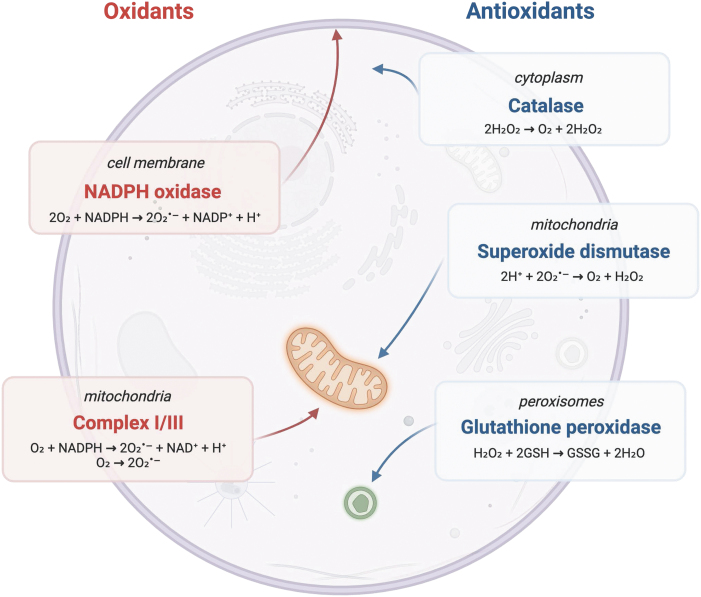
FIG. 1.
FIG. 1.
Main sources of oxidants and antioxidants in the cell. Redox imbalance occurs when any of these systems is compromised.
FIG. 2.
FIG. 2.
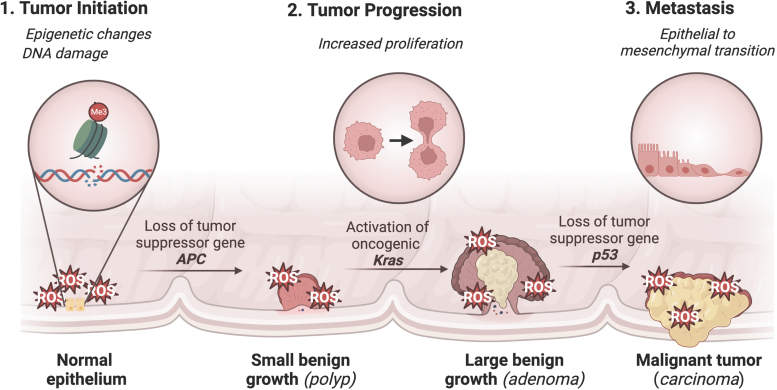
Role of ROS in CRC tumorigenesis. ROS are essential in CRC tumor initiation, progression, and metastasis. Tumor initiation begins with genetic and epigenetic changes. ROS directly contribute to tumor initiation through oxidative DNA damage and the formation of mutagenic 8-oxodG, which induces guanine to thymine transversion through its ability to bond to both cytosine and adenine (Oka and Nakabeppu, 2011). In addition, ROS help drive aberrant methylation of DNA (Barnicle et al., ; Lucafò et al., 2021). Tumor progression involves the selective expansion of cells given a proliferative advantage. It was shown that increased H2O2 generation secondary to upregulation of NOX1 in NIH 3T3 fibroblasts led to the increased expression of cell cycle and growth genes (Arnold et al., 2001). ROS have also been shown to promote proliferation and migration of CRC cells through regulation of cell cycle progression and EMT (Zeng et al., 2021). Lastly, metastasis involves neoplastic growth at a secondary site. ROS help promote induction of EMT essential for metastasis. During EMT, epithelial-like cells lose cell–cell and cell–matrix adhesions and become more mesenchymal-like with increased motility and migratory capability (Bhatia et al., 2020). 8-oxodG, 8-oxo-7-hydro-2′-deoxyguanosine; CRC, colorectal cancer; EMT, epithelial-to-mesenchymal transition; ROS, reactive oxygen species.
FIG. 3.
FIG. 3.
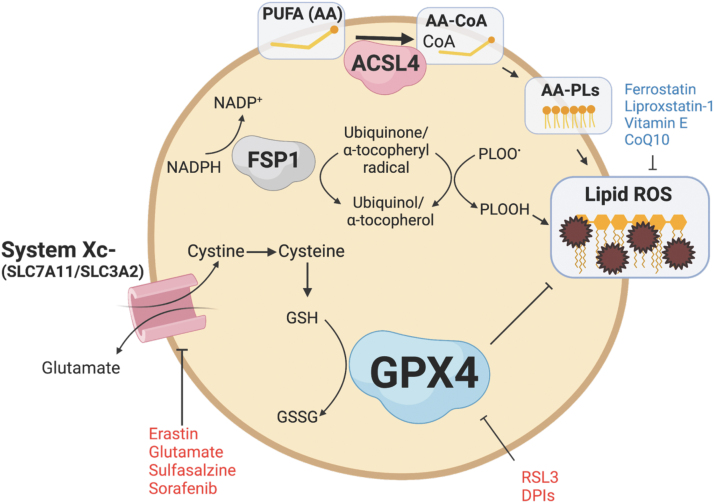
Mechanisms governing ferroptosis. Ferroptosis is an iron-dependent regulated cell death pathway based on the accumulation of lipid peroxides. The primary regulators of this pathway are GPX4 and cystine/glutamate antiporter System Xc. GPX4 reduces cytotoxic lipid ROS, while System Xc transports the cystine, the necessary precursor for substrates of GPX4. Additional pathways include ACSL4, which incorporates PUFA-CoA into phospholipid cell membranes, and FSP1, which reduces lipid ROS through a GPX4-independent pathway. ACSL4, acyl-CoA synthetase long-chain family member 4; FSP1, ferroptosis suppressor protein 1; GPX4, glutathione peroxidase 4; PUFA, polyunsaturated fatty acid.
FIG. 4.
FIG. 4.
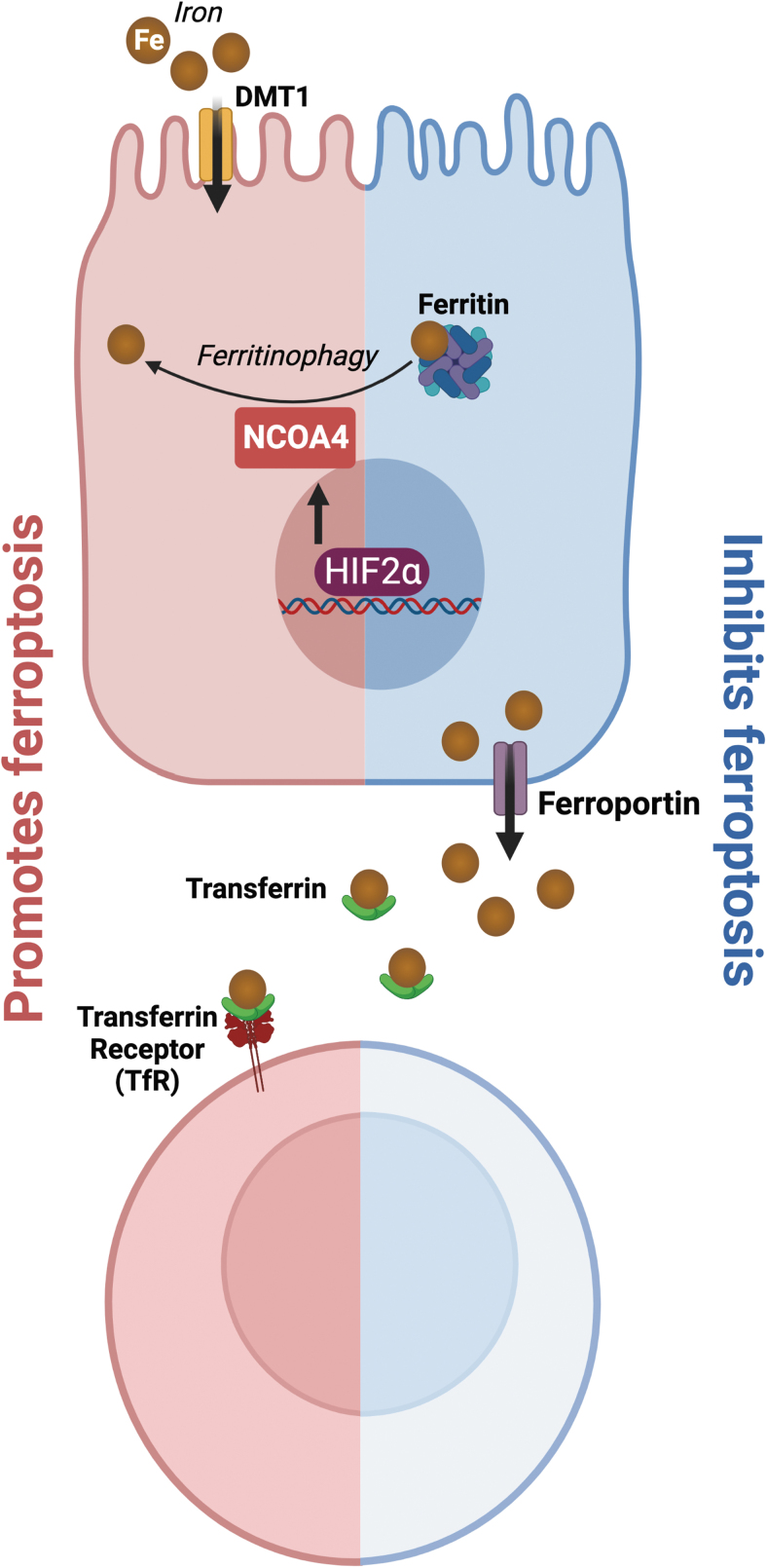
Role of iron metabolism in ferroptosis. Excess iron results in the Fenton reaction producing ROS. Iron transport proteins such as DMT1, transferring, and TfR promote ferroptosis. DMT1 imports iron from the apical lumen side into duodenal enterocytes. Transferrin and its receptor, TfR, mediate the transport of iron through blood. NCOA4 mediates the breakdown of ferritin to release free iron, thus promoting ferroptosis. Iron storage (ferritin) and export (ferroportin) proteins inhibit ferroptosis by sequestering iron and decreasing cellular iron levels. DMT1, divalent metal transporter-1; NCOA4, nuclear receptor coactivator 4; TfR, transferrin receptor.
FIG. 5.
FIG. 5.
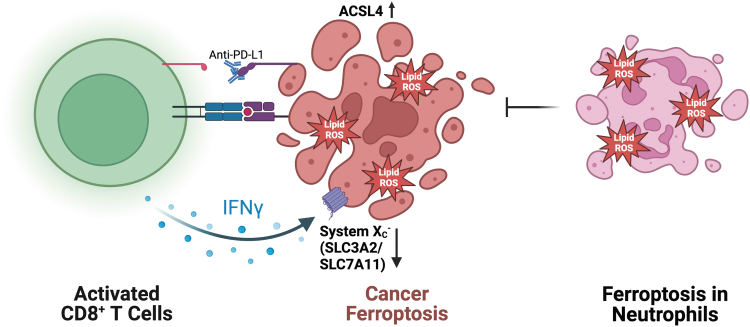
Immune-mediated mechanisms of ferroptosis. Immune checkpoint inhibitor-activated CD8+ T cells promote ferroptosis in cancer cells through IFNγ-dependent System Xc downregulation and ACSL4 upregulation. Ferroptosis in neutrophils results in immune suppression and cancer promotion. IFNγ, interferon γ.
FIG. 6.
FIG. 6.
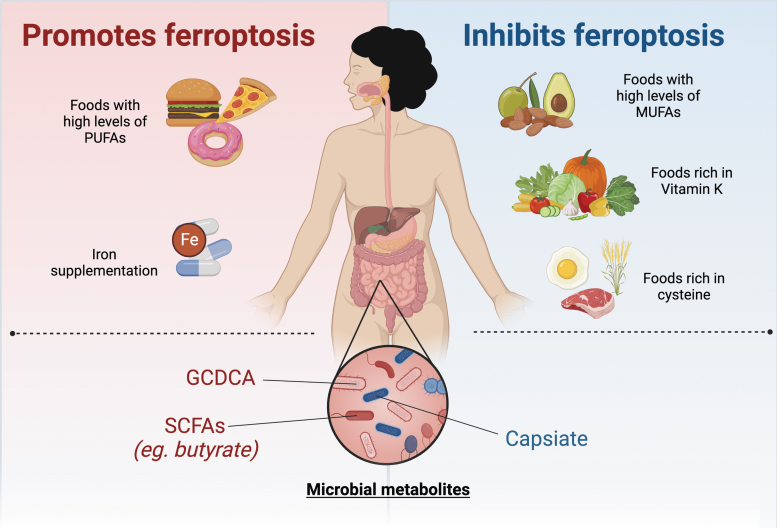
Nonpharmacological effects on ferroptosis. Diet and microbiota have been shown to affect ferroptosis. Diets rich in PUFAs and iron supplementation promote ferroptosis, while diets rich in MUFAs, cysteine, and vitamin K inhibit ferroptosis. Gut dysbiosis affects ferroptosis in a context-dependent manner. Some microbial metabolites (GCDCA, SCFAs) have been reported to inhibit ferroptosis, while other microbial metabolites (capsiate) are able to protect against ferroptosis. GCDCA, glycochenodeoxycholate; MUFA, monounsaturated fatty acid; SCFA, short-chain fatty acid.

References

    1. Abraham C, Cho JH. Inflammatory bowel disease. New Engl J Med 2009;361(21):2066–2078; doi: 10.1056/nejmra0804647 - DOI - PMC - PubMed
    1. Alfadda AA, Sallam RM. Reactive oxygen species in health and disease. J Biomed Biotechnol 2012;2012:936486; doi: 10.1155/2012/936486 - DOI - PMC - PubMed
    1. Ananthakrishnan AN, Cagan A, Cai T, et al. . Statin use is associated with reduced risk of colorectal cancer in patients with inflammatory bowel diseases. Clin Gastroenterol Hepatol 2016;14(7):973–979; doi: 10.1016/j.cgh.2016.02.017 - DOI - PMC - PubMed
    1. Andreani C, Bartolacci C, Scaglioni PP. Ferroptosis: A specific vulnerability of RAS-driven cancers? Frontiers Oncol 2022;12:923915; doi: 10.3389/fonc.2022.923915 - DOI - PMC - PubMed
    1. Angeli JPF, Schneider M, Proneth B, et al. . Inactivation of the ferroptosis regulator Gpx4 triggers acute renal failure in mice. Nat Cell Biol 2014;16(12):1180–1191; doi: 10.1038/ncb3064 - DOI - PMC - PubMed

Publication types

MeSH terms

Substances

LinkOut - more resources