


Engineered living materials grown from programmable Aspergillus niger mycelial pellets
- PMID: 36793323
- PMCID: PMC9922812
- DOI: 10.1016/j.mtbio.2023.100545
Engineered living materials grown from programmable Aspergillus niger mycelial pellets
Abstract
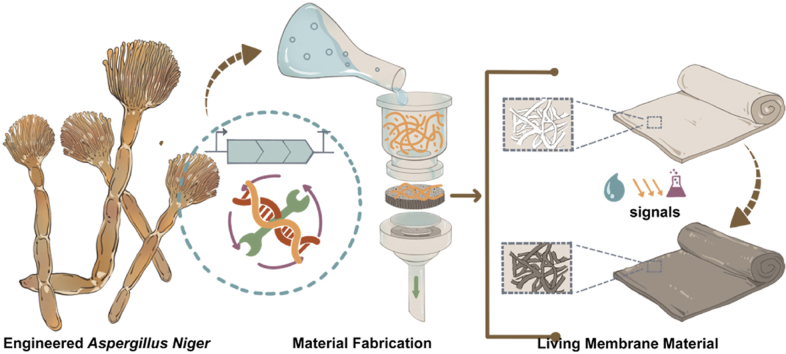
The development of engineered living materials (ELMs) has recently attracted significant attention from researchers across multiple disciplines. Fungi-derived ELMs represent a new type of macroscale, cost-effective, environmentally sustainable materials. However, current fungi-based ELMs either have to undergo a final process to heat-kill the living cells or rely on the co-culture with a model organism for functional modification, which hinders the engineerability and versatility of these materials. In this study, we report a new type of ELMs - grown from programmable Aspergillus niger mycelial pellets - by a simple filtration step under ambient conditions. We demonstrate that A. Niger pellets can provide sufficient cohesion to maintain large-area self-supporting structures even under low pH conditions. Subsequently, by tuning the inducible expression of genes involved in melanin biosynthesis, we verified the fabrication of self-supporting living membrane materials with tunable colors in response to xylose concentration in the surroundings, which can be further explored as a potential biosensor for detecting xylose level in industrial wastewater. Notably, the living materials remain alive, self-regenerative, and functional even after 3-month storage. Thus, beyond reporting a new engineerable fungi chassis for constructing ELMs, our study provides new opportunities for developing bulk living materials for real-world applications such as the production of fabrics, packaging materials, and biosensors.
Keywords: Aspergillus niger; Engineered living material; Filamentous fungus; Genetic circuit; Melanin.
© 2023 Published by Elsevier Ltd.
Conflict of interest statement
The authors declare that they have no known competing financial interests or personal relationships that could have appeared to influence the work reported in this paper.
Figures


References
-
- Liu T., Yu Y.Y., Deng X.P., Ng C.K., Cao B., Wang J.Y., Rice S.A., Kjelleberg S., Song H. Enhanced Shewanella biofilm promotes bioelectricity generation. Biotechnol. Bioeng. 2015;112(10):2051–2059. - PubMed
-
- Smith R.S.H., Bader C., Sharma S., Kolb D., Tang T.-C., Hosny A., Moser F., Weaver J.C., Voigt C.A., Oxman N. Hybrid living materials: digital design and fabrication of 3D multimaterial structures with programmable biohybrid surfaces. Adv. Funct. Mater. 2020;30(7)
-
- Tang T.-C., An B., Huang Y., Vasikaran S., Wang Y., Jiang X., Lu T.K., Zhong C. Materials design by synthetic biology. Nat. Rev. Mater. 2021;6:332–350.
-
- Huang J., Liu S., Zhang C., Wang X., Pu J., Ba F., Xue S., Ye H., Zhao T., Li K. Biofilms as engineered living materials. Nat. Chem. Biol. 2019;15:34–41. - PubMed
LinkOut - more resources
Full Text Sources
