Review
. 2023 Jan 30:11:1089068.
doi: 10.3389/fcell.2023.1089068. eCollection 2023.

Cancer-associated fibroblasts: The chief architect in the tumor microenvironment

Affiliations
Review

Cancer-associated fibroblasts: The chief architect in the tumor microenvironment

Mrinmoy Sarkar et al. Front Cell Dev Biol. .

Abstract

Stromal heterogeneity of tumor microenvironment (TME) plays a crucial role in malignancy and therapeutic resistance. Cancer-associated fibroblasts (CAFs) are one of the major players in tumor stroma. The heterogeneous sources of origin and subsequent impacts of crosstalk with breast cancer cells flaunt serious challenges before current therapies to cure triple-negative breast cancer (TNBC) and other cancers. The positive and reciprocal feedback of CAFs to induce cancer cells dictates their mutual synergy in establishing malignancy. Their substantial role in creating a tumor-promoting niche has reduced the efficacy of several anti-cancer treatments, including radiation, chemotherapy, immunotherapy, and endocrine therapy. Over the years, there has been an emphasis on understanding CAF-induced therapeutic resistance in order to enhance cancer therapy results. CAFs, in the majority of cases, employ crosstalk, stromal management, and other strategies to generate resilience in surrounding tumor cells. This emphasizes the significance of developing novel strategies that target particular tumor-promoting CAF subpopulations, which will improve treatment sensitivity and impede tumor growth. In this review, we discuss the current understanding of the origin and heterogeneity of CAFs, their role in tumor progression, and altering the tumor response to therapeutic agents in breast cancer. In addition, we also discuss the potential and possible approaches for CAF-mediated therapies.

Keywords: CAF; breast cancer; heterogeneity; targeting; tumor microenvironment.


Conflict of interest statement

The authors declare that the research was conducted in the absence of any commercial or financial relationships that could be construed as a potential conflict of interest.

Figures
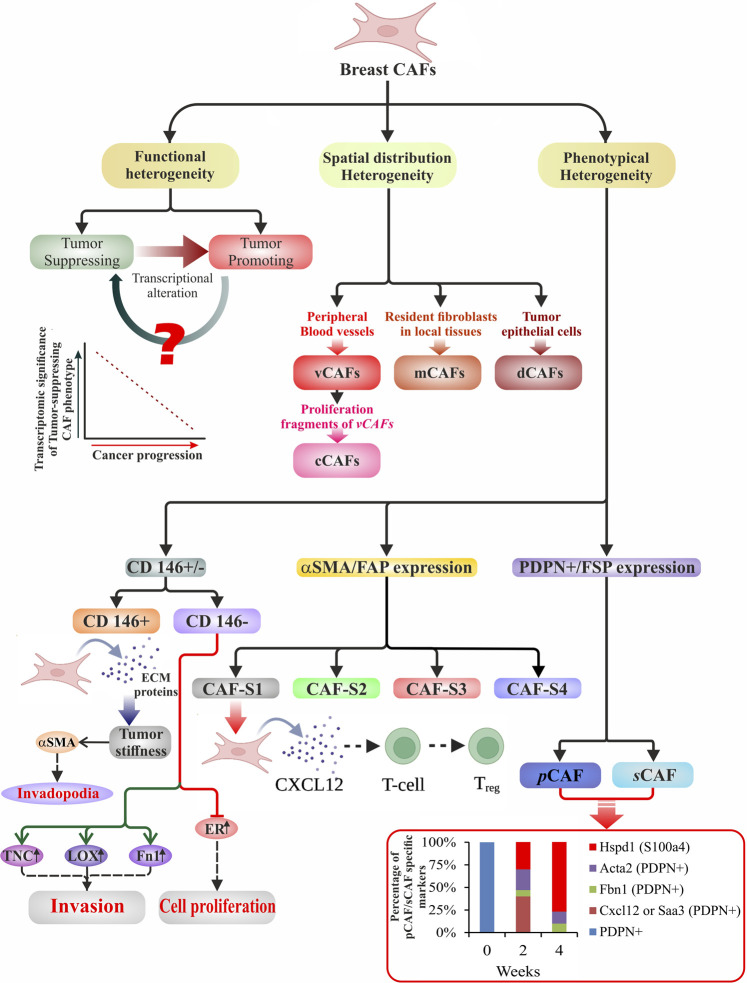
FIGURE 1
FIGURE 1
Schematic illustration of heterogeneity in breast CAFs. Broadly, breast CAFs are distinguished under three subclasses based on their heterogeneous function, spatial distribution, and cell surface phenotype. They have been divided into tumor-promoting and tumor-suppressing cell types due to their stage-specific distinct approach toward tumor cells. With the progression of cancer, transcriptional alteration of the tumor-suppressing CAF phenotypes results in the generation of tumor-promoting breast CAFs. Manipulation of the event may prove to be a potent therapeutic tool. Bartoschek et al. (2018) used single-cell RNA data to classify the CAFs according to their spatial distribution. Vascular development, ECM-enriched signaling, expression of proliferative genes, and variously expressed differentiation genes shaped their classification into vCAFs, mCAFs, cCAFs, and dCAFs. Phenotypically breast CAFs could be sub-classified depending upon the i) presence or absence of CD146 (Brechbuhl et al., 2020), ii) expression of αSMA/FAP (Costa et al., 2018), and iii) expression of PDPN/FSP (Friedman et al., 2020). This diagram displays the several subtypes with phenotypical distinctions that are accountable for classified functions at various phases of carcinogenesis. The bottom right graph illustrates the percentage of pCAF/sCAF specific markers over a period of 4 weeks in a breast cancer model.
FIGURE 2
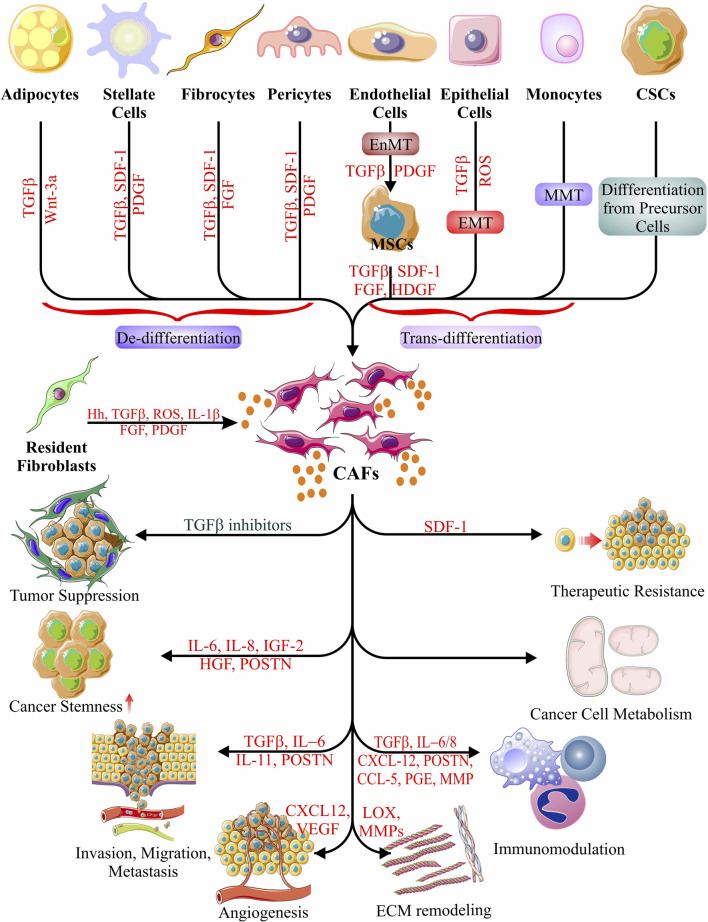
FIGURE 2
Origin and function of CAFs. Schematic representations of possible CAF cell origins have been depicted, as evidenced to date. Different types of cellular differentiation, trans-differentiation, and de-differentiations give rise to the generation of CAFs. CAFs show a plethora of activities in accord with and against cancer cell survival and malignancy, evidently in a stage-specific manner. The only event that results in the suppression of tumors occurs when the CAF-derived secretome includes TGFβ inhibitors. The other roles of CAFs in cancer include the induction of all the hallmarks of cancer via the secretion of various cytokines, chemokines, growth factors, carbohydrate intermediates, and nitrogen sources (amino acids). Their activities include induction of cancer stemness, metastasis, migration, invasion, angiogenesis, ECM remodeling, immunomodulation, metabolic manipulation, and therapeutic resistance (Karnoub et al., 2007; Mani et al., 2008; Erez et al., 2010; Baccelli and Trumpp, 2012; Oskarsson et al., 2014; Albrengues et al., 2015; Yeon et al., 2018; Fiori et al., 2019; Sahai et al., 2020a; Shen et al., 2020; Loh and Ma, 2021; Ping et al., 2021; Wu et al., 2021).
FIGURE 3
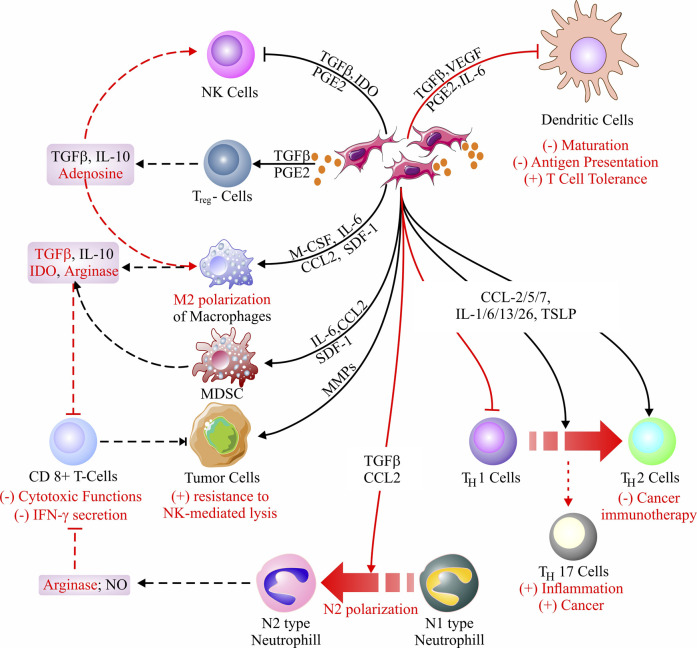
FIGURE 3
Cancer-associated fibroblast (CAF) immunomodulatory mechanisms. CAFs-derived secretome primarily alters the immune microenvironment around the stroma by infusing immunosuppression. Inhibition of NK cells, generation of Treg cells, and M2 polarization of macrophages are the key reasons behind the immunosuppression. Besides, CAFs can block antigen presentation by inhibiting DCs, largely impeding cell-mediated immunity. In addition, CAF-secretome is responsible for N1 to N2 conversion, thereby minimizing the T-cell (CD8+)-mediated cytotoxicity against tumor cells. Moreover, CAFs are known to regress the impact of cancer immunotherapy and favor tumor progression via the reduction of TH1 cells through their conversion into TH2 cells and generation of TH17 cells, respectively (Dikov et al., 2005; Kitamura et al., 2005; Flavell et al., 2010; Allard et al., 2016; Hashimoto et al., 2016; Kitamura et al., 2017; Mantovani et al., 2017; Takahashi et al., 2017; Cheng et al., 2018; Nakamura et al., 2018; Qian et al., 2018; Liu et al., 2019a; Monteran and Erez, 2019a; Masucci et al., 2019; Owusu-Ansah et al., 2019; Zhang et al., 2019; An et al., 2020; Veglia et al., 2021).
FIGURE 4
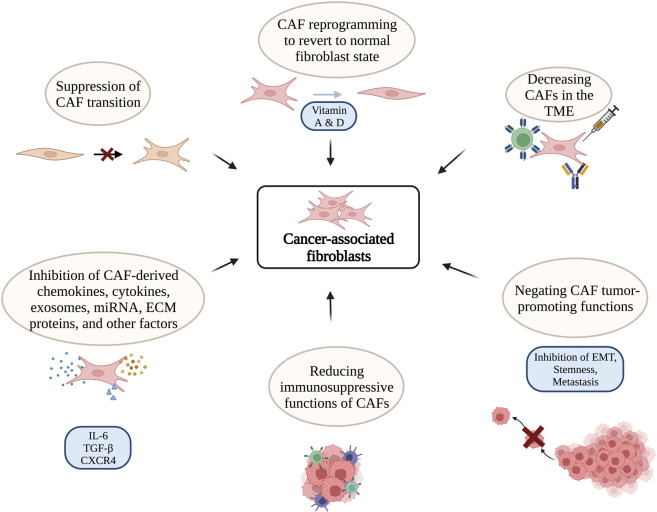
FIGURE 4
Various targeting strategies against CAFs. This illustration includes CAF-targeting approaches, including suppression of CAF transition from inactive to active states (Hanley et al., 2017); CAF reprogramming by targeting Vitamin A&D receptors to revert to the quiescent state (Sherman et al., 2014; Ferrer-Mayorga et al., 2017); decreasing CAFs in TME through CAR-T-cell therapy (Sakemura et al., 2019), vaccination (Chen et al., 2015), monoclonal antibody (Hanley and Thomas, 2020); Negating CAF tumor-promoting functions through inhibition of EMT, stemness, and metastasis (Sakemura et al., 2019); reducing immunosuppressive functions of CAFs to achieve greater T-cell accessibility to tumor cells and increased sensitivity to therapeutic approaches (Hanley and Thomas, 2020); inhibition of CAF-derived chemokines, cytokines, exosomes, miRNA, ECM proteins, and other factors (Izumi et al., 2016).

References

    1. Acerbi I., Cassereau L., Dean I., Shi Q., Au A., Park C., et al. (2015). Human breast cancer invasion and aggression correlates with ECM stiffening and immune cell infiltration. Integr. Biol. (Camb). 7 (10), 1120–1134. 10.1039/c5ib00040h - DOI - PMC - PubMed
    1. Addadi Y., Moskovits N., Granot D., Lozano G., Carmi Y., Apte R. N., et al. (2010). p53 status in stromal fibroblasts modulates tumor growth in an SDF1-dependent manner. Cancer Res. 70 (23), 9650–9658. 10.1158/0008-5472.CAN-10-1146 - DOI - PMC - PubMed
    1. Albonici L., Giganti M. G., Modesti A., Manzari V., Bei R. (2019). Multifaceted role of the placental growth factor (PlGF) in the antitumor immune response and cancer progression. Int. J. Mol. Sci. 20 (12), 2970. 10.3390/ijms20122970 - DOI - PMC - PubMed
    1. Albrengues J., Bertero T., Grasset E., Bonan S., Maiel M., Bourget I., et al. (2015). Epigenetic switch drives the conversion of fibroblasts into proinvasive cancer-associated fibroblasts. Nat. Commun. 6, 10204. 10.1038/ncomms10204 - DOI - PMC - PubMed
    1. Albrengues J., Bourget I., Pons C., Butet V., Hofman P., Tartare-Deckert S., et al. (2014). LIF mediates proinvasive activation of stromal fibroblasts in cancer. Cell. Rep. 7 (5), 1664–1678. 10.1016/j.celrep.2014.04.036 - DOI - PubMed

LinkOut - more resources