


Model for enhancing the research conducted by the university medical staff: Participatory action research
- PMID: 36793952
- PMCID: PMC9922824
- DOI: 10.1016/j.heliyon.2023.e13208
Model for enhancing the research conducted by the university medical staff: Participatory action research
Abstract
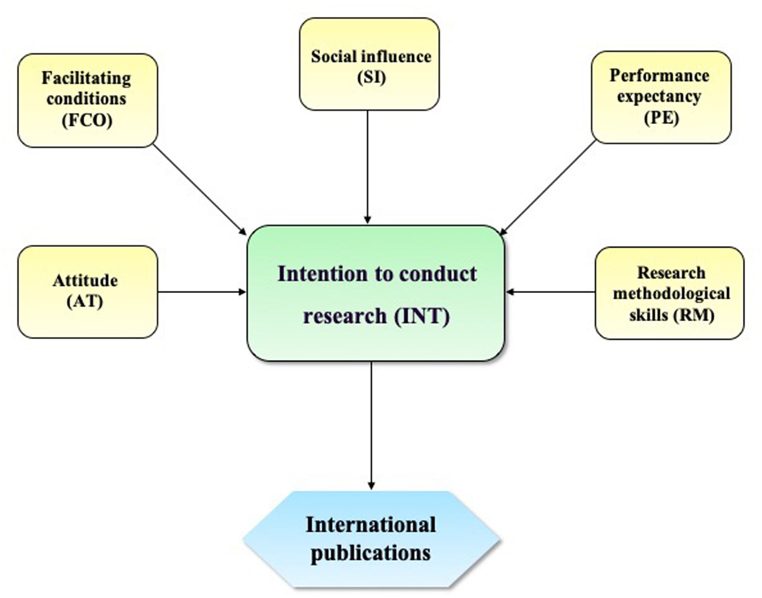
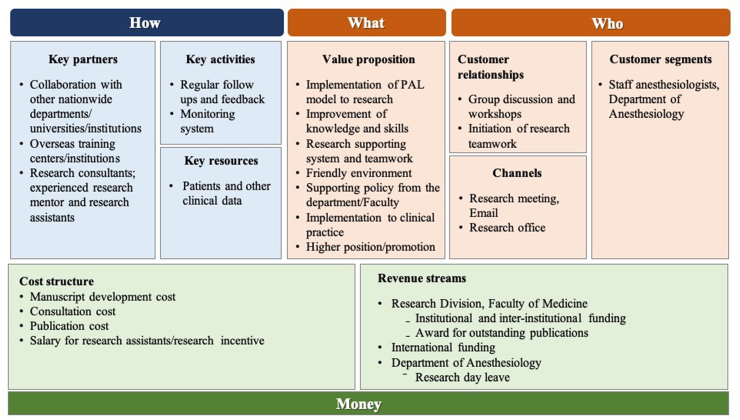
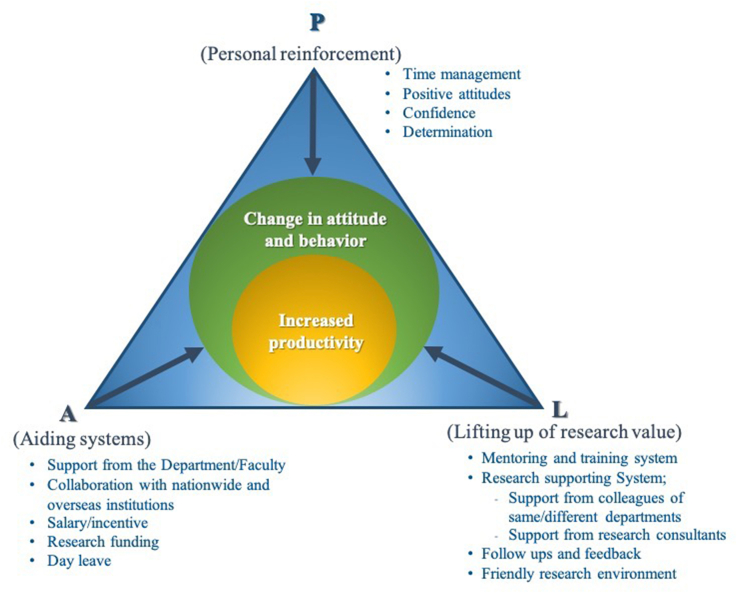
This study employed mixed methods with a participatory action research approach to explore factors currently undermining the conduction of research and to develop strategies to boost research productivity. A questionnaire was distributed to 64 staff members of the Department of Anesthesiology at a university-based hospital. Thirty-nine staff members (60.9%) gave informed consent and responses. Staff views were also collected through focus group discussions. The staff reported that limited research methodology skills, time management, and complex managerial processes were the limitations. Age, attitudes, and performance expectancy were significantly correlated with research productivity. A regression analysis demonstrated that age and performance expectancy significantly influenced research productivity. A Business Model Canvas (BMC) was implemented to gain insight into the goal of enhancing the conduct of research. Business Model Innovation (BMI) established a strategy to improve research productivity. The concept, comprising personal reinforcement (P), aiding systems (A), and a lifting-up of the value of research (L), the PAL concept, was considered key to enhancing the conduct of research, with the BMC providing details and integrating with the BMI. To upgrade the research performance, the involvement of management is imperative, and future action will involve the implementation of a BMI model to increase research productivity.
Keywords: Business model canvas (BMC); Business model innovation (BMI); Participatory action research (PAR); Theory of planned behavior (TPB).
© 2023 The Authors. Published by Elsevier Ltd.
Conflict of interest statement
The authors declare that they have no known competing financial interests or personal relationships that could have appeared to influence the work reported in this paper.
Figures
References
-
- Papasavas P., Filippa D., Reilly P., Chandawarkar R., Kirton O. Effect of a mandatory research requirement on categorical resident academic productivity in a university-based general surgery residency. J. Surg. Educ. 2013;70(6):715–719. - PubMed
-
- Pitout H. Barriers and strategies to increase research involvement of South African occupational therapists. J. South African J. Occupat. Therapy. 2014;44:17–21.
-
- Neale A.V., West P., French L. Surviving your resident research requirement. JAMA. 1998;280(20):1802.
-
- Shin A.Y., Almond C.S., Mannix R.C., Duncan C.N., Son M.B., McLauchlan H.M., et al. The Boston Marathon Study: a novel approach to research during residency. Pediatrics. 2006;117(5):1818–1822. - PubMed
-
- Shewan L.G., Glatz J.A., Bennett C.C., Coats A.J. Contemporary (post-Wills) survey of the views of Australian medical researchers: importance of funding, infrastructure and motivators for a research career. Med. J. Aust. 2005;183(11–12):606–611. - PubMed
LinkOut - more resources
Full Text Sources
