


Deep Learning With Chest Radiographs for Making Prognoses in Patients With COVID-19: Retrospective Cohort Study
- PMID: 36795468
- PMCID: PMC9937110
- DOI: 10.2196/42717
Deep Learning With Chest Radiographs for Making Prognoses in Patients With COVID-19: Retrospective Cohort Study
Erratum in
-
Correction: Deep Learning With Chest Radiographs for Making Prognoses in Patients With COVID-19: Retrospective Cohort Study.J Med Internet Res. 2023 Aug 23;25:e51951. doi: 10.2196/51951. J Med Internet Res. 2023. PMID: 37611252 Free PMC article.
Abstract
Background: An artificial intelligence (AI) model using chest radiography (CXR) may provide good performance in making prognoses for COVID-19.
Objective: We aimed to develop and validate a prediction model using CXR based on an AI model and clinical variables to predict clinical outcomes in patients with COVID-19.
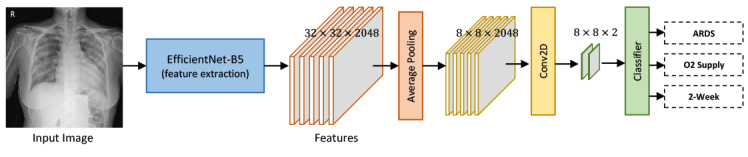
Methods: This retrospective longitudinal study included patients hospitalized for COVID-19 at multiple COVID-19 medical centers between February 2020 and October 2020. Patients at Boramae Medical Center were randomly classified into training, validation, and internal testing sets (at a ratio of 8:1:1, respectively). An AI model using initial CXR images as input, a logistic regression model using clinical information, and a combined model using the output of the AI model (as CXR score) and clinical information were developed and trained to predict hospital length of stay (LOS) ≤2 weeks, need for oxygen supplementation, and acute respiratory distress syndrome (ARDS). The models were externally validated in the Korean Imaging Cohort of COVID-19 data set for discrimination and calibration.
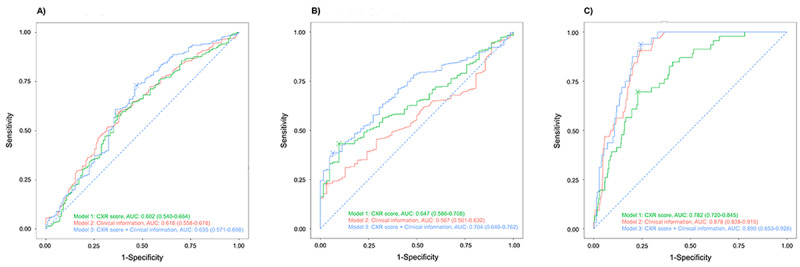
Results: The AI model using CXR and the logistic regression model using clinical variables were suboptimal to predict hospital LOS ≤2 weeks or the need for oxygen supplementation but performed acceptably in the prediction of ARDS (AI model area under the curve [AUC] 0.782, 95% CI 0.720-0.845; logistic regression model AUC 0.878, 95% CI 0.838-0.919). The combined model performed better in predicting the need for oxygen supplementation (AUC 0.704, 95% CI 0.646-0.762) and ARDS (AUC 0.890, 95% CI 0.853-0.928) compared to the CXR score alone. Both the AI and combined models showed good calibration for predicting ARDS (P=.079 and P=.859).
Conclusions: The combined prediction model, comprising the CXR score and clinical information, was externally validated as having acceptable performance in predicting severe illness and excellent performance in predicting ARDS in patients with COVID-19.
Keywords: AI model; COVID-19; artificial intelligence; clinical outcome; deep learning; machine learning; medical imaging; prediction model; prognosis; radiography, thoracic.
©Hyun Woo Lee, Hyun Jun Yang, Hyungjin Kim, Ue-Hwan Kim, Dong Hyun Kim, Soon Ho Yoon, Soo-Youn Ham, Bo Da Nam, Kum Ju Chae, Dabee Lee, Jin Young Yoo, So Hyeon Bak, Jin Young Kim, Jin Hwan Kim, Ki Beom Kim, Jung Im Jung, Jae-Kwang Lim, Jong Eun Lee, Myung Jin Chung, Young Kyung Lee, Young Seon Kim, Sang Min Lee, Woocheol Kwon, Chang Min Park, Yun-Hyeon Kim, Yeon Joo Jeong, Kwang Nam Jin, Jin Mo Goo. Originally published in the Journal of Medical Internet Research (https://www.jmir.org), 16.02.2023.
Conflict of interest statement
Conflicts of Interest: HK received consulting fees from Radisen; holds stock and stock options in MEDICALIP. Outside this study, SHY works as a chief medical officer in the MEDICAL IP.
Figures
References
-
- WHO coronavirus disease (COVID-19) dashboard. World Health Organization. [2023-01-30]. https://covid19.who.int .
-
- Chua F, Vancheeswaran R, Draper A, Vaghela T, Knight M, Mogal R, Singh J, Spencer LG, Thwaite E, Mitchell H, Calmonson S, Mahdi N, Assadullah S, Leung M, O'Neill A, Popat C, Kumar R, Humphries T, Talbutt R, Raghunath S, Molyneaux PL, Schechter M, Lowe J, Barlow A. Early prognostication of COVID-19 to guide hospitalisation versus outpatient monitoring using a point-of-test risk prediction score. Thorax. 2021 Jul;76(7):696–703. doi: 10.1136/thoraxjnl-2020-216425. https://europepmc.org/abstract/MED/33692174 thoraxjnl-2020-216425 - DOI - PubMed
-
- Wynants L, Van Calster B, Collins GS, Riley RD, Heinze G, Schuit E, Bonten MMJ, Dahly Darren L, Damen Johanna A A, Debray Thomas P A, de Jong Valentijn M T, De Vos Maarten, Dhiman Paul, Haller Maria C, Harhay Michael O, Henckaerts Liesbet, Heus Pauline, Kammer Michael, Kreuzberger Nina, Lohmann Anna, Luijken Kim, Ma Jie, Martin Glen P, McLernon David J, Andaur Navarro Constanza L, Reitsma Johannes B, Sergeant Jamie C, Shi Chunhu, Skoetz Nicole, Smits Luc J M, Snell Kym I E, Sperrin Matthew, Spijker René, Steyerberg Ewout W, Takada Toshihiko, Tzoulaki Ioanna, van Kuijk Sander M J, van Bussel Bas, van der Horst Iwan C C, van Royen Florien S, Verbakel Jan Y, Wallisch Christine, Wilkinson Jack, Wolff Robert, Hooft Lotty, Moons Karel G M, van Smeden Maarten. Prediction models for diagnosis and prognosis of covid-19: systematic review and critical appraisal. BMJ. 2020 Apr 07;369:m1328. doi: 10.1136/bmj.m1328. http://www.bmj.com/lookup/pmidlookup?view=long&pmid=32265220 - DOI - PMC - PubMed
-
- Recommendations for the use of Chest Radiography and Computed Tomography (CT) for Suspected COVID-19 Infection. American College of Radiology. [2023-01-30]. https://www.acr.org/Advocacy-and-Economics/ACR-Position-Statements/Recom... .
-
- Wang L, Zhang Y, Wang D, Tong X, Liu T, Zhang S, Huang J, Zhang L, Chen L, Fan H, Clarke M. Artificial intelligence for COVID-19: a systematic review. Front Med (Lausanne) 2021;8:704256. doi: 10.3389/fmed.2021.704256. https://europepmc.org/abstract/MED/34660623 - DOI - PMC - PubMed
Publication types
MeSH terms
Substances
LinkOut - more resources
Full Text Sources
Medical
