Peripheral Defocus and Myopia Management: A Mini-Review
- PMID: 36796348
- PMCID: PMC9935061
- DOI: 10.3341/kjo.2022.0125
Peripheral Defocus and Myopia Management: A Mini-Review
Abstract
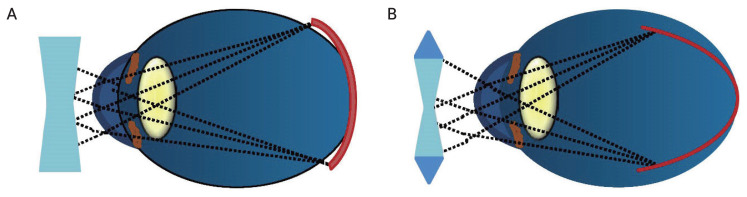
Myopia is the most common refractive error in the world, and its' prevalence continually increases. The potential pathological and visual complications of progressive myopia have inspired researchers to study the sources of myopia, axial elongation, and explore modalities to arrest progression. Considerable attention has been given over the past few years to the myopia risk factor known as hyperopic peripheral blur, the focus of this review. The primary theories currently believed to be the cause of myopia, the parameters considered to contribute and influence the effect of peripheral blur, such as the surface retinal area or depth of blur will be discussed. The currently available optical devices designed to provide peripheral myopic defocus will be discussed, including bifocal and progressive addition ophthalmic lenses, peripheral defocus single vision ophthalmic lenses, orthokeratology lenses, and bifocal or multifocal center distance soft lenses, as well as their effectivity as mentioned in the literature to date.
Keywords: Hyperopic peripheral blur; Myopia; Peripheral defocus.
Conflict of interest statement
Figures

References
-
- Matsumura S, Ching-Yu C, Saw SM. Global epidemiology of myopia. In: Ang M, Wong TY, editors. Updates on myopia. Springer; 2020. pp. 27–51.
-
- Ohno-Matsui K, Jonas JB. Posterior staphyloma in pathologic myopia. Prog Retin Eye Res. 2019;70:99–109. - PubMed
-
- Naidoo KS, Fricke TR, Frick KD, et al. Potential lost productivity resulting from the global burden of myopia: systematic review, meta-analysis, and modeling. Ophthalmology. 2019;126:338–46. - PubMed
Publication types
MeSH terms
LinkOut - more resources
Full Text Sources
Miscellaneous