. 2023 Apr;153(4):1122-1132.
doi: 10.1016/j.tjnut.2023.01.039. Epub 2023 Feb 14.

Maternal Diet Quality During Pregnancy and Offspring Hepatic Fat in Early Childhood: The Healthy Start Study

Affiliations

Maternal Diet Quality During Pregnancy and Offspring Hepatic Fat in Early Childhood: The Healthy Start Study

Catherine C Cohen et al. J Nutr. 2023 Apr.

Abstract

Background: Overnutrition in utero may increase offspring risk of nonalcoholic fatty liver disease (NAFLD), but the specific contribution of maternal diet quality during pregnancy to this association remains understudied in humans.

Objectives: This study aimed to examine the associations of maternal diet quality during pregnancy with offspring hepatic fat in early childhood (median: 5 y old, range: 4-8 y old).

Methods: Data were from 278 mother-child pairs in the longitudinal, Colorado-based Healthy Start Study. Multiple 24-h recalls were collected from mothers during pregnancy on a monthly basis (median: 3 recalls, range: 1-8 recalls starting after enrollment), and used to estimate maternal usual nutrient intakes and dietary pattern scores [Healthy Eating Index-2010 (HEI-2010), Dietary Inflammatory Index (DII), and Relative Mediterranean Diet Score (rMED)]. Offspring hepatic fat was measured in early childhood by MRI. Associations of maternal dietary predictors during pregnancy with offspring log-transformed hepatic fat were assessed using linear regression models adjusted for offspring demographics, maternal/perinatal confounders, and maternal total energy intake.

Results: Higher maternal fiber intake and rMED scores during pregnancy were associated with lower offspring hepatic fat in early childhood in fully adjusted models [Back-transformed β (95% CI): 0.82 (0.72, 0.94) per 5 g/1000 kcal fiber; 0.93 (0.88, 0.99) per 1 SD for rMED]. In contrast, higher maternal total sugar and added sugar intakes, and DII scores were associated with higher offspring hepatic fat [Back-transformed β (95% CI): 1.18 (1.05, 1.32) per 5% kcal/d added sugar; 1.08 (0.99, 1.18) per 1 SD for DII]. Analyses of dietary pattern subcomponents also revealed that lower maternal intakes of green vegetables and legumes and higher intake of "empty calories" were associated with higher offspring hepatic fat in early childhood.

Conclusions: Poorer maternal diet quality during pregnancy was associated with greater offspring susceptibility to hepatic fat in early childhood. Our findings provide insights into potential perinatal targets for the primordial prevention of pediatric NAFLD.

Keywords: developmental origins; diet quality; fatty liver; maternal–child health; pediatrics.


Figures

FIGURE 1
FIGURE 1
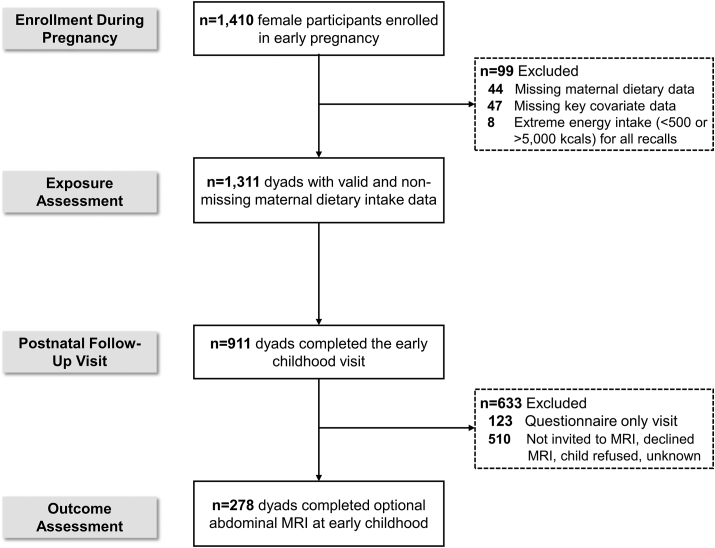
Flowchart summarizing the selection of participants.
FIGURE 2
FIGURE 2
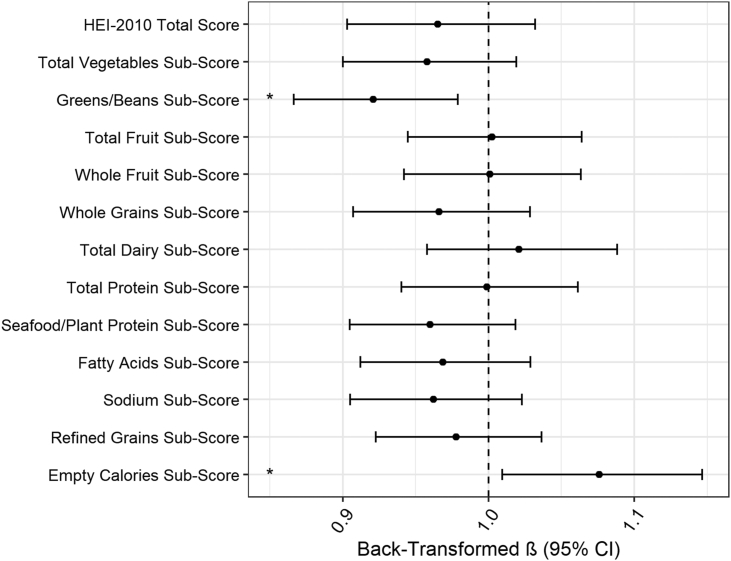
Associations of HEI-2010 subcomponents with offspring hepatic fat in early childhood (n = 278). Points and error bars are back-transformed regression estimates and 95% CIs, respectively, and represent the ratio of geometric means for the dependent variable (that is, the percent change in offspring hepatic fat) per 1 SD increase in each dietary pattern subcomponent. Asterisk (∗) indicates associations with P <0.05. All estimates are from linear regression models adjusted for offspring sex, race, ethnicity, age in early childhood, maternal age at enrollment, maternal education, parity, prepregnancy BMI, smoking during pregnancy, physical activity during pregnancy, and maternal energy intake (kcal/d) during pregnancy. HEI-2010, Healthy Eating Index-2010.
FIGURE 3
FIGURE 3
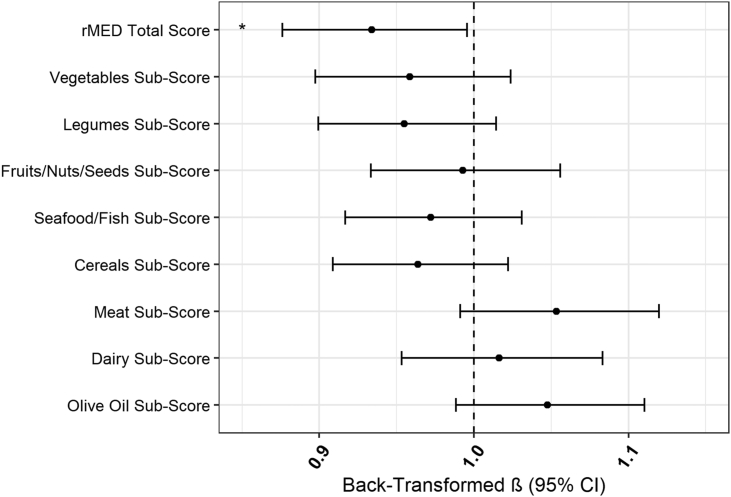
Associations of rMED subcomponents with offspring hepatic fat in early childhood (n = 278). Points and error bars are back-transformed regression estimates and 95% CIs, respectively, and represent the ratio of geometric means for the dependent variable (that is, the percent change in offspring hepatic fat) per 1 SD increase in each dietary pattern subcomponent. Asterisk (∗) indicates associations with P <0.05. All estimates are from linear regression models adjusted for offspring sex, race, ethnicity, age in early childhood, maternal age at enrollment, maternal education, parity, prepregnancy BMI, smoking during pregnancy, physical activity during pregnancy, and maternal energy intake (kcal/d) during pregnancy. rMED, Relative Mediterranean Diet Score.

References

    1. Sahota A.K., Shapiro W.L., Newton K.P., Kim S.T., Chung J., Schwimmer J.B. The incidence of nonalcoholic fatty liver disease in children: 2009–2018. Pediatrics. 2020;146(6) doi: 10.1542/peds.2020-0771. - DOI - PMC - PubMed
    1. Anderson E.L., Howe L.D., Jones H.E., Higgins J.P., Lawlor D.A., Fraser A. The prevalence of non-alcoholic fatty liver disease in children and adolescents: a systematic review and meta-analysis. PLOS ONE. 2015;10(10) doi: 10.1371/journal.pone.0140908. - DOI - PMC - PubMed
    1. Tricò D., Caprio S., Rosaria Umano G., Pierpont B., Nouws J., Galderisi A., et al. Metabolic features of non-alcoholic fatty liver (NAFL) in obese adolescents: findings from a multiethnic cohort. Hepatology. 2018;68(4):1376–1390. doi: 10.1002/hep.30035. - DOI - PMC - PubMed
    1. Feldstein A.E., Charatcharoenwitthaya P., Treeprasertuk S., Benson J.T., Enders F.B., Angulo P. The natural history of nonalcoholic fatty liver disease in children: follow-up study for up to 20-years. Gut. 2009;58(11):1538–1544. doi: 10.1136/gut.2008.171280. - DOI - PMC - PubMed
    1. Cioffi C.E., Welsh J.A., Cleeton R.L., Caltharp S.A., Romero R., Wulkan M.L., et al. Natural history of NAFLD diagnosed in childhood: a single-center study. Children (Basel). 2017;4(5) doi: 10.3390/children4050034. - DOI - PMC - PubMed

Publication types