


Motor Symptom Asymmetry Predicts Cognitive and Neuropsychiatric Profile Following Deep Brain Stimulation of the Subthalamic Nucleus in Parkinson's Disease: a 5-Year Longitudinal Study
- PMID: 36796803
- PMCID: PMC10456213
- DOI: 10.1093/arclin/acad013
Motor Symptom Asymmetry Predicts Cognitive and Neuropsychiatric Profile Following Deep Brain Stimulation of the Subthalamic Nucleus in Parkinson's Disease: a 5-Year Longitudinal Study
Abstract
Introduction: Risk factors (e.g., motor symptom asymmetry) for short- and long-term cognitive and neuropsychiatric symptoms following deep brain stimulation (DBS) of the subthalamic nucleus (STN) in patients with Parkinson's disease have yet to be fully identified. The objectives of the present study were to determine whether motor symptom asymmetry in Parkinson's disease is one such risk factor and to identify predictors of subnormal cognitive decline.
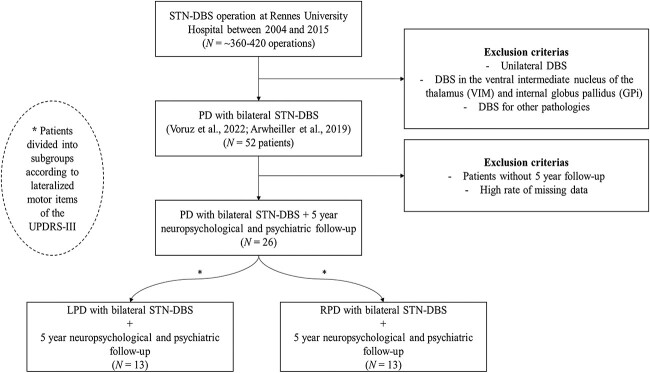
Methods: A total of 26 patients receiving STN-DBS (13 with left-sided motor symptoms and 13 with right-sided ones) underwent follow-up neuropsychological, depression and apathy assessments over a 5-year period. Nonparametric intergroup comparisons were performed on raw scores, as well as Cox regression analyses on standardized Mattis Dementia Rating Scale scores.
Results: Compared with patients who had predominantly left-sided symptoms, right-sided patients scored higher on both apathy (at 3 months and 36 months) and depressive symptoms (at 6 months and 12 months) and scored lower on global cognitive efficiency (at 36 months and 60 months). Survival analyses revealed that only right-sided patients had subnormal standardized dementia scores, which were negatively associated with the number of perseverations in the Wisconsin Card Scoring Test.
Conclusion: Right-sided motor symptoms are a risk factor for more severe short- and long-term cognitive and neuropsychiatric symptoms following STN-DBS, confirming literature findings on left hemispheric vulnerability.
Keywords: Cognition; Cognitive vulnerability; Left hemisphere; Motor symptom asymmetry; STN-DBS.
© The Author(s) 2023. Published by Oxford University Press. All rights reserved. For permissions, please e-mail: journals.permission@oup.com.
Figures


References
-
- Ahrweiller,K., Houvenaghel, J., Riou, A., Drapier, S., Sauleau, P., Haegelen, C., et al. (2019). Postural instability and gait disorders after subthalamic nucleus deep brain stimulation in Parkinson’s disease: A PET study. Journal of Neurology, 266(11), 2764–2771. 10.1007/s00415-019-09482-y. - DOI - PubMed
-
- Aviles-Olmos, I., Kefalopoulou, Z., Tripoliti, E., Candelario, J., Akram, H., Martinez-Torres, I., et al. (2014). Long-term outcome of subthalamic nucleus deep brain stimulation for Parkinson's disease using an MRI-guided and MRI-verified approach. Journal of Neurology, Neurosurgery & Psychiatry, 85(12), 1419–1425. 10.1136/jnnp-2013-306907. - DOI - PMC - PubMed
-
- Cardebat, D., Doyon, B., Puel, M., Goulet, P., & Joanette, Y. (1990). Formal and semantic lexical evocation in normal subjects. Performance and dynamics of production as a function of sex, age and educational level. Acta Neurologica Belgica, 90(4), 207–217. - PubMed
-
- Daniel, S., & Lees, A. (1993). Parkinson's Disease Society Brain Bank, London: Overview and research. Journal of Neural Transmission. Supplementum, 39, 165–172. - PubMed
MeSH terms
Grants and funding
LinkOut - more resources
Full Text Sources
Medical
