. 2023 Feb 16;13(1):2094.
doi: 10.1038/s41598-023-28959-5.

Spontaneous action matching in dog puppies, kittens and wolf pups

Affiliations

Spontaneous action matching in dog puppies, kittens and wolf pups

Claudia Fugazza et al. Sci Rep. .

Abstract

We investigated the spontaneous tendency of dog puppies, kittens and wolf pups to match their behaviour to actions demonstrated by a human, in the absence of food reward. Based on dogs' inherent sociality and domestication history, we predicted that the tendency to match human actions is more pronounced in this species than in the other two. To test this, we exposed N = 42 dog puppies, N = 39 kittens and N = 8 wolf pups to ostensive human demonstrations of an object-related action. We found that dog puppies paid more attention to the demonstration than kittens and wolf pups. Dog puppies and wolf pups matched the demonstrated actions in more trials than kittens. Dog puppies also tended to reproduce the human demonstration that differed from the action they typically preformed in the absence of demonstration. These results support that dog puppies show a tendency to attend to humans and conform their behaviour to human demonstrations in the absence of extrinsic food rewards. This spontaneous tendency is also relevant for practical applications, by providing the basis to devise puppy-training methods that rely less on food rewards, and instead exploit puppies' natural predisposition for social learning.


Conflict of interest statement

The authors declare no competing interests.

Figures
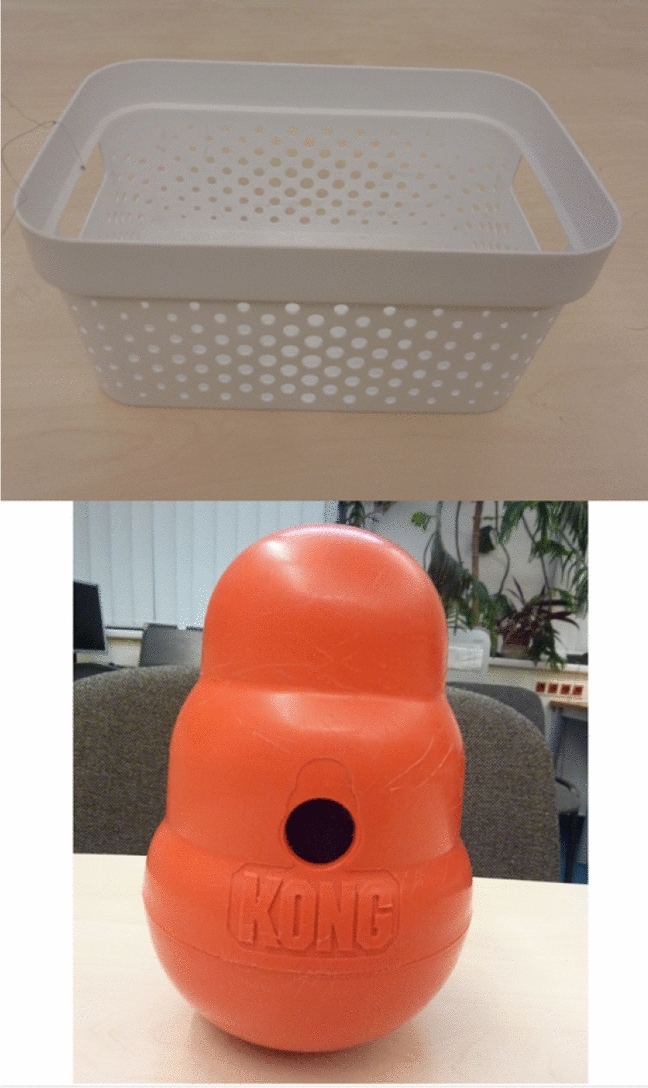
Figure 1
Figure 1
Objects used for testing (Box at the top, Wobbler Kong at the bottom).
Figure 2
Figure 2
Experimental setup. In the free exploration trial and in the experimental trials, the demonstrator is within reaching distance from the object. The owner gently holds the subject at its chest, in front of him/her. In the trials with demonstration, the demonstrator makes eye contact and uses ostensive communication before and during the demonstration.
Figure 3
Figure 3
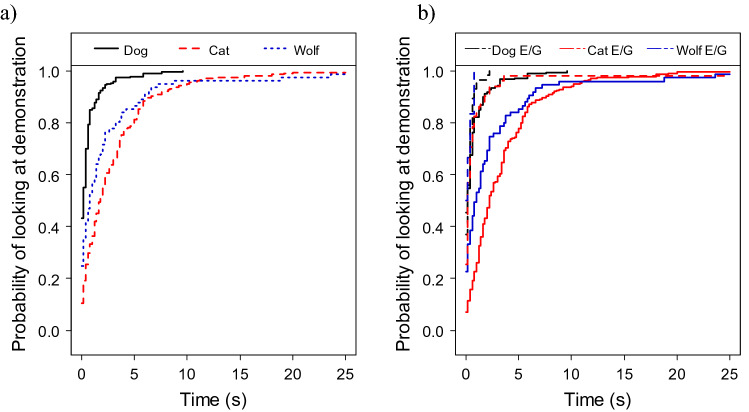
(a) Species differences: dog puppies were more likely to look at the demonstration than wolves and kittens and (b) species-specific effects of condition (experimental condition, E, illustrated with solid, and ghost condition, G, with dotted line) on the probability of looking at the demonstration: dog puppies looked at the demonstration in both, experimental and ghost trials; kittens and wolves looked more at the demonstration in the ghost trials than in the experimental trials, with this difference being more pronounced in kittens.
Figure 4
Figure 4
(a) Species differences: dog puppies and wolf pups interacted more likely with the object than kittens; (b) species-specific effects of condition (experimental condition, E, illustrated with solid, and ghost condition, G, with dotted line) on the probability of interacting with the object in dog puppies, kittens and wolf pups: kittens and, to a lesser extent, also wolf pups (but not dog puppies) interacted with the object more likely in the ghost trials than in the experimental trials.
Figure 5
Figure 5
Probability of action matching in dog puppies, kittens and wolf pups. Dog puppies and wolf pups matched their actions to the demonstrated one more often than kittens (GLMM of action matching, effect of species: χ22 = 11.931; P = 0.003; dog puppies → kittens: exp(β) = 0.046 [0.005; 0.431], z = − 2.70, P = 0.007; dog puppies → wolf pups: exp(β) = 1.249 [0.081; 19.324], z = 0.16, P = 0.874).
Figure 6
Figure 6
Probability of using paw in dog puppies, kittens and wolf pups, based on the body action of the demonstration (‘BAD’: nose or hand) by the human. Dog puppies used their paw to interact with the object more likely in those trials in which the human demonstration was shown by hand, compared to those in which it was shown by nose.

References

    1. Galef B, Laland K. Social learning in animals: Empirical studies and theoretical models. Bioscience. 2005;55:489. doi: 10.1641/0006-3568(2005)055[0489:SLIAES]2.0.CO;2. - DOI
    1. Thornton A, Clutton-Brock T. Social learning and the development of individual and group behaviour in mammal societies. Philos. Trans. R. Soc. B Biol. Sci. 2011;366:978–987. doi: 10.1098/rstb.2010.0312. - DOI - PMC - PubMed
    1. Terkel J. Cultural transmission of feeding behavior in the black rat (Rattus rattus) In: Heyes CM, Galef JBG, editors. Social Learning in Animals: The Roots of Culture. Academic Press; 1996. pp. 17–47.
    1. Kavanagh LC, Winkielman P. The functionality of spontaneous mimicry and its influences on affiliation: An implicit socialization account. Front. Psychol. 2016;7:458. doi: 10.3389/fpsyg.2016.00458. - DOI - PMC - PubMed
    1. Persson T, Sauciuc GA, Madsen EA. Spontaneous cross-species imitation in interactions between chimpanzees and zoo visitors. Primates. 2018;59:19–29. doi: 10.1007/s10329-017-0624-9. - DOI - PMC - PubMed

Publication types