


How Extracellular Reactive Oxygen Species Reach Their Intracellular Targets in Plants
- PMID: 36799103
- PMCID: PMC10258463
- DOI: 10.14348/molcells.2023.2158
How Extracellular Reactive Oxygen Species Reach Their Intracellular Targets in Plants
Abstract
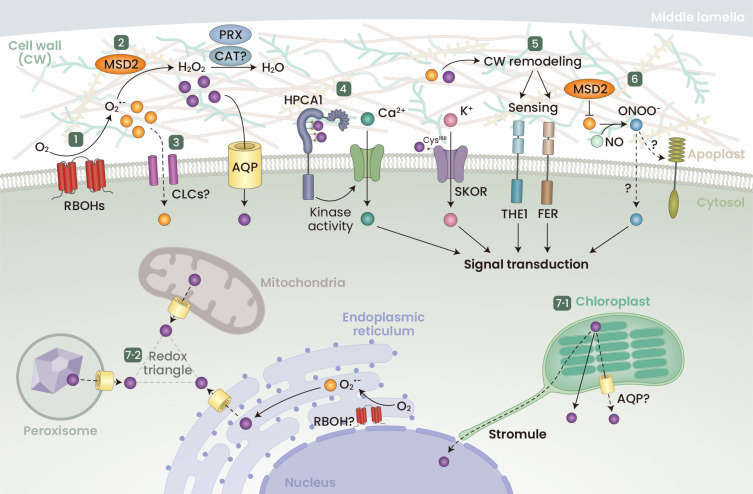
Reactive oxygen species (ROS) serve as secondary messengers that regulate various developmental and signal transduction processes, with ROS primarily generated by NADPH OXIDASEs (referred to as RESPIRATORY BURST OXIDASE HOMOLOGs [RBOHs] in plants). However, the types and locations of ROS produced by RBOHs are different from those expected to mediate intracellular signaling. RBOHs produce O2•- rather than H2O2 which is relatively long-lived and able to diffuse through membranes, and this production occurs outside the cell instead of in the cytoplasm, where signaling cascades occur. A widely accepted model explaining this discrepancy proposes that RBOH-produced extracellular O2•- is converted to H2O2 by superoxide dismutase and then imported by aquaporins to reach its cytoplasmic targets. However, this model does not explain how the specificity of ROS targeting is ensured while minimizing unnecessary damage during the bulk translocation of extracellular ROS (eROS). An increasing number of studies have provided clues about eROS action mechanisms, revealing various mechanisms for eROS perception in the apoplast, crosstalk between eROS and reactive nitrogen species, and the contribution of intracellular organelles to cytoplasmic ROS bursts. In this review, we summarize these recent advances, highlight the mechanisms underlying eROS action, and provide an overview of the routes by which eROS-induced changes reach the intracellular space.
Keywords: NADPH oxidase; peroxidase; reactive oxygen species; receptor-like kinase; superoxide dismutase.
Conflict of interest statement
The authors have no potential conflicts of interest to disclose.
Figures
References
-
- Bacete L., Schulz J., Engelsdorf T., Bartosova Z., Vaahtera L., Yan G., Gerhold J.M., Tichá T., Øvstebø C., Gigli-Bisceglia N., et al. THESEUS1 modulates cell wall stiffness and abscisic acid production in Arabidopsis thaliana. Proc. Natl. Acad. Sci. U. S. A. 2022;119:e2119258119. doi: 10.1073/pnas.2119258119. - DOI - PMC - PubMed
Publication types
MeSH terms
Substances
LinkOut - more resources
Full Text Sources
