


NIH HEAL Clinical Data Elements (CDE) implementation: NIH HEAL Initiative IMPOWR network IDEA-CC
- PMID: 36799548
- PMCID: PMC10321760
- DOI: 10.1093/pm/pnad018
NIH HEAL Clinical Data Elements (CDE) implementation: NIH HEAL Initiative IMPOWR network IDEA-CC
Erratum in
-
Erratum to: NIH HEAL Common Data Elements (CDE) implementation: NIH HEAL Initiative IDEA-CC.Pain Med. 2024 May 2;25(5):365. doi: 10.1093/pm/pnae015. Pain Med. 2024. PMID: 38518205 Free PMC article. No abstract available.
Abstract
Objective: The National Institutes of Health (NIH) HEAL Initiative is making data findable, accessible, interoperable, and reusable (FAIR) to maximize the value of the unprecedented federal investment in pain and opioid-use disorder research. This involves standardizing the use of common data elements (CDE) for clinical research.
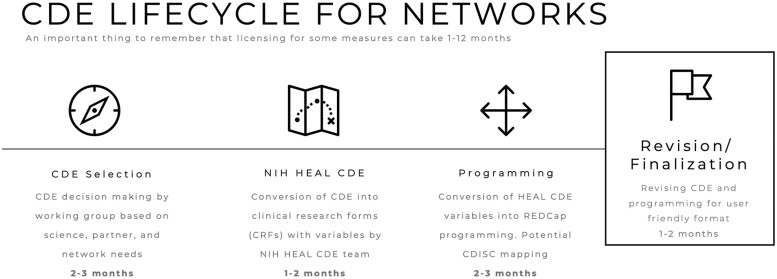
Methods: This work describes the process of the selection, processing, harmonization, and design constraints of CDE across a pain and opioid use disorder clinical trials network (NIH HEAL IMPOWR).
Results: The network alignment allowed for incorporation of newer data standards across the clinical trials. Specific advances included geographic coding (RUCA), deidentified patient identifiers (GUID), shareable clinical survey libraries (REDCap), and concept mapping to standardized concepts (UMLS).
Conclusions: While complex, harmonization across a network of chronic pain and opioid use disorder clinical trials with separate interventions can be optimized through use of CDEs and data standardization processes. This standardization process will support the robust secondary data analyses. Scaling this process could standardize CDE results across interventions or disease state which could help inform insurance companies or government organizations about coverage determinations. The development of the HEAL CDE program supports connecting isolated studies and solutions to each other, but the practical aspects may be challenging for some studies to implement. Leveraging tools and technology to simplify process and create ready to use resources may support wider adoption of consistent data standards.
© The Author(s) 2023. Published by Oxford University Press on behalf of the American Academy of Pain Medicine. All rights reserved. For permissions, please e-mail: journals.permissions@oup.com.
Figures



References
-
- NIH HEAL Initiative. Accessed January 28, 2023. https://heal.nih.gov/about.
-
- HEAL Data FAIR Principles. Accessed January 28, 2023. https://www.healdatafair.org/.
-
- Wandner LD, Domenichiello AF, Beierlein J, et al. NIH's helping to end addiction long-term(SM) initiative (NIH HEAL Initiative) clinical pain management common data element program. J Pain. 2022;23(3):370–378. - PubMed
-
- HEAL Data Ecosystem. Accessed January 28, 2023. https://heal.nih.gov/data/heal-data-ecosystem.
-
- HEAL Common Data Elements. Accessed January 28, 2023. https://heal.nih.gov/data/common-data-elements.
Publication types
MeSH terms
Grants and funding
LinkOut - more resources
Full Text Sources
Medical
