. 2023 May 10;46(5):zsad033.
doi: 10.1093/sleep/zsad033.

The dim light melatonin onset across ages, methodologies, and sex and its relationship with morningness/eveningness

Affiliations

The dim light melatonin onset across ages, methodologies, and sex and its relationship with morningness/eveningness

David J Kennaway. Sleep. .

Abstract

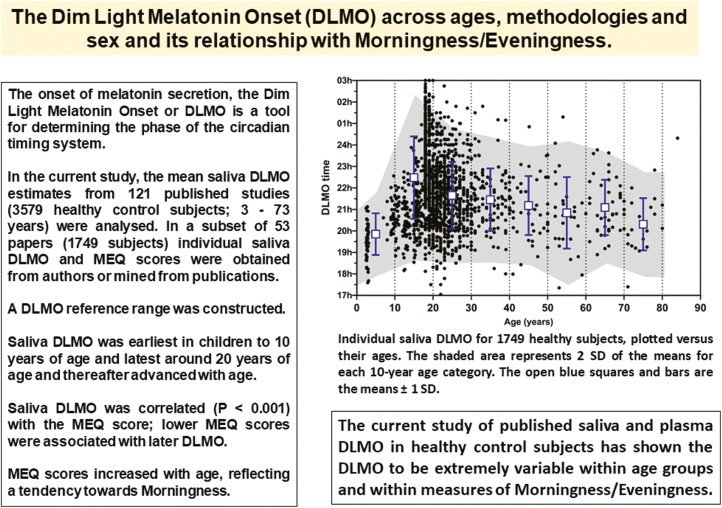
The onset of melatonin secretion, the dim light melatonin onset (DLMO), is a tool for determining the phase of the circadian timing system. Although small studies have investigated the impacts of age and methods of calculating DLMO, there is no DLMO reference range. In the current study, the saliva DLMO from 3579 participants from 121 published studies and plasma DLMO from 818 healthy controls from 31 studies (aged 3-73 years) were analyzed. In a subset of 53 papers (1749 participants), individual saliva DLMO and Morningness Eveningness Questionaire (MEQ) scores were obtained from authors or mined from publications and a reference range was constructed. Saliva DLMO was earliest in children to 10 years of age and latest around 20 years of age and thereafter advanced with age by 30 min in the oldest participants. Melatonin assay methods and DLMO calculation methods had little effect on the determination of the DLMO. Saliva DLMO was correlated (p < 0.001) with the MEQ score; lower MEQ scores were associated with later DLMO. MEQ scores increased with age, reflecting a tendency toward morningness. An evaluation of 14 saliva DLMO studies of clinically diagnosed patients living with delayed sleep-wake phase disorder (mean ages 20 to 31 years) revealed mean saliva DLMO within the reference range albeit at the late extreme. Peak plasma melatonin levels from 179 studies of healthy participants revealed a high degree of variability within studies and age groups, but only a small decline between the 20 and 50 years and lowest levels after 70 years.

Keywords: Circadian; DSWPD; chronotype; melatonin onset; phase; sleep disorders.


Figures

None
Graphical abstract
Figure 1.
Figure 1.
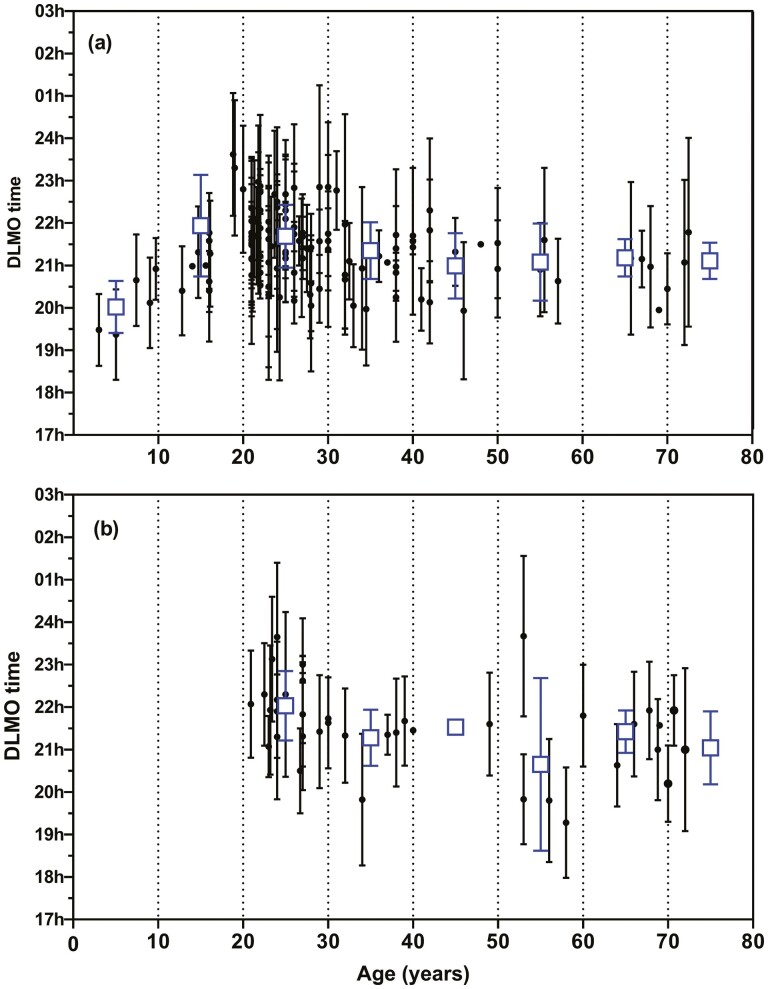
The saliva DLMO (A) and plasma DLMO (B) (mean ± SD) of groups of healthy participants from 121 published studies. The open squares are the n-weighted means ± SD of the 10-year age groups. Note that in some cases, no SD was available.
Figure 2.
Figure 2.
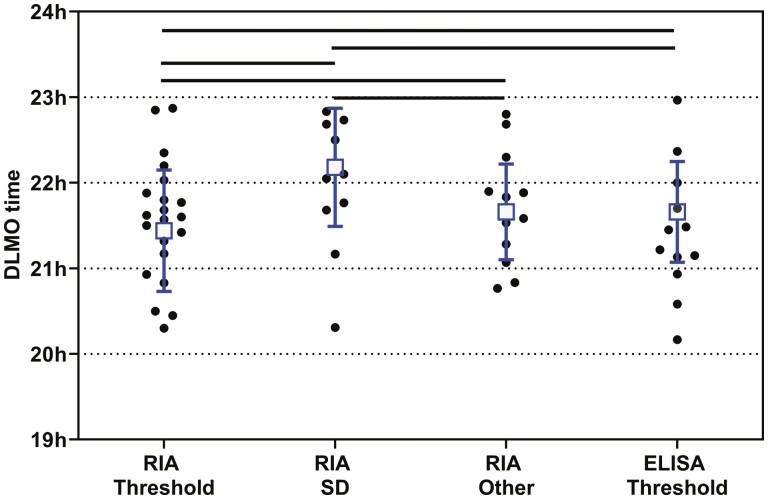
The published saliva DLMO means from healthy participants with mean ages between 20 and 29 years (the SD of the individual points were omitted for clarity). The squares and bars represent the n-weighted means ± SD for the following groups: (1) Melatonin assayed by RIA and DLMO determined as the time the melatonin concentration exceeded a threshold value, (2) melatonin assayed by RIA and the DLMO determined as the time it exceeded two standard deviations of the baseline, (3) melatonin assayed by RIA and the DLMO determined by other methods, and (4) melatonin assayed by ELISA and DLMO determined as the time the melatonin concentration exceeded a threshold value. The horizontal lines represent significant differences (p < 0.001) between the underlying groups. The data are from 21, 10, 12, and 12 studies, respectively.
Figure 3.
Figure 3.
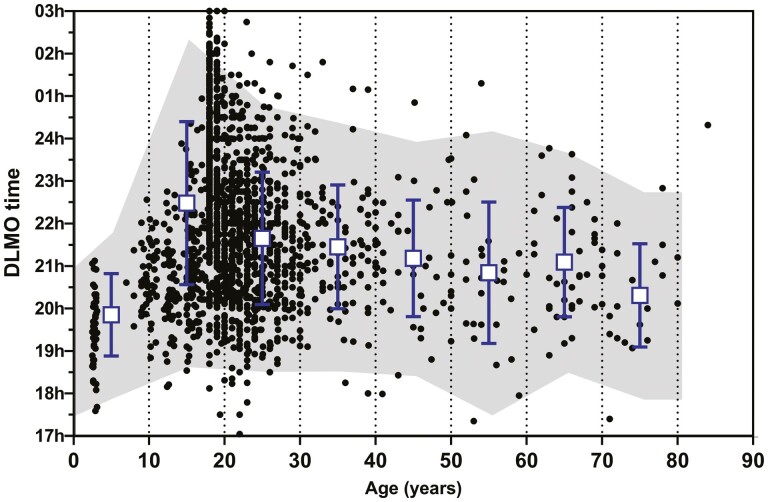
Individual saliva DLMO for 1721 healthy participants, plotted versus their ages. The shaded area represents two SD of the n-weighted means for each 10-year age category. The squares and bars are the means ± SD.
Figure 4.
Figure 4.
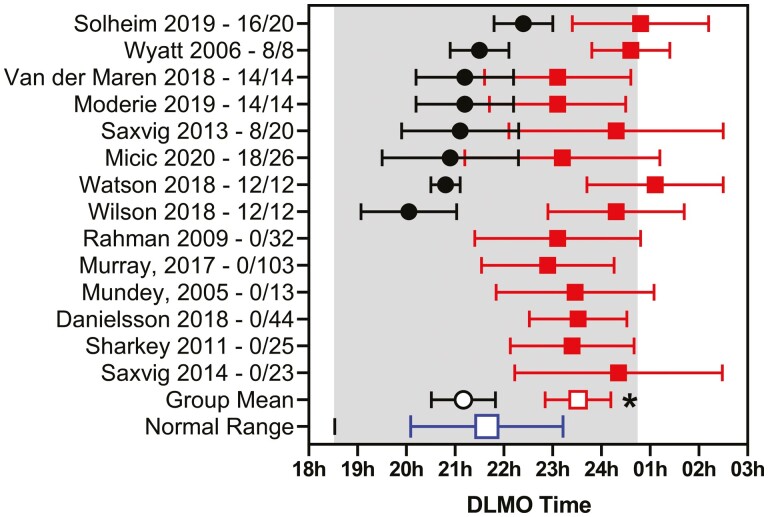
The published saliva DLMO (mean ± SD) for healthy control participants (filled circles) and patients diagnosed with DSWPD (filled squares) aged between 20 and 31 years. The author and publication years are shown, together with the number of participants studied. Group n-weighted means ± SD for the healthy controls (open circle) and DSWPD (small square) are shown. Also shown is the n-weighted mean ± SD (large square) for this age group. The shaded area represents two SD of the means of the individual data.
Figure 5.
Figure 5.
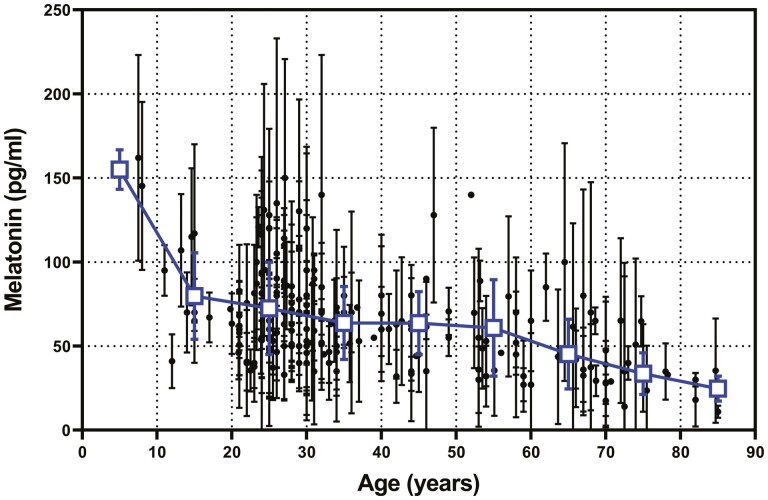
The published peak (24 h–03 h) plasma melatonin levels (mean ± SD) in healthy participants from 179 studies versus age. The n-weighted means ± SD are also shown (squares).
Figure 6.
Figure 6.
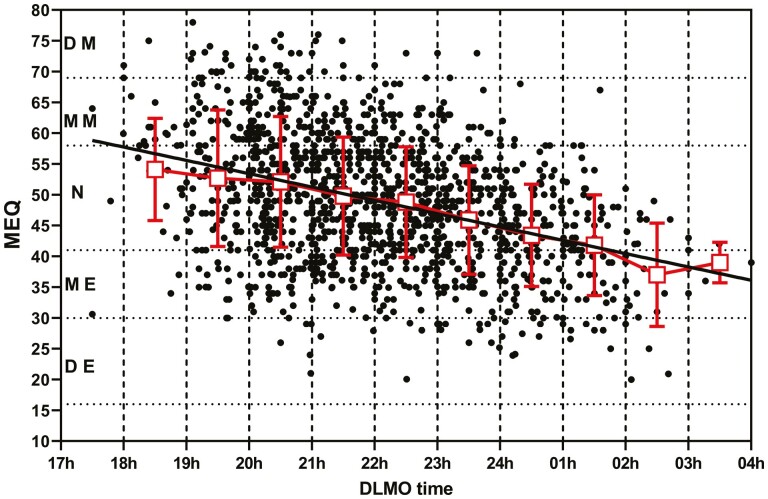
Individual MEQ scores were plotted versus the saliva DLMO for healthy participants not corrected for age. The MEQ (mean ± SD) for each 1-hour DLMO block is plotted (squares) together with the result of the simple linear regression line of the full data set. DE, definite evening; ME, moderate evening; N, neither morning nor evening; MM, moderate morning; DM, definite morning.
Figure 7.
Figure 7.
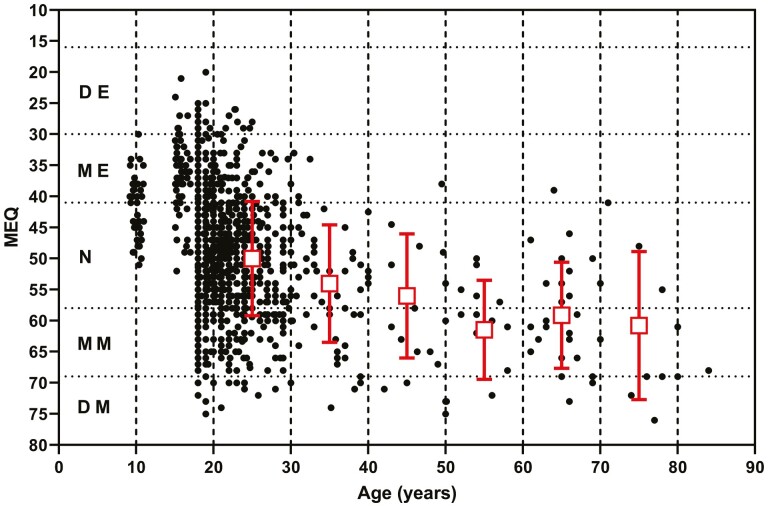
Individual MEQ scores were plotted against age for healthy participants. The MEQ (mean ± SD) for each 10-year age group between 20 and 80 years is also plotted (squares). DE, definite evening; ME, moderate evening; N, neither morning nor evening; MM, moderate morning; DM, definite morning.
Figure 8.
Figure 8.
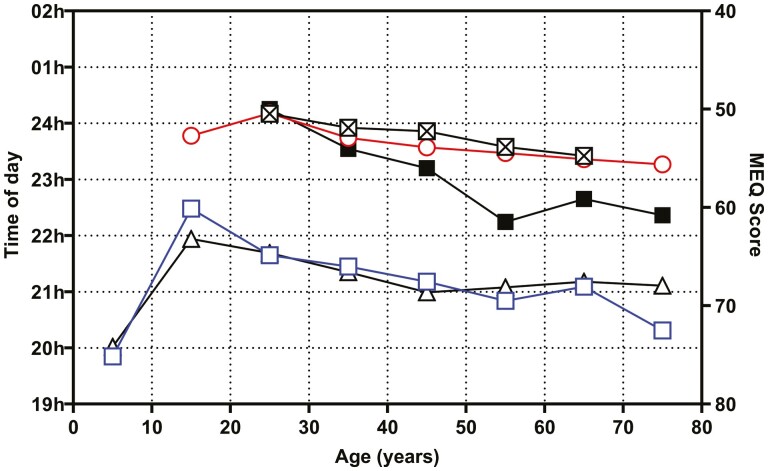
Summary of the saliva DLMO and MEQ scores from the current study and mean bedtimes and mean sleep onset from the literature. The n-weighted mean saliva DLMO from published studies (triangles). Mean saliva DLMO from the individual values in the current study (open squares). The mean MEQ scores from the individual values in the current study (filled squares). The mean bedtimes were redrawn from the paper by [88]. The mean sleep onset was redrawn from the paper by [87].

References

    1. Wurtman RJ, et al. Melatonin synthesis in the pineal gland: effect of light mediated by the sympathetic nervous system. Science. 1964;143:1328–1329. doi: 10.1126/science.143.3612.1328 - DOI - PubMed
    1. Pang SF, et al. Pineal and serum melatonin at midday and midnight following pinealectomy or castration in male rats. J Exp Zool. 1975;193:275–280. - PubMed
    1. Arendt J, et al. 24-hour profiles of melatonin, cortisol, insulin, C-peptide and GIP following a meal and subsequent fasting. Clin Endocrinol. 1982;16:89–95. - PubMed

    1. Duffy JF, et al. Sex difference in the near-24-hour intrinsic period of the human circadian timing system. Proc Natl Acad Sci U S A. 2011;108(suppl 3):15602–15608. doi: 10.1073/pnas.1010666108 - DOI - PMC - PubMed
    1. Dijk DJ, et al. Novel approaches for assessing circadian rhythmicity in humans: a review. J Biol Rhythms. 2020;35:421–438. doi: 10.1177/0748730420940483 - DOI - PMC - PubMed

Publication types