. 2023 Mar:89:104473.
doi: 10.1016/j.ebiom.2023.104473. Epub 2023 Feb 16.

Brexanolone therapeutics in post-partum depression involves inhibition of systemic inflammatory pathways

Affiliations

Brexanolone therapeutics in post-partum depression involves inhibition of systemic inflammatory pathways

Irina Balan et al. EBioMedicine. 2023 Mar.

Abstract

Background: Brexanolone has rapid, long-lasting, and remarkable efficacy in the treatment of post-partum depression (PPD). We test the hypothesis that brexanolone inhibits proinflammatory modulators and macrophage activation in PPD patients, which may promote clinical recovery.

Methods: PPD patients (N = 18) provided blood samples before and after brexanolone infusion according to the FDA-approved protocol. Patients were unresponsive to prior treatment before brexanolone therapy. Serum was collected to determine neurosteroid levels and whole blood cell lysates were examined for inflammatory markers and in vitro responses to the inflammatory activators lipopolysaccharide (LPS) and imiquimod (IMQ).

Findings: Brexanolone infusion altered multiple neuroactive steroid levels (N = 15-18), reduced levels of inflammatory mediators (N = 11) and inhibited their response to inflammatory immune activators (N = 9-11). Specifically, brexanolone infusion reduced whole blood cell tumor necrosis factor-α (TNF-α, p = 0.003), and interleukin-6 (IL-6, p = 0.04) and these effects were correlated with HAM-D score improvement (TNF-α, p = 0.049; IL-6, p = 0.02). Furthermore, brexanolone infusion prevented LPS and IMQ-induced elevation of TNF-α (LPS: p = 0.02; IMQ: p = 0.01), IL-1β (LPS: p = 0.006; IMQ: p = 0.02) and IL-6 (LPS: p = 0.009; IMQ: p = 0.01), indicating inhibition of toll-like receptor (TLR)4 and TLR7 responses. Finally, inhibition of TNF-α, IL-1β and IL-6 responses to both LPS and IMQ were correlated with HAM-D score improvements (p < 0.05).

Interpretation: Brexanolone actions involve inhibition of inflammatory mediator production and inhibition of inflammatory responses to TLR4 and TLR7 activators. The data suggest that inflammation plays a role in post-partum depression and that inhibition of inflammatory pathways contributes to the therapeutic efficacy of brexanolone.

Funding: The Foundation of Hope, Raleigh, NC and UNC School of Medicine, Chapel Hill.

Keywords: Cytokines; Hamilton rating scale for depression (HAM-D); Toll-like receptors; [3α,5α]-3-hydroxy-pregnan-20-one (3α,5α-THP).


Conflict of interest statement

Declaration of interests ALM and IB declare a U.S. provisional patent on the anti-inflammatory effects of allopregnanolone and related steroids. ALM and SMB have previously received research funding from Sage Therapeutics for other projects. SMB has received consulting fees from Ancora Bio, Modern Health and Web MD. The authors declare no other potential conflicts of interest.

Figures
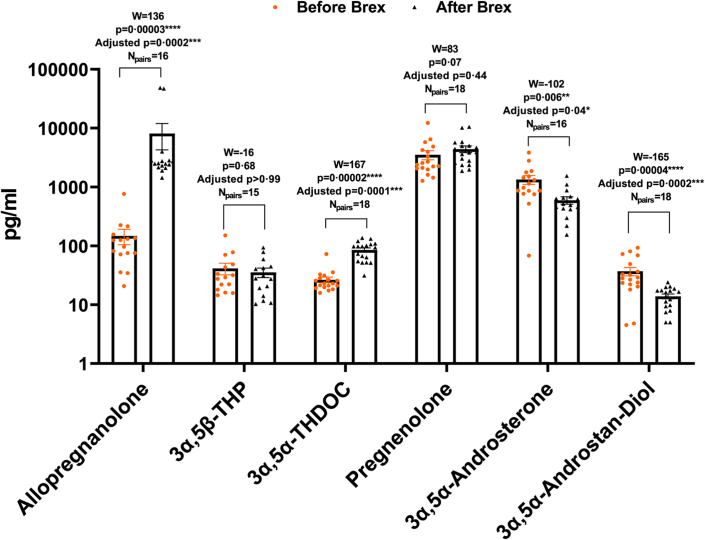
Fig. 1
Fig. 1
Brexanolone infusion alters multiple steroid levels in PPD patient serum. Serum was collected ∼1 h pre- and 6 h post-brexanolone (Brex) infusion (60 h) and simultaneously analyzed for the levels of allopregnanolone, pregnanolone (3α,5β-THP), allotetrahydrodeoxycorticosterone (3α,5α-THDOC), pregnenolone, 3α,5α-androsterone and 3α,5α-androstan-diol by gas chromatography-mass spectrometry (GCMS). Since the data values did not represent normal (Gaussian) distribution using the Kolmogorov–Smirnov normality test, Multiple Wilcoxon matched-pairs signed rank tests with Bonferroni-Dunn correction (MLT Wilcoxon BFD) for the multiple comparisons were applied to determine the effects of brexanolone infusion on the levels of the neurosteroids. The median values of differences in picograms/milliliter (pg/ml), % confidence intervals (CI) of differences, sum of signed ranks (W), p and adjusted p values were examined. Brexanolone infusion increased the levels of allopregnanolone (Npairs = 16) and 3α, 5α-THDOC (Npairs = 18), while decreasing 3α,5α-androsterone (Npairs = 16) and 3α,5α-androstan-diol (Npairs = 18). The changes in the levels of 3α,5β-THP (Npairs = 15) and pregnenolone (Npairs = 18) after brexanolone infusion were not statistically significant. The W values, p and adjusted p values are presented in the figure. ∗p < 0.05; ∗∗p < 0.01; ∗∗∗p < 0.001; ∗∗∗∗p < 0.0001 [MLT Wilcoxon BFD].
Fig. 2
Fig. 2
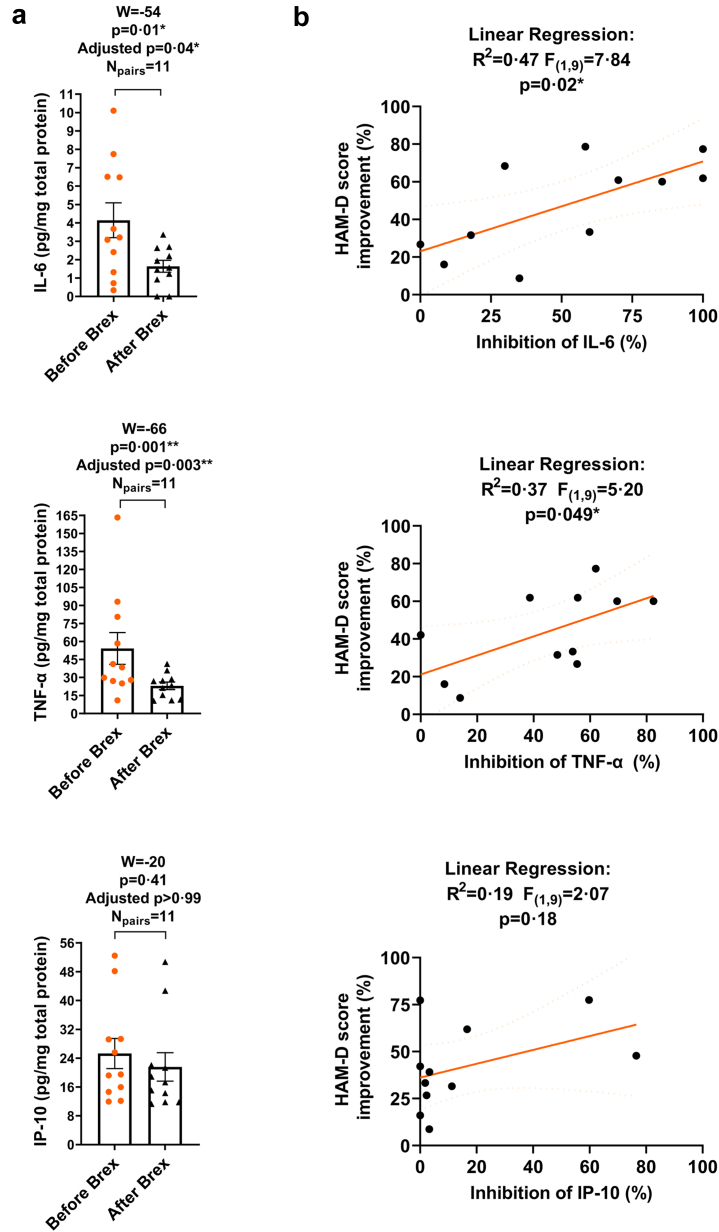
Brexanolone infusion inhibits IL-6 and TNF-α, but not IP-10 in blood cells of post-partum depression (PPD) patients. The inhibition of IL-6 and TNF-α correlates with HAM-D score improvement after brexanolone infusion. Cell lysates were isolated from whole blood of PPD patients ∼1 h before and 6 h after 60 h duration of brexanolone (Brex) infusion and the levels of IL-6, TNF-α, and IP-10 were examined by ELISAs. a: Since the groups with TNF-α and IP-10 values did not pass the Kolmogorov–Smirnov normality test, the Multiple Wilcoxon matched-pairs signed rank tests with Bonferroni-Dunn correction for the multiple comparisons were applied to determine the effects of brexanolone infusion on the levels of IL-6, TNF-α, and IP-10. The median values of differences in picograms/milligram total protein (pg/mg), % confidence intervals (CI) of differences, sum of signed ranks (W), p and adjusted p values were examined. Brexanolone infusion decreased the levels of IL-6 (Npairs = 11) and TNF-α (Npairs = 11), but not IP-10 (Npairs = 11). The W values, p and adjusted p values are presented in the figure. ∗p < 0.05; ∗∗p < 0.01, [MLT Wilcoxon BFD] b: Linear regression analysis was applied to examine whether the % inhibition in IL-6, TNF-α, or IP-10 after brexanolone infusion correlated with the % decrease (improvement) in HAM-D score. The coefficient of determination (R2 value), F statistic, degrees of freedom, and p value were examined. The inhibition (%) of both IL-6 and TNF-α positively correlated with the % decrease (improvement) in HAM-D score after brexanolone infusion. The % change in IP-10 did not correlate with the % decrease (improvement) in HAM-D score. ∗p < 0.05, [Linear regression analysis].
Fig. 3
Fig. 3
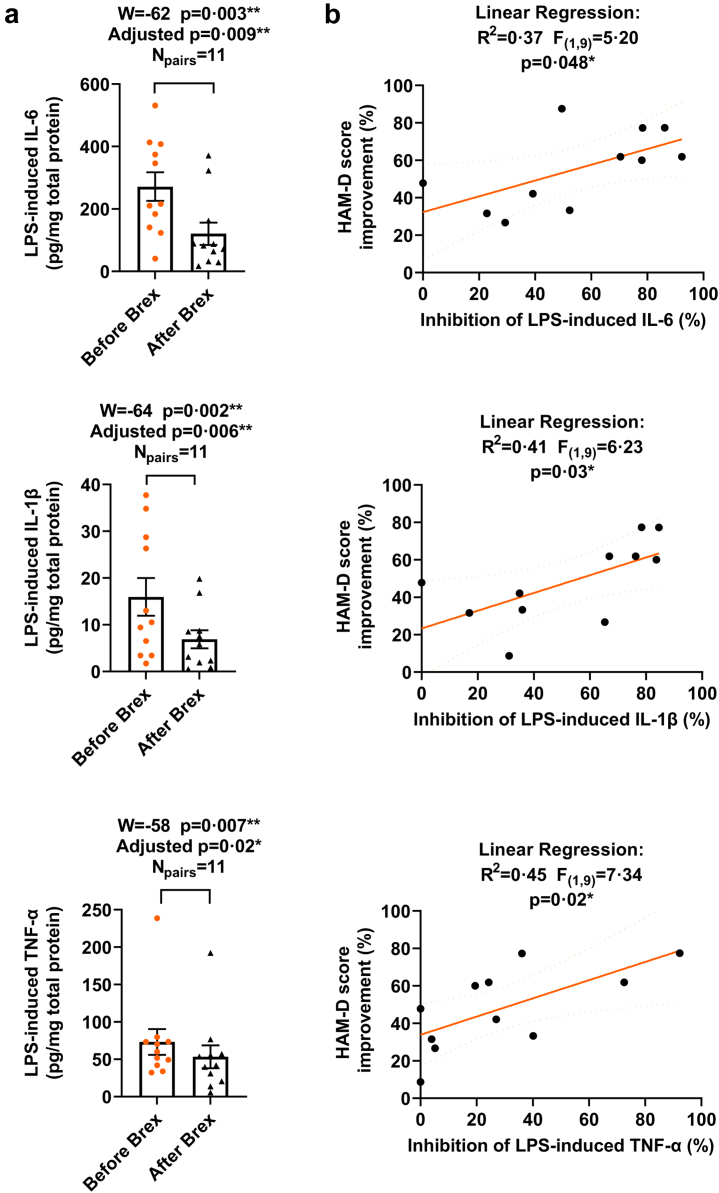
Brexanolone infusion alters in vitro blood cell responses to the TLR4 inflammatory agonist lipopolysaccharide (LPS) as defined by the levels of cytokines IL-6, IL-1β, and TNF-α. The inhibition of the LPS-induced IL-6, IL-1β, and TNF-α correlates with HAM-D score improvement after brexanolone infusion. Whole blood drawn from post-partum depression (PPD) patients ∼1 h before and 6 h after 60 h duration of brexanolone (Brex) infusion was exposed to LPS (10 μg/ml; 37 °C; 4 h) in cell culture in vitro. The levels of IL-6, IL-1β, and TNF-α in culture at baseline, and following the in vitro exposure to LPS were examined in isolated cell lysates by ELISAs. a: Since the values of the baseline adjusted LPS-induced levels of the cytokines in the pre- or post-brexanolone condition, did not represent normal (Gaussian) distribution (the Kolmogorov–Smirnov normality test), the Multiple Wilcoxon matched-pairs signed rank tests with Bonferroni-Dunn correction for the multiple comparisons were applied. The median values of differences in picograms/milligram total protein (pg/mg) and % confidence intervals (CI) of differences were examined. The levels of IL-6 (Npairs = 11), IL-1β (Npairs = 11), and TNF-α (Npairs = 11) were significantly reduced in the post-brexanolone (After Brex) condition when compared with the pre-brexanolone (Before Brex) condition. The W values, p and adjusted p values are presented in the figure. ∗p < 0.05; ∗∗p < 0.01, [MLT Wilcoxon BFD] b: The linear regression analysis was applied to examine whether the % inhibition in LPS-induced IL-6, IL-1β, or TNF-α after brexanolone infusion were correlated with the % decrease (improvement) in HAM-D score. The coefficient of determination (R2 value), F statistic, degrees of freedom, and p value were examined. The inhibition (%) of LPS-induced IL-6, IL-1β, and TNF-α were each positively correlated with the % decrease (improvement) in HAM-D score after brexanolone infusion. ∗p < 0.05, [Linear regression analysis].
Fig. 4
Fig. 4
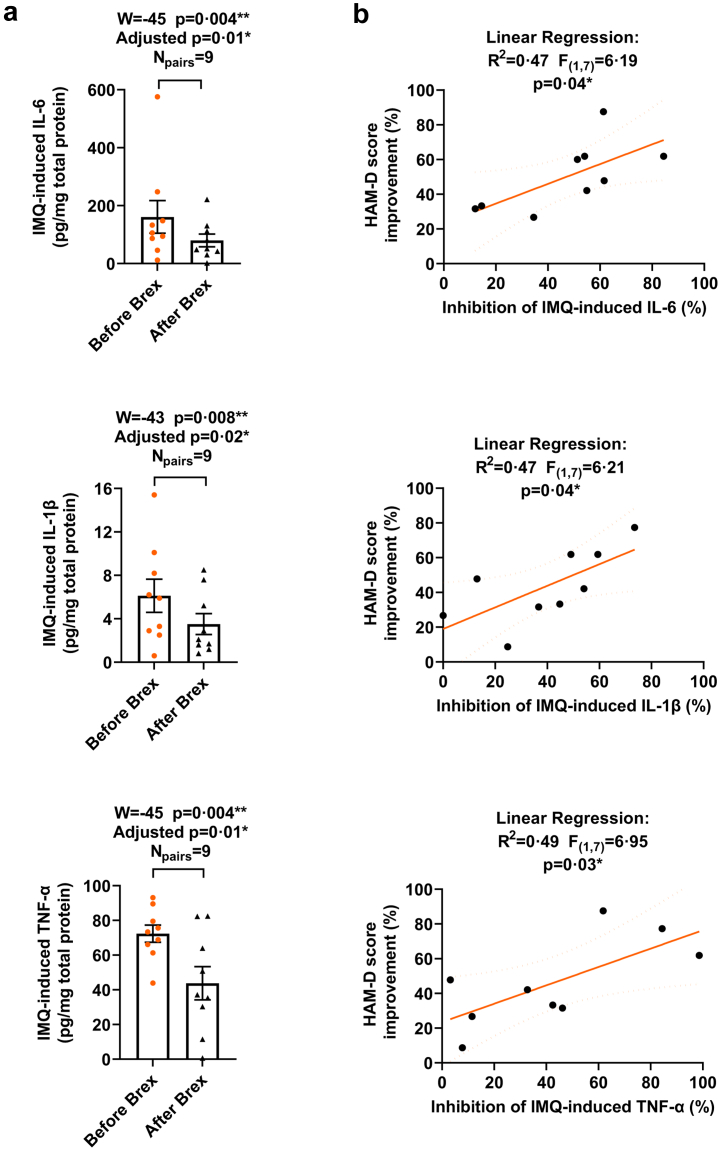
Brexanolone infusion alters in vitro blood cell responses to the TLR7 inflammatory agonist imiquimod (IMQ) as defined by the levels of cytokines IL-6, IL-1β, and TNF-α. The inhibition of the IMQ-induced IL-6, IL-1β, and TNF-α correlates with HAM-D score improvement after brexanolone infusion. Whole blood drawn from post-partum depression (PPD) patients ∼1 h before and 6 h after 60 h duration of brexanolone (Brex) infusion was exposed to IMQ (30 μg/ml; 37 °C; 4 h) in cell culture in vitro. The levels of IL-6, IL-1β, and TNF-α in culture at baseline, and following the in vitro exposure to IMQ were examined in isolated cell lysates by ELISAs. a: Since the values of the baseline adjusted IMQ-induced levels of the cytokines in the pre- or post-brexanolone condition, did not represent normal (Gaussian) distribution (the Kolmogorov–Smirnov normality test), the Multiple Wilcoxon matched-pairs signed rank tests with Bonferroni-Dunn correction for the multiple comparisons were applied. The median values of differences in picograms/milligram total protein (pg/mg) and % confidence intervals (CI) of differences were examined. The levels of IL-6 (Npairs = 9), IL-1β (Npairs = 9), and TNF-α (Npairs = 9) were significantly reduced in the post-brexanolone (After Brex) condition when compared with the pre-brexanolone (Before Brex) condition. The W values, p and adjusted p values are presented in the figure. ∗p < 0.05, ∗∗p < 0.01, [MLT Wilcoxon BFD]. b: Linear regression analysis was applied to examine whether the % inhibition in the IMQ-induced IL-6, IL-1β, or TNF-α after brexanolone infusion correlated with the % decrease (improvement) in HAM-D score. The coefficient of determination (R2 value), F statistic, degrees of freedom, and p value were examined. The inhibition (%) of the IMQ-induced IL-6, IL-1β, and TNF-α were positively correlated with the % decrease (improvement) in HAM-D score after brexanolone infusion. ∗p < 0.05, [Linear regression analysis].

References

    1. Gavin N.I., Gaynes B.N., Lohr K.N., Meltzer-Brody S., Gartlehner G., Swinson T. Perinatal depression: a systematic review of prevalence and incidence. Obstet Gynecol. 2005;106(5 Pt 1):1071–1083. - PubMed
    1. Meltzer-Brody S., Colquhoun H., Riesenberg R., et al. Brexanolone injection in post-partum depression: two multicentre, double-blind, randomised, placebo-controlled, phase 3 trials. Lancet. 2018;392(10152):1058–1070. - PubMed
    1. Arifin S.R.M., Cheyne H., Maxwell M. Review of the prevalence of postnatal depression across cultures. AIMS Public Health. 2018;5(3):260–295. - PMC - PubMed
    1. Canady V.A. FDA approves first drug for postpartum depression treatment. Ment Health Wkly. 2019;29(12):6.
    1. Kanes S., Colquhoun H., Gunduz-Bruce H., et al. Brexanolone (SAGE-547 injection) in post-partum depression: a randomised controlled trial. Lancet. 2017;390(10093):480–489. - PubMed