Review
. 2023 Aug;37(12):2385-2390.
doi: 10.1038/s41433-023-02437-8. Epub 2023 Feb 17.

Vision as a piece of the head trauma puzzle

Affiliations
Review

Vision as a piece of the head trauma puzzle

Carter A Bell et al. Eye (Lond). 2023 Aug.

Abstract

Approximately half of the brain's circuits are involved in vision and control of eye movements. Therefore, visual dysfunction is a common symptom of concussion, the mildest form of traumatic brain injury (TBI). Photosensitivity, vergence dysfunction, saccadic abnormalities, and distortions in visual perception have been reported as vision-related symptoms following concussion. Impaired visual function has also been reported in populations with a lifetime history of TBI. Consequently, vision-based tools have been developed to detect and diagnose concussion in the acute setting, and characterize visual and cognitive function in those with a lifetime history of TBI. Rapid automatized naming (RAN) tasks have provided widely accessible and quantitative measures of visual-cognitive function. Laboratory-based eye tracking approaches demonstrate promise in measuring visual function and validating results from RAN tasks in patients with concussion. Optical coherence tomography (OCT) has detected neurodegeneration in patients with Alzheimer's disease and multiple sclerosis and may provide critical insight into chronic conditions related to TBI, such as traumatic encephalopathy syndrome. Here, we review the literature and discuss the future directions of vision-based assessments of concussion and conditions related to TBI.

摘要: 将近一半的大脑回路参与视觉及眼球运动的控制。因此, 视觉障碍是脑震荡的常见症状, 是最轻微的脑部创伤 (TBI) ——。光敏度下降、辐辏功能失调、扫视运动异常和视物变形已被报道为脑震荡后的视觉相关体征。在有TBI终生病史的人群中, 也有视觉功能受损的报道。因此, 用于检测和诊断急性环境中的脑震荡的视觉工具已研发出来, 用以检测有TBI终生病史的患者的视觉和认知功能。快速自动命名 (RAN) 任务提供了视觉认知功能的广泛可及的定量测量。基于实验室的眼动追踪方法在测量脑震荡患者的视觉功能和验证RAN任务的结果方面大有前景。相干光断层扫描技术 (OCT) 已检测到阿尔茨海默病和多发性硬化症患者的神经元退行性变, 并可能提供与TBI相关的慢性疾病之间的关键性证据, 如创伤性脑病综合征。本文我们对文献进行了回顾性分析, 讨论了基于视觉的脑震荡评估和TBI相关研究的未来方向。.


Conflict of interest statement

LJB is editor-in-chief of the Journal of Neuro-Ophthalmology. The remaining authors have no disclosures.

Figures

Fig. 1
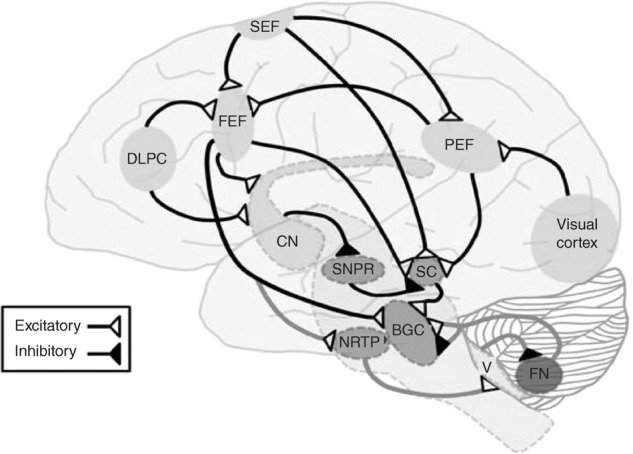
Fig. 1. Major cortical and subcortical pathways involved in saccadic generation.
Eye fields (FEF). Striate cortex (SC). Dorsolateral prefrontal cortex (DLPC). Supplementary eye fields (SEF). Fastigial nucleus (FN). Substantia nigra pars reticulata (SNPR). Nucleus reticularis tegmenti pontis (NRTP). Brainstem Gaze Centers (BGC). Cerebellum Oculomotor Vermis (V). Reprinted with permission from: Galetta et al. [44].
Fig. 2
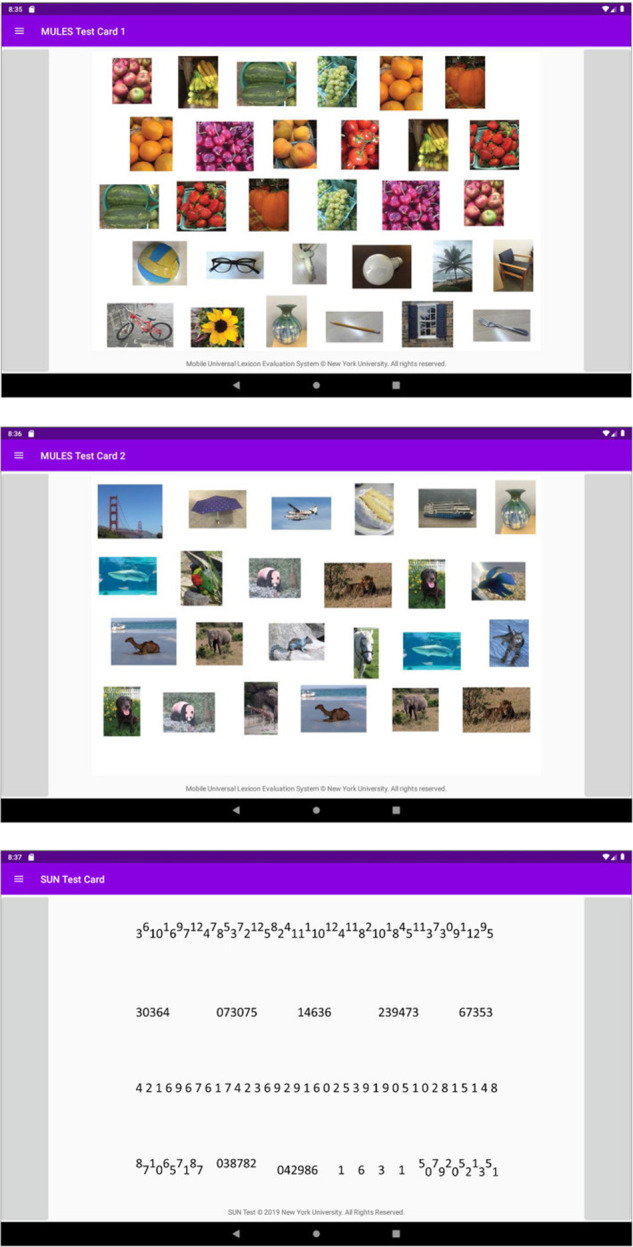
Fig. 2. Screenshots of the Mobile Integrated Cognitive Kit (MICK) app.
This app includes digitized versions of the MULES (upper two panels) and SUN tests (lowest panel), tailored for tablet devices to allow for greater accessibility of testing. The app is currently available for research-based testing. Trained professionals who perform testing are able to assess performance on the MULES and SUN tests in a user-friendly manner with additional features such as timers and voice recordings. Versions of the app that can be used on smartphone-based platforms are also under development. Reprinted with permission from: Park et al. [32].
Fig. 3
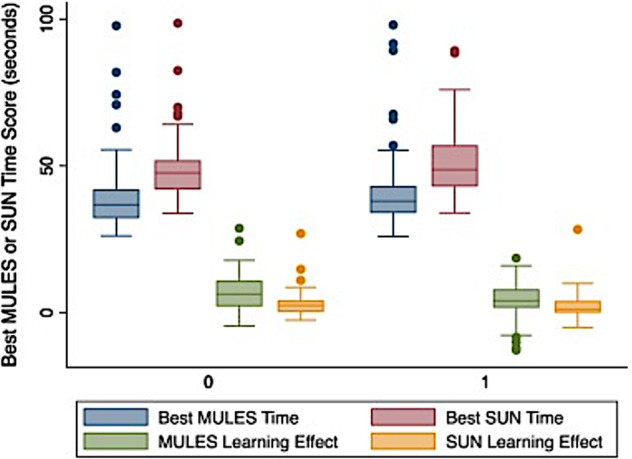
Fig. 3. Box plot showing MULES and SUN time scores with learning effects (n = 59).
Lines in the boxes represent medians; boxes delineate the interquartile range (25th to 75th percentiles). Whiskers represent ranges of observations; outliers are represented by dots. No significant differences were noted between MICK app-based MULES and SUN vs. the previously developed paper/ pencil versions. These analyses accounted for whether MICK app versions or paper/ pencil versions were presented first (P = 0.45 for MULES, P = 0.50 for SUN, linear regression models). Percentage learning effects (difference between two trials divided by best time for each test) were significantly greater for the paper/pencil version compared with the MICK app only for the MULES (17.8% vs. 11.5%, P = 0.03, linear regression accounting simultaneously for which platform was presented first). MULES learning effects were significantly greater than those for SUN, as demonstrated in previous studies [32, 36]. Reprinted with permission from: Park et al. [32].

References

    1. Langlois JA, Rutland-Brown W, Wald MM. The epidemiology and impact of traumatic brain injury: a brief overview. J Head Trauma Rehabil. 2006;21:375–8. doi: 10.1097/00001199-200609000-00001. - DOI - PubMed
    1. Thurman DJ. The epidemiology of traumatic brain injury in children and youths: a review of research since 1990. J Child Neurol. 2016;31:20–7. doi: 10.1177/0883073814544363. - DOI - PubMed
    1. McCrory P, Meeuwisse W, Dvorak J, Aubry M, Bailes J, Broglio S, et al. Consensus statement on concussion in sport—the 5th international conference on concussion in sport held in Berlin, October 2016. Br J Sports Med. 2017;51:838–47. - PubMed
    1. McKee AC, Stern RA, Nowinski CJ, Stein TD, Alvarez VE, Daneshvar DH, et al. The spectrum of disease in chronic traumatic encephalopathy. Brain J Neurol. 2013;136:43–64. doi: 10.1093/brain/aws307. - DOI - PMC - PubMed
    1. McAllister T, McCrea M. Long-term cognitive and neuropsychiatric consequences of repetitive concussion and head-impact exposure. J Athl Train. 2017;52:309–17. doi: 10.4085/1062-6050-52.1.14. - DOI - PMC - PubMed