


Sex differences in the diagnosis, treatment and prognosis of cancer: the rationale for an individualised approach
- PMID: 36802013
- PMCID: PMC10250517
- DOI: 10.1007/s12094-023-03112-w
Sex differences in the diagnosis, treatment and prognosis of cancer: the rationale for an individualised approach
Abstract
Background: Precision medicine in oncology aims to identify the most beneficial interventions based on a patient's individual features and disease. However, disparities exist when providing cancer care to patients based on an individual's sex.
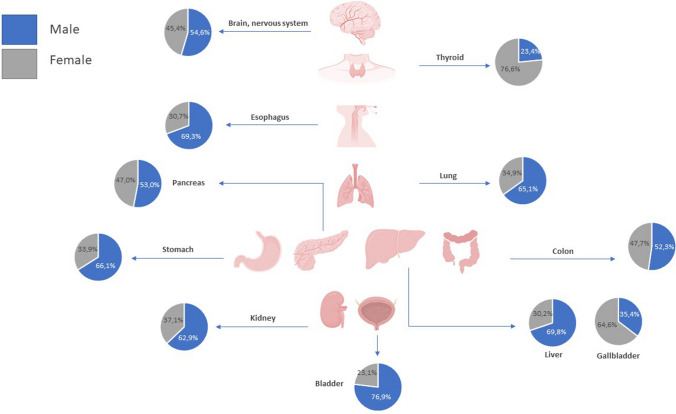
Objective: To discuss how sex differences impact the epidemiology, pathophysiology, clinical manifestations, disease progression, and response to treatment, with a focus on data from Spain.
Results: Genetic and environmental factors (social or economic inequalities, power imbalances, and discrimination) that contribute to these differences adversely affect cancer patient health outcomes. Increased health professional awareness of sex differences is essential to the success of translational research and clinical oncological care.
Conclusions: The Sociedad Española de Oncología Médica created a Task Force group to raise oncologists' awareness and to implement measures to address sex differences in cancer patient management in Spain. This is a necessary and fundamental step towards optimizing precision medicine that will benefit all individuals equally and equitably.
Keywords: Cancer; Epidemiology; Female; Male; Sex; Treatment.
© 2023. The Author(s).
Conflict of interest statement
Ruth Vera has received honoraria from or acted in an advisory role for Roche, Sanofi, MSD, Merck, Eisai, Novartis, Pierre Fabre, Lilly, BAXTER, and ABBOTT, funding for educational or research programmes from Roche, Lilly and MSD, as well as payment of travel/accommodation expenses from Roche, Merck, Sanofi, Pierre Fabre, and MSD. Oscar Juan-Vidal has received honoraria from or acted in an advisory role for Boehringer Ingelheim, Bristol-Myers Squibb, Merck Sharp & Dohme, Roche/Genentech, AstraZeneca, Pfizer, Eli Lilly, AbbVie, and Takeda, and has received travel/accommodation expenses from Takeda and AstraZeneca. María José Safont Aguilera has received honoraria from or acted in an advisory role for Amgen, Merck, Servier, and Pierre Fabre, and travel/accommodation expenses from Amgen, Merck and Servier. Francisco Ayala de la Peña has received honoraria from or acted in an advisory role for AstraZeneca, Celgene, Eisai, Novartis, Roche, Pfizer, Pierre Fabre, Lilly, Sanofi, Seagen, and Daichi-Sankyo, funding for educational or research programmes from Celgene, Roche, and MSD, and travel/accommodation expenses from Roche, Pfizer, Celgene, Eisai, Pfizer, Pierre Fabre, and MSD. Aránzazu González del Alba has received research funding from Astellas, travel grants from Astellas, Jansen, Sanofi, BMS, Roche, Pfizer, MSD and Ipsen and honoraria for speaker engagements, advisory boards and continuous medical education from Janssen, Astellas, Sanofi, Bayer, Roche, Ipsen, BMS, MSD, Pfizer, Eusa Pharma, Eisai, Novartis, AAA and AstraZeneca.
Figures
References
-
- Office of Research on Women's Health. Sex & gender. 2022. https://orwh.od.nih.gov/sex-gender#:~:text=%22Sex%22%20refers%20to%20bio.... Accessed July 12, 2022.
-
- World Health Organization. Gender and health. 2022. https://www.who.int/health-topics/gender#tab=tab_1. Accessed July 12, 2022.
MeSH terms
LinkOut - more resources
Full Text Sources
Medical
