. 2023 Feb 28;120(9):e2220934120.
doi: 10.1073/pnas.2220934120. Epub 2023 Feb 21.

Terpene biosynthesis in marine sponge animals

Affiliations

Terpene biosynthesis in marine sponge animals

Kayla Wilson et al. Proc Natl Acad Sci U S A. .

Abstract

Sea sponges are the largest marine source of small-molecule natural products described to date. Sponge-derived molecules, such as the chemotherapeutic eribulin, the calcium-channel blocker manoalide, and antimalarial compound kalihinol A, are renowned for their impressive medicinal, chemical, and biological properties. Sponges contain microbiomes that control the production of many natural products isolated from these marine invertebrates. In fact, all genomic studies to date investigating the metabolic origins of sponge-derived small molecules concluded that microbes-not the sponge animal host-are the biosynthetic producers. However, early cell-sorting studies suggested the sponge animal host may play a role particularly in the production of terpenoid molecules. To investigate the genetic underpinnings of sponge terpenoid biosynthesis, we sequenced the metagenome and transcriptome of an isonitrile sesquiterpenoid-containing sponge of the order Bubarida. Using bioinformatic searches and biochemical validation, we identified a group of type I terpene synthases (TSs) from this sponge and multiple other species, the first of this enzyme class characterized from the sponge holobiome. The Bubarida TS-associated contigs consist of intron-containing genes homologous to sponge genes and feature GC percentage and coverage consistent with other eukaryotic sequences. We identified and characterized TS homologs from five different sponge species isolated from geographically distant locations, thereby suggesting a broad distribution amongst sponges. This work sheds light on the role of sponges in secondary metabolite production and speaks to the possibility that other sponge-specific molecules originate from the animal host.

Keywords: biosynthesis; marine sponge; natural products; terpene synthase.


Conflict of interest statement

The authors declare no competing interest.

Figures
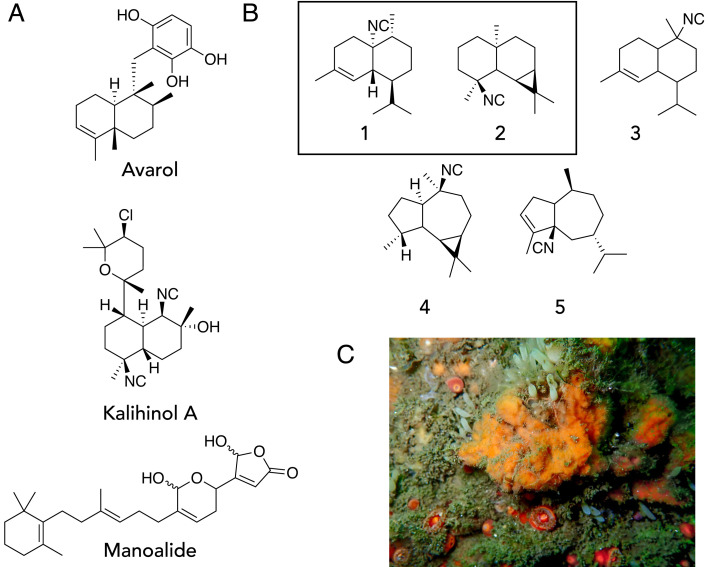
Fig. 1.
Fig. 1.
Terpenoids from marine sponges. (A) Bioactive sponge-derived terpenoids: avarol from Dysidea avara, kalihinol A from Acanthella sp., and manoalide from Luffariella variabilis. (B) Reported isonitrile sesquiterpenes to 5 from Bubarida sponges from San Diego. Boxed compounds are molecules validated from the uncharacterized Bubarida sample that was sequenced in this study and represent relative stereochemistry only (22). (C) in situ uncharacterized Bubarida sponge from San Diego.
Fig. 2.
Fig. 2.
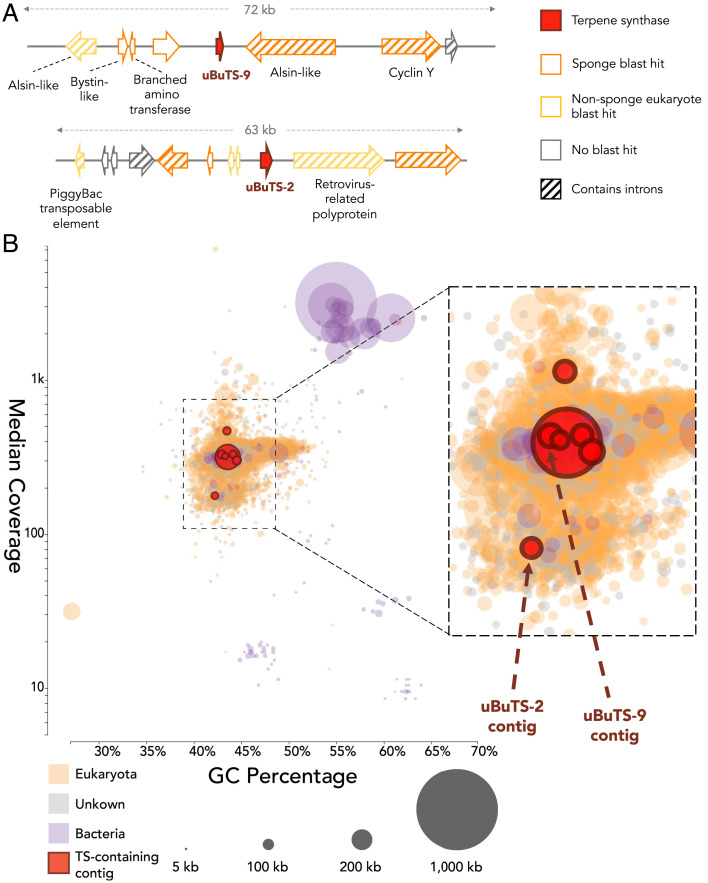
Eukaryotic features of terpene synthase-containing contigs. (A) TS-containing contigs from the uncharacterized Bubarida sponge. Annotations based on closest blastx hit from the NCBI GenBank nonredundant database (SI Appendix, Table S5). (B) GC percentage vs. median coverage plot for all uncharacterized Bubarida metagenomic contigs greater than 5 kb in length. Each circle represents an individual contig. The size of the circle indicates the length of the contig, and for contigs not harboring a TS, the circle’s color indicates taxonomic assignment as inferred by homology. Total contig count, sum, contig length, and n50 are as follows: Eukaryota: 2,700, 140 Mb, 74 kb; Unknown: 433, 7.1 Mb, 21 kb; Bacteria: 122, 8.8 Mb, 180 kb. TS-containing contigs: 7, 650 kb, 74 kb. Maximum contig size is 960,860 kb.
Fig. 3.
Fig. 3.
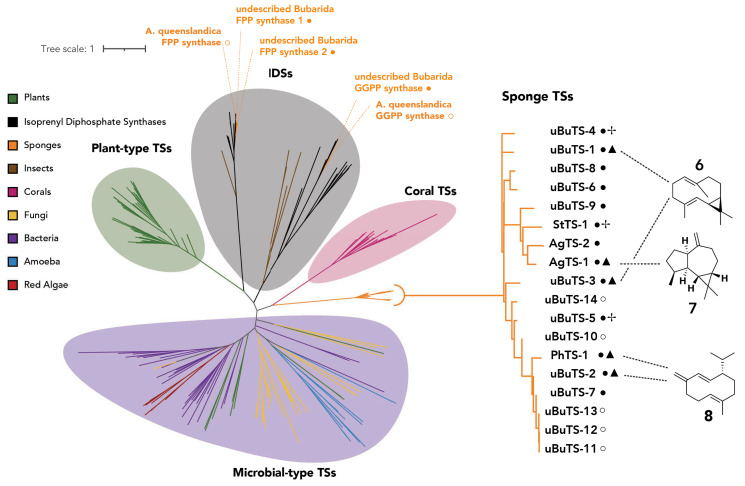
Phylogenetic tree of selected type I TSs from several domains of life. Isoprenyl diphosphate synthases (IDSs) are included as an outgroup. The first two or three letters of each TS name represent the taxonomy of sponge from which it originated. Enzymes with ● have been biochemically tested, while those with ○ have not been tested. The major sesquiterpene products of enzymes marked with ▲ were fully characterized (SI Appendix, Supplementary Note), whereas enzymes with ✢ produce a mixture of terpenes identified only by GC-MS (SI Appendix, Figs. S18, S19, and S35). Entries marked with only ● did not produce terpenes under our experimental conditions.
Fig. 4.
Fig. 4.
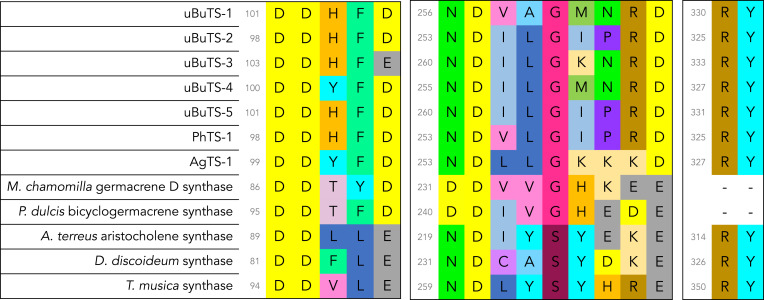
Multiple sequence alignment of key active site residues for sponge TSs and selected plant, microbial, and coral TSs.
Fig. 5.
Fig. 5.
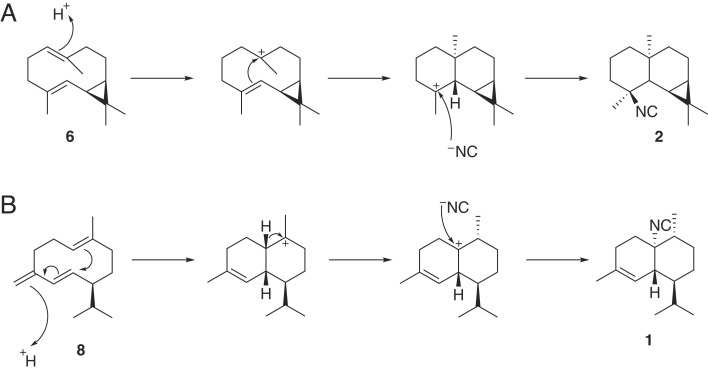
Two proposed mechanistic routes to nitrogenous sesquiterpenoids from sponge TS products. (A) Proposed mechanism to yield undescribed Bubarida natural product 2 from uBuTS-1 product 6. (B) Proposed mechanism to yield undescribed Bubarida natural product 1 from uBuTS-2 product 8.

References

    1. Mehbub M. F., Lei J., Franco C., Zhang W., Marine sponge derived natural products between 2001 and 2010: Trends and opportunities for discovery of bioactives. Mar. Drugs 12, 4539–4577 (2014). - PMC - PubMed
    1. Lyu C., et al. , CMNPD: A comprehensive marine natural products database towards facilitating drug discovery from the ocean. Nucleic Acids Res. 49, D509–D515 (2021). - PMC - PubMed
    1. Proksch P., Defensive roles for secondary metabolites from marine sponges and sponge-feeding nudibranchs. Toxicon 32, 639–655 (1994). - PubMed
    1. Takamatsu S., et al. , Marine natural products as novel antioxidant prototypes. J. Nat. Prod. 66, 605–608 (2003). - PMC - PubMed
    1. Fusetani N., Antifouling marine natural products. Nat. Prod. Rep. 28, 400–410 (2011). - PubMed

Publication types

Substances