


Fecal microbiota transplantation attenuates Escherichia coli infected outgrowth by modulating the intestinal microbiome
- PMID: 36803386
- PMCID: PMC9936653
- DOI: 10.1186/s12934-023-02027-z
Fecal microbiota transplantation attenuates Escherichia coli infected outgrowth by modulating the intestinal microbiome
Abstract
Background: Given the crucial role of gut microbiota in animal and human health, studies on modulating the intestinal microbiome for therapeutic purposes have grasped a significant attention, of which the role of fecal microbiota transplantation (FMT) has been emphasized.
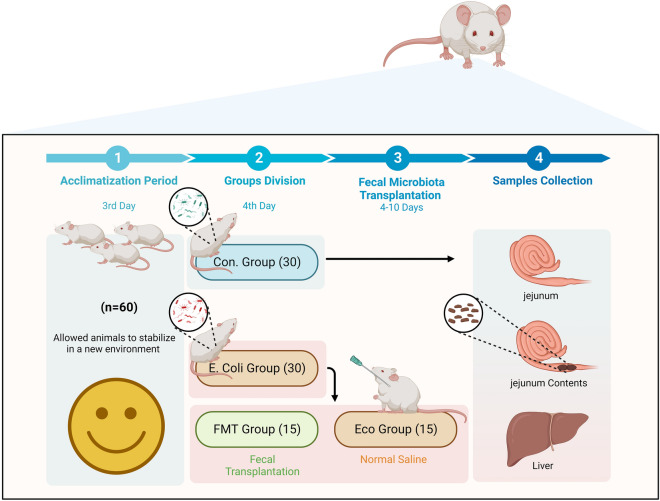
Methods: In the current study, we evaluated the effect of FMT on gut functions in Escherichia coli (E. coli) infection by using mice model. Moreover, we also investigated the subsequently dependent variables of infection, i.e., body weight, mortality, intestinal histopathology, and the expression changes in tight junction proteins (TJPs).
Results: The FMT effectively decreased weight loss and mortality to a certain extent with the restoration of intestinal villi that resulted in high histological scores for jejunum tissue damage (p < 0.05). The effect of FMT on alleviating the reduction of intestinal TJPs was also proved by immunohistochemistry analysis and mRNA expression levels. Moreover, the abundance of health-threatening bacteria, belonging to phylum Proteobacteria, family Enterobacteriaceae and Tannerellaceae, genus Escherichia-Shigella, Sphingomonas, Collinsella, etc., were significantly increased, whereas beneficial bacteria, belonging to phylum Firmicutes, family Lactobacillaceae, genus Lactobacillus were decreased in the gut of infected mice. Furthermore, we sought to investigate the association of clinical symptoms with FMT treatment with modulation in gut microbiota. According to beta diversity, the microbial community of gut microbiota results reflected the similarities between non-infected and FMT groups. The improvement of the intestinal microbiota in FMT group was characterized by the significant high level of beneficial microorganisms with the synergistic decrease of Escherichia-Shigella, Acinetobacter, and other taxa.
Conclusion: The findings suggest a beneficial host-microbiome correlation following fecal microbiota transplanatation for controlling gut infections and pathogens-associated diseases.
Keywords: Escherichia coli; Fecal microbiota transplantation; Intestinal injury; Intestinal microbiome.
© 2023. The Author(s).
Conflict of interest statement
The authors declare that they have no competing interests.
Figures


References
-
- Suzuki TA. Links between natural variation in the microbiome and host fitness in wild mammals. Integr Comp Biol. 2017;57:756–769. - PubMed
-
- McFall-Ngai M, Hadfield MG, Bosch TC, Carey HV, Domazet-Loso T, Douglas AE, Dubilier N, Eberl G, Fukami T, Gilbert SF, Hentschel U, King N, Kjelleberg S, Knoll AH, Kremer N, Mazmanian SK, Metcalf JL, Nealson K, Pierce NE, Rawls JF, Reid A, Ruby EG, Rumpho M, Sanders JG, Tautz D, Wernegreen JJ. Animals in a bacterial world, a new imperative for the life sciences. Proc Natl Acad Sci USA. 2013;110:3229–3236. - PMC - PubMed
-
- Tremaroli V, Backhed F. Functional interactions between the gut microbiota and host metabolism. Nature. 2012;489:242–249. - PubMed
MeSH terms
Grants and funding
LinkOut - more resources
Full Text Sources
