Review
. 2023 Feb 17;18(1):9.
doi: 10.1186/s40793-023-00466-0.

The Arabidopsis holobiont: a (re)source of insights to understand the amazing world of plant-microbe interactions

Affiliations
Review

The Arabidopsis holobiont: a (re)source of insights to understand the amazing world of plant-microbe interactions

M J Poupin et al. Environ Microbiome. .

Abstract

As holobiont, a plant is intrinsically connected to its microbiomes. However, some characteristics of these microbiomes, such as their taxonomic composition, biological and evolutionary role, and especially the drivers that shape them, are not entirely elucidated. Reports on the microbiota of Arabidopsis thaliana first appeared more than ten years ago. However, there is still a lack of a comprehensive understanding of the vast amount of information that has been generated using this holobiont. The main goal of this review was to perform an in-depth, exhaustive, and systematic analysis of the literature regarding the Arabidopsis-microbiome interaction. A core microbiota was identified as composed of a few bacterial and non-bacterial taxa. The soil (and, to a lesser degree, air) were detected as primary microorganism sources. From the plant perspective, the species, ecotype, circadian cycle, developmental stage, environmental responses, and the exudation of metabolites were crucial factors shaping the plant-microbe interaction. From the microbial perspective, the microbe-microbe interactions, the type of microorganisms belonging to the microbiota (i.e., beneficial or detrimental), and the microbial metabolic responses were also key drivers. The underlying mechanisms are just beginning to be unveiled, but relevant future research needs were identified. Thus, this review provides valuable information and novel analyses that will shed light to deepen our understanding of this plant holobiont and its interaction with the environment.

Keywords: Arabidopsis; Bacteria; Community; Fungi; Microbiota; Plant; Plant-growth-promotion-rhizobacteria; Plant-root-exudates; Rhizosphere.


Conflict of interest statement

The authors declare that they have no competing interests.

Figures
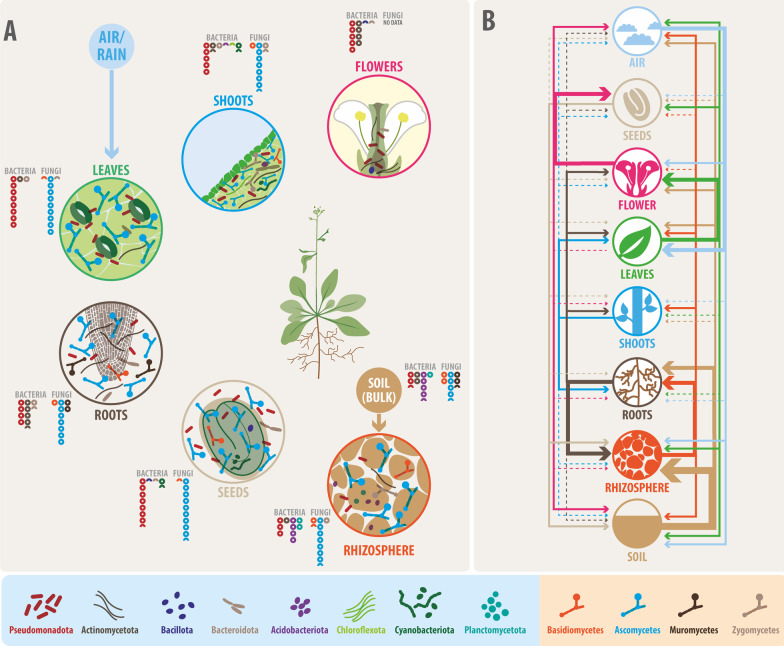
Fig. 1
Fig. 1
Features and connections in the Arabidopsis microbiota. A The distribution of the main microbial taxa among different plant compartments is represented by symbols explained in the boxes at the bottom of the figure; light blue for bacterial phyla and light orange for fungal phyla, while relative abundances of the major phyla are represented next to each compartment [20, 22, 23, 30, 60, 85, 191]. B Connections among the microbiota of compartments and their different sources (inputs) of inoculation. The arrow width represents the relative contributions of the sources based on the percentage of each source input with respect to the total input. Dashed lines represent minor influences. Roots comprise endorhizosphere plus rhizoplane. Leaves comprise the endophyllosphere plus the epiphyllosphere. Names of the taxa are Pseudomonadota, Actinomycetota, Bacillota, Bacteroidota, Acidobacteriota, Chloroflexota, Cyanobacteriota, Planctomycetota, Basidiomycota, Ascomycota, Zygomycota, and Mucoromycota, formerly Proteobacteria, Actinobacteria, Firmicutes, Bacteroidetes, Acidobacteria, Chloroflexi, Cyanobacteria, Planctomycetes, Basidiomycetes, Ascomycetes, Zygomycetes, and Mucoromycetes, respectively
Fig. 2
Fig. 2
The Arabidopsis-microbiota interaction as a complex system: Multiple drivers that shape the outcomes of this plant–microbe interaction. A Drivers from the macro-organism plant perspective (from top to bottom): circadian and seasonal effects; ecotype; soil; plant developmental stage; biomolecules released by plants (i.e., root exudates); responses to the environment (i.e., biotic/abiotic stress responses) B Drivers from the microbial perspective: microbe-microbe interactions; microbial responses to biotic and abiotic stresses; biomolecules released by microorganisms and type of microorganisms (i.e., plant growth-promoting/protecting bacteria). C Future research needs

References

    1. Acosta K, Xu J, Gilbert S, Denison E, Brinkman T, Lebeis S, Lam E. Duckweed hosts a taxonomically similar bacterial assemblage as the terrestrial leaf microbiome. PLoS ONE. 2020;15:e0228560. doi: 10.1371/journal.pone.0228560. - DOI - PMC - PubMed
    1. Agler MT, Ruhe J, Kroll S, Morhenn C, Kim S-T, Weigel D, Kemen EM. Microbial hub taxa link host and abiotic factors to plant microbiome variation. PLoS Biol. 2016;14:e1002352. doi: 10.1371/journal.pbio.1002352. - DOI - PMC - PubMed
    1. Almario J, Mahmudi M, Kroll S, Agler M, Placzek A, Mari A, Kemen E. The leaf microbiota of Arabidopsis displays reproducible dynamics and patterns throughout the growing season. mbio. 2022;13:e02825–21. doi: 10.1128/mbio.02825-21. - DOI - PMC - PubMed
    1. Almario J, Fabiańska I, Saridis G, Bucher M. Unearthing the plant-microbe quid pro quo in root associations with beneficial fungi. New Phytol. 2022;234:1967–1976. doi: 10.1111/nph.18061. - DOI - PubMed
    1. Armijo, G., Kraiser, T., Medina, M.P., Gras, D.E., Zuñiga, A., González, B., and Gutiérrez, R.A. (2020). Arabidopsis thaliana interaction with Ensifer meliloti can support plant growth under N-deficiency. bioRxiv preprint. 10.1101/2020.07.25.221283.

LinkOut - more resources