


Background Music and Memory in Mild Cognitive Impairment: The Role of Interindividual Differences
- PMID: 36806508
- PMCID: PMC10116144
- DOI: 10.3233/JAD-221051
Background Music and Memory in Mild Cognitive Impairment: The Role of Interindividual Differences
Abstract
Background: Recent research has shown that background music may improve memory consolidation and retrieval. Nevertheless, in the clinical conditions preceding dementia such as mild cognitive impairment (MCI), there is no current evidence speaking to what effect background music during memory tasks has on impaired cognition.
Objective: Across three experiments, we investigated if background music is able to improve memory performance, the most impacted cognitive domain in amnestic MCI.
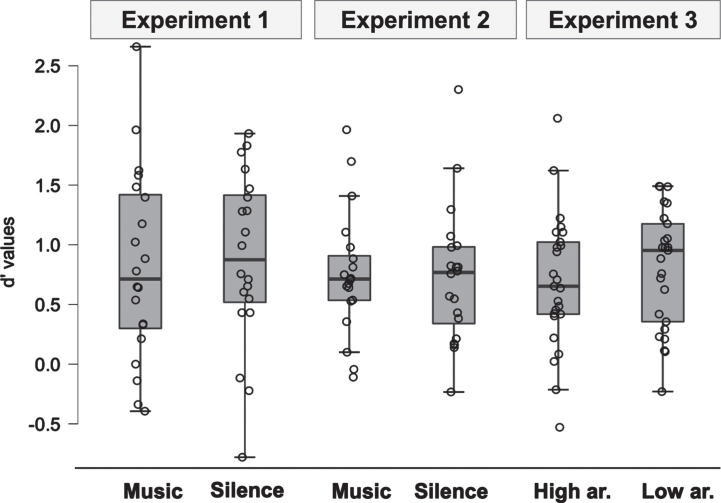
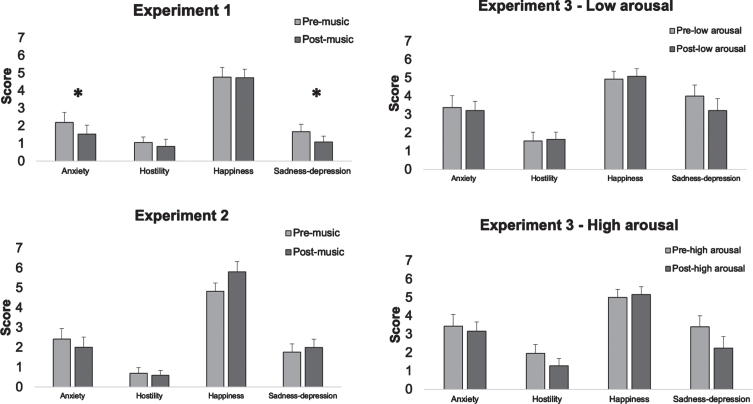
Methods: We tested the effect of background music by using a face recognition memory task in patients with amnestic MCI. In Experiment 1, we tested the effect of background music on memory when it was played solely during an encoding phase. In Experiment 2, we explored effects of background music when played during both encoding and recognition phases. In Experiment 3, we explored the role of musically induced arousal on memory.
Results: The main finding from these three experiments was that background music played during a memory task did not improve or worsen participant performance. However, when exposed to high-arousal music, memory performance was predicted by individual mood regulation. For low-arousal music conditions, there was a negative relationship between rating scores for music pleasantness and performance on the memory task.
Conclusion: Our results suggest that the benefits of background music on memory in individuals with MCI are modulated by interindividual preferences towards music.
Keywords: Background music; cognitive stimulation; memory; mild cognitive impairment.
Conflict of interest statement
The authors have no conflict of interest to report.
The authors have no conflict of interest to report.
Figures


References
-
- Giannouli V, Kolev V, Yordanova J (2019) Is there a specific Vivaldi effect on verbal memory functions? Evidence from listening to music in younger and older adults. Psychol Music 47, 325–341.
-
- de la Mora Velasco E, Hirumi A (2020) The effects of background music on learning: A systematic review of literature to guide future research and practice. Educ Technol Res Dev 68, 2817–2837.
-
- Nguyen T, Grahn JA (2017) Mind your music: The effects of music-induced mood and arousal across different memory tasks. Psychomusicology Music Mind Brain 27, 81–94.
Publication types
MeSH terms
LinkOut - more resources
Full Text Sources
