Clinical Trial
. 2023 Jun 1;29(11):2066-2074.
doi: 10.1158/1078-0432.CCR-22-2765.

Tumor Mutational Burden as a Predictor of Survival with Durvalumab and/or Tremelimumab Treatment in Recurrent or Metastatic Head and Neck Squamous Cell Carcinoma

Affiliations
Clinical Trial

Tumor Mutational Burden as a Predictor of Survival with Durvalumab and/or Tremelimumab Treatment in Recurrent or Metastatic Head and Neck Squamous Cell Carcinoma

Sophie Wildsmith et al. Clin Cancer Res. .

Abstract

Purpose: Biomarkers that predict response to immune checkpoint inhibitors (ICI) in recurrent or metastatic head and neck squamous cell carcinoma (R/M HNSCC) are needed. This retrospective study assessed tumor mutational burden (TMB) and outcomes in the phase II HAWK and CONDOR and phase III EAGLE studies of durvalumab with or without tremelimumab in platinum-resistant R/M HNSCC.

Patients and methods: Tumor samples from HAWK/CONDOR (N = 153) and blood samples from EAGLE (N = 247) were analyzed for TMB. Associations with survival were evaluated for tissue TMB (tTMB) at cutoffs from 10 to 20 mutations/megabase (mut/Mb) and for blood plasma TMB (bTMB) at cutoffs from 8 to 24 mut/Mb.

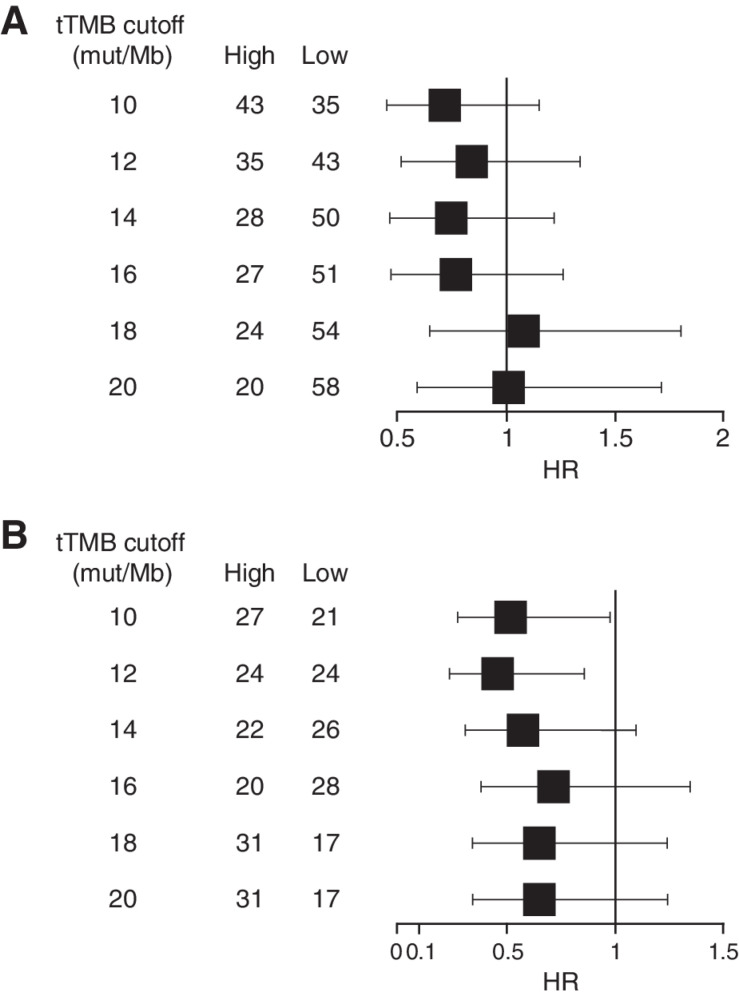
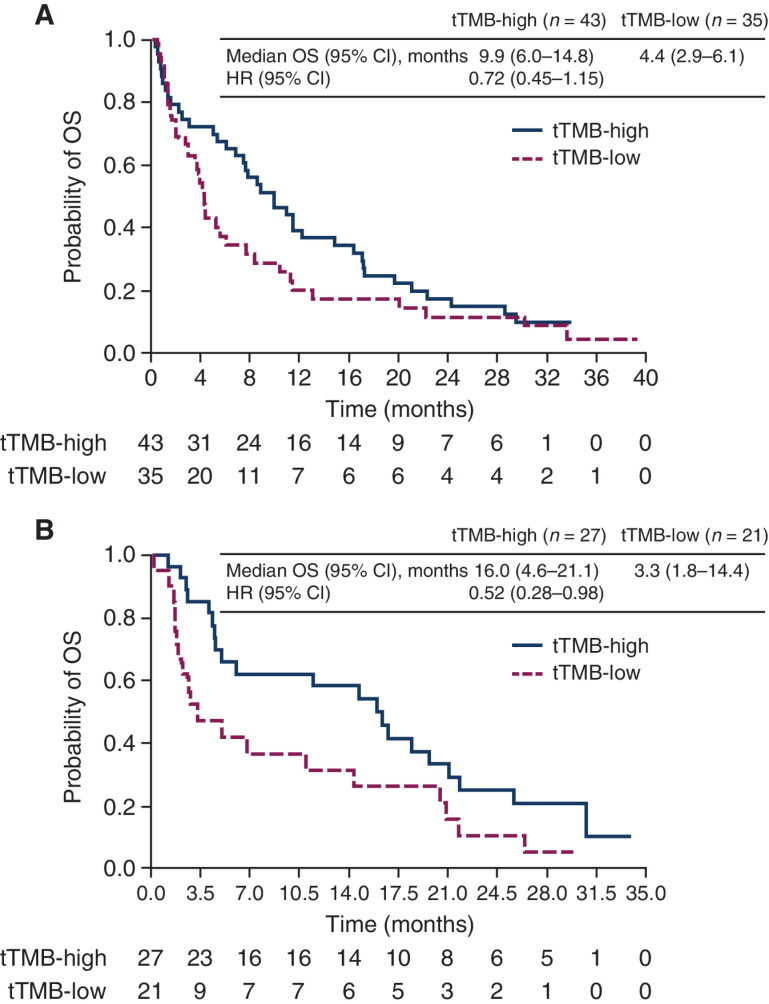
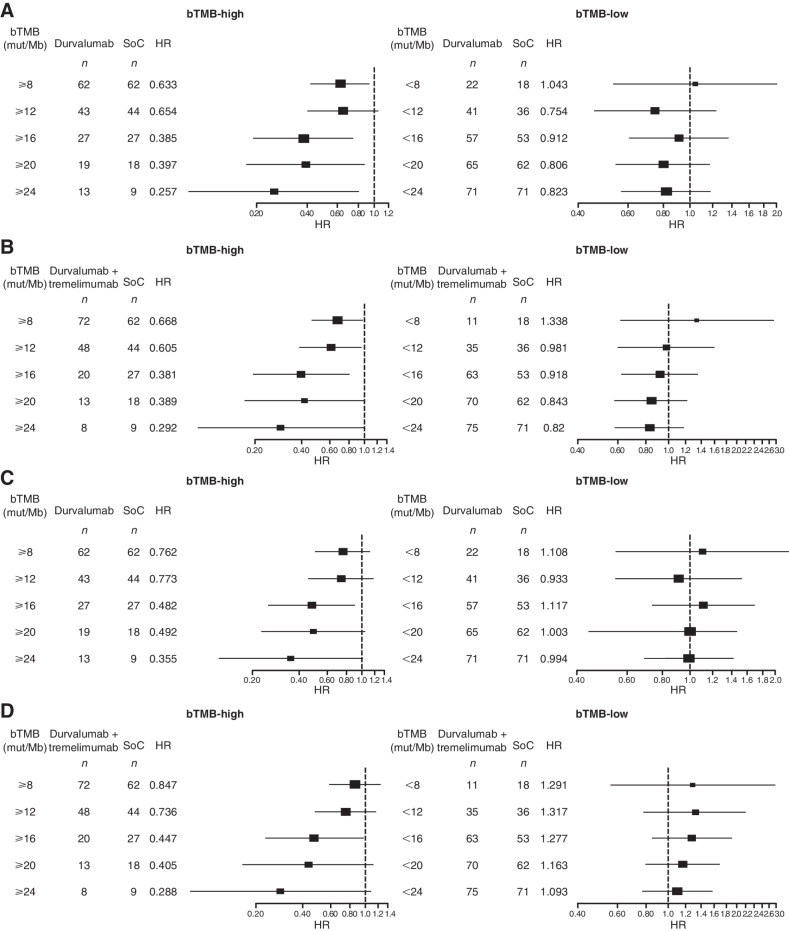
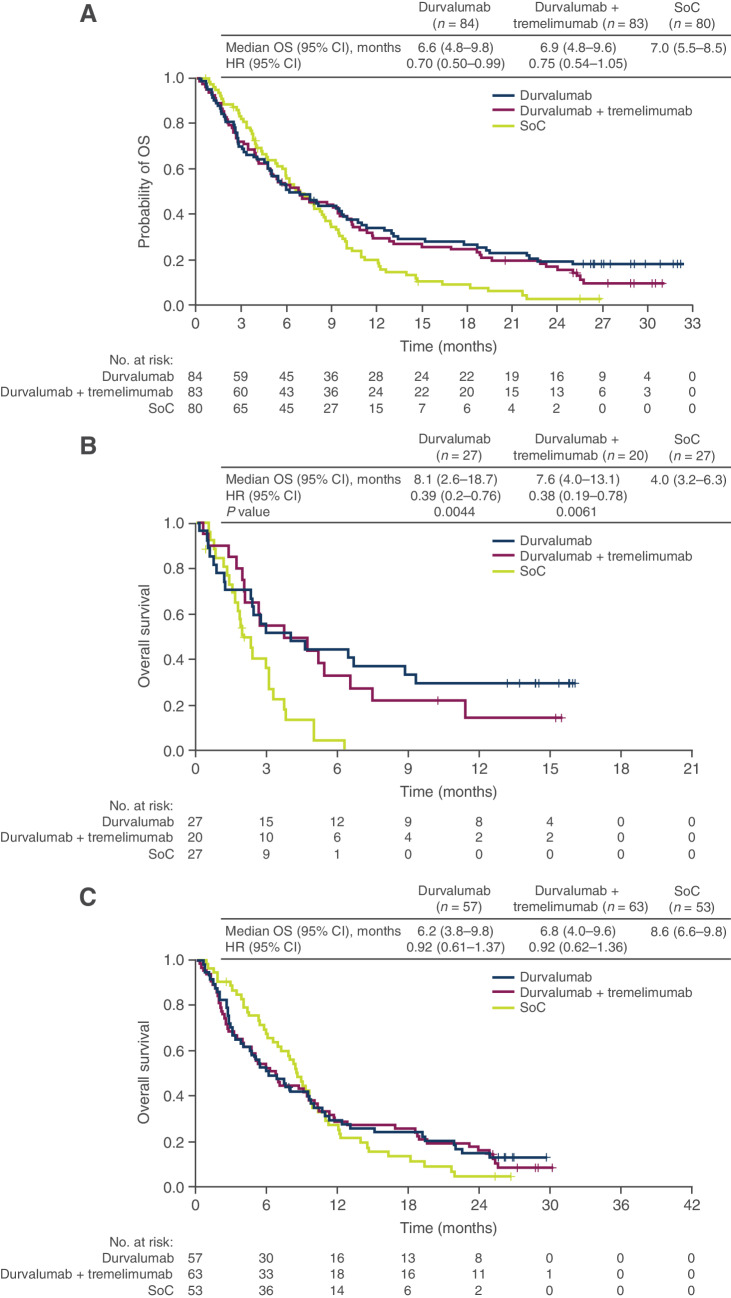
Results: In HAWK/CONDOR, overall survival (OS) with durvalumab with or without tremelimumab was longer for high versus low tTMB: statistically significant differences were observed with durvalumab plus tremelimumab at tTMB ≥ 10 mut/Mb [HR, 0.52 (95% confidence interval, CI, 0.28-0.98)] and tTMB ≥ 12 mut/Mb [HR, 0.46 (95% CI, 0.24-0.86)]. In EAGLE, a significant OS benefit versus chemotherapy was observed with durvalumab and durvalumab plus tremelimumab at bTMB≥16 mut/Mb [HR, 0.39 (95% CI, 0.20-0.76) and 0.38 (95% CI, 0.19-0.78), respectively] but not bTMB < 16 mut/Mb [HR, 0.92 (0.61-1.37) and 0.92 (95% CI, 0.62-1.36), respectively]. A significant progression-free survival benefit was also observed in the ICI arms versus chemotherapy at bTMB ≥ 16 mut/Mb.

Conclusions: Findings support TMB as a biomarker for predicting survival in patients with platinum-resistant R/M HNSCC treated with ICIs. The analysis of EAGLE demonstrated that bTMB was predictive of survival with ICI treatment versus chemotherapy in a large, randomized controlled study population.


Figures

Figure 1. Forest plot of OS in the tTMB-high versus tTMB-low subgroups by tTMB cutoff with durvalumab monotherapy (A) or with durvalumab plus tremelimumab (B) in HAWK/CONDOR. HRs were calculated as tTMB-high versus -low for each treatment group. HR, hazard ratio; OS, overall survival; tTMB, tissue tumor mutational burden.
Figure 1.
Forest plot of OS in the tTMB-high versus tTMB-low subgroups by tTMB cutoff with durvalumab monotherapy (A) or with durvalumab plus tremelimumab (B) in HAWK/CONDOR. HRs were calculated as tTMB-high versus -low for each treatment group. HR, hazard ratio; OS, overall survival; tTMB, tissue tumor mutational burden.
Figure 2. Kaplan–Meier plot of OS in the tTMB-high (≥10 mut/Mb) and tTMB-low (<10 mut/Mb) subgroups for patients treated with durvalumab monotherapy (A) or with durvalumab plus tremelimumab (B) in HAWK/CONDOR. HRs were calculated as tTMB-high versus -low for each treatment group. CI, confidence interval; HR, hazard ratio; OS, overall survival; mut/Mb, mutations/megabase; tTMB, tissue tumor mutational burden
Figure 2.
Kaplan–Meier plot of OS in the tTMB-high (≥10 mut/Mb) and tTMB-low (<10 mut/Mb) subgroups for patients treated with durvalumab monotherapy (A) or with durvalumab plus tremelimumab (B) in HAWK/CONDOR. HRs were calculated as tTMB-high versus -low for each treatment group. CI, confidence interval; HR, hazard ratio; OS, overall survival; mut/Mb, mutations/megabase; tTMB, tissue tumor mutational burden
Figure 3. Forest plot of OS in the bTMB-high and bTMB-low subgroups by bTMB cutoff for durvalumab monotherapy versus SoC (A) and for durvalumab plus tremelimumab versus SoC (B) and PFS in the bTMB-high and bTMB-low subgroups by bTMB cutoff for durvalumab versus SoC (C) and for durvalumab plus tremelimumab versus SoC (D) in EAGLE. HRs were calculated as durvalumab with/without tremelimumab versus chemotherapy. bTMB, blood plasma tumor mutational burden; D, durvalumab; HR, hazard ratio; OS, overall survival; PFS, progression-free survival; SoC, standard of care; tTMB, tissue tumor mutational burden.
Figure 3.
Forest plot of OS in the bTMB-high and bTMB-low subgroups by bTMB cutoff for durvalumab monotherapy versus SoC (A) and for durvalumab plus tremelimumab versus SoC (B) and PFS in the bTMB-high and bTMB-low subgroups by bTMB cutoff for durvalumab versus SoC (C) and for durvalumab plus tremelimumab versus SoC (D) in EAGLE. HRs were calculated as durvalumab with/without tremelimumab versus chemotherapy. bTMB, blood plasma tumor mutational burden; D, durvalumab; HR, hazard ratio; OS, overall survival; PFS, progression-free survival; SoC, standard of care; tTMB, tissue tumor mutational burden.
Figure 4. Kaplan–Meier plot of OS in the durvalumab monotherapy, durvalumab plus tremelimumab and SoC treatment arms in the bTMB-evaluable population (A), bTMB-high subgroup (B), and bTMB-low subgroup (C). HRs were calculated as durvalumab with/without tremelimumab versus chemotherapy. bTMB, blood plasma tumor mutational burden; CI, confidence interval; HR, hazard ratio; OS, overall survival; SoC, standard of care.
Figure 4.
Kaplan–Meier plot of OS in the durvalumab monotherapy, durvalumab plus tremelimumab, and SoC treatment arms in the bTMB-evaluable population (A), bTMB-high subgroup (B), and bTMB-low subgroup (C). HRs were calculated as durvalumab with/without tremelimumab versus chemotherapy. bTMB, blood plasma tumor mutational burden; CI, confidence interval; HR, hazard ratio; OS, overall survival; SoC, standard of care.

References

    1. Lala M, Chirovsky D, Cheng JD, Mayawala K. Clinical outcomes with therapies for previously treated recurrent/metastatic head-and-neck squamous cell carcinoma (R/M HNSCC): a systematic literature review. Oral Oncol 2018;84:108–20. - PubMed
    1. Lasinska I, Kolenda T, Teresiak A, Lamperska KM, Galus L, Mackiewicz J. Immunotherapy in patients with recurrent and metastatic squamous cell carcinoma of the head and neck. Anticancer Agents Med Chem 2019;19:290–303. - PubMed
    1. Ferris RL, Blumenschein G Jr, Fayette J, Guigay J, Colevas AD, Licitra L, et al. Nivolumab for recurrent squamous-cell carcinoma of the head and neck. N Engl J Med 2016;375:1856–67. - PMC - PubMed
    1. Cohen EEW, Soulières D, Le Tourneau C, Dinis J, Licitra L, Ahn MJ, et al. Pembrolizumab versus methotrexate, docetaxel, or cetuximab for recurrent or metastatic head-and-neck squamous cell carcinoma (KEYNOTE-040): a randomised, open-label, phase 3 study. Lancet 2019;393:156–67. - PubMed
    1. Ferris RL, Haddad R, Even C, Tahara M, Dvorkin M, Ciuleanu TE, et al. Durvalumab with or without tremelimumab in patients with recurrent or metastatic head and neck squamous cell carcinoma: EAGLE, a randomized, open-label phase III study. Ann Oncol 2020;31:942–50. - PubMed

Publication types

MeSH terms