. 2023 May 15;129(10):1602-1613.
doi: 10.1002/cncr.34700. Epub 2023 Feb 17.

Dietary supplement use among adult survivors of childhood cancer: A report from the St. Jude Lifetime Cohort Study

Affiliations

Dietary supplement use among adult survivors of childhood cancer: A report from the St. Jude Lifetime Cohort Study

Fang Fang Zhang et al. Cancer. .

Abstract

Background: Adult survivors of childhood cancer have poor adherence to nutrition guidelines and inadequate intake of dietary vitamins D and E, potassium, fiber, magnesium, and calcium. The contribution of vitamin and mineral supplement use to total nutrient intake in this population is unclear.

Methods: We examined the prevalence and dose of nutrient intake among 2570 adult survivors of childhood cancer participating in the St. Jude Lifetime Cohort Study, and the association of dietary supplement use with treatment exposures, symptom burden, and quality of life.

Results: Nearly 40% of the adult survivors of cancer survivors reported regular use of dietary supplements. Although cancer survivors who used dietary supplements were less likely to have inadequate intake of several nutrients, they were also more likely to have excessive intake (total nutrient intake ≥ tolerable upper intake levels) of folate (15.4% vs. 1.3%), vitamin A (12.2% vs. 0.2%), iron (27.8% vs. 1.2%), zinc (18.6% vs. 1%), and calcium (5.1% vs. 0.9%) compared with survivors who did not use dietary supplements (all p < 0.05). Treatment exposures, symptom burden, and physical functioning were not associated with supplement use, whereas emotional well-being and vitality were positively associated with supplement use among childhood cancer survivors.

Conclusions: Supplement use is associated with both inadequate and excessive intake of specific nutrients, but positively impacts aspects of quality of life among childhood cancer survivors.

Keywords: childhood cancer survivors; dietary supplements; excess intake; inadequate intake; nutrients.


Conflict of interest statement

Conflict of Interest (COI) Statement: The authors have no conflicts of interests to disclose.

Figures

Figure 1.
Figure 1.
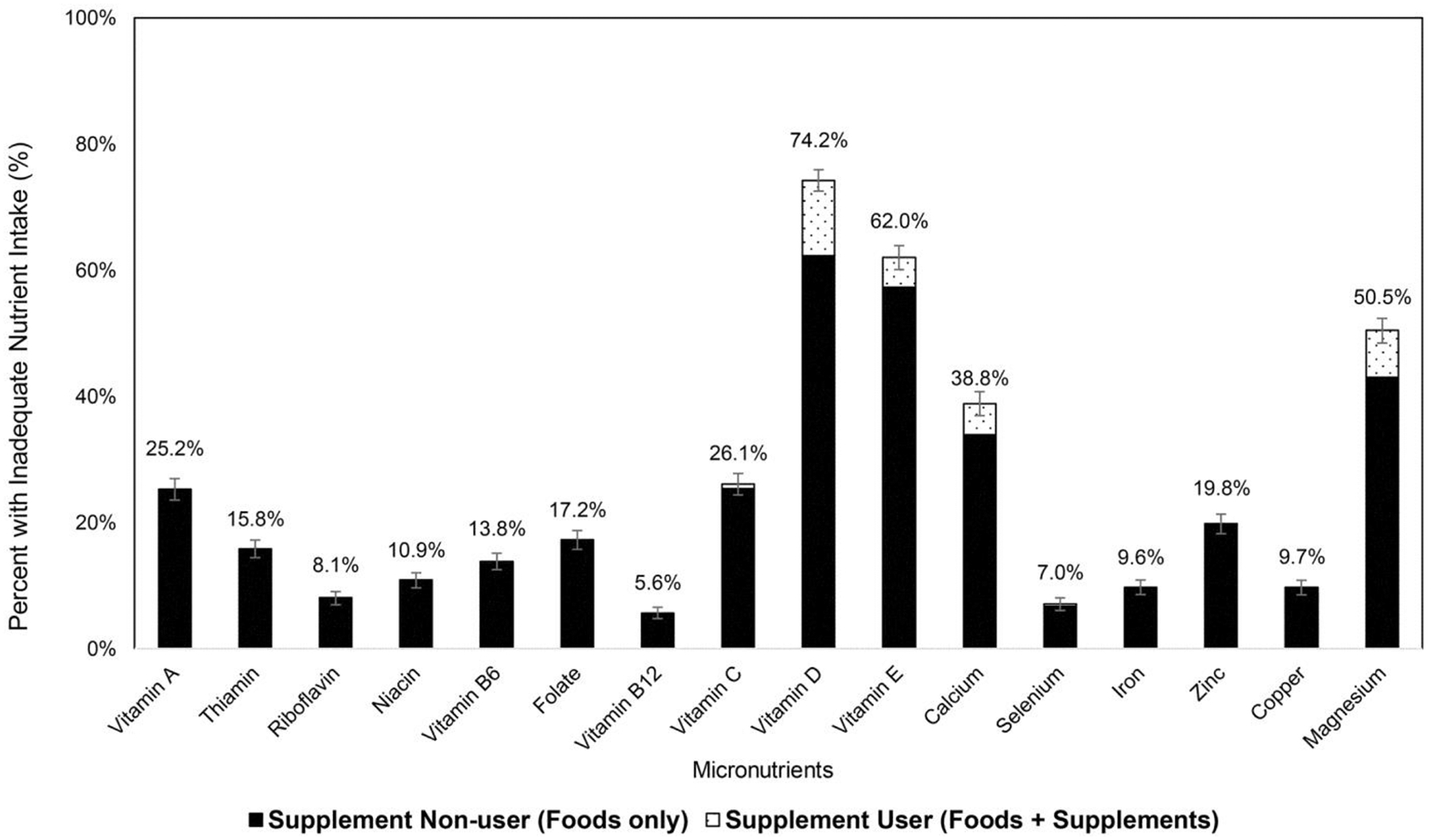
Percent of adult survivors of childhood cancer with inadequate nutrient intake (total intake level < estimated average requirement). Number above the bar represents the percent of inadequate nutrient among all adult survivors of childhood cancer, including both supplement users and nonusers. The bar in black corresponds to the percent of inadequate nutrient intake among supplement nonusers; the bar in white with dotted pattern corresponds to the percent of inadequate nutrient intake among supplement users.
Figure 2.
Figure 2.
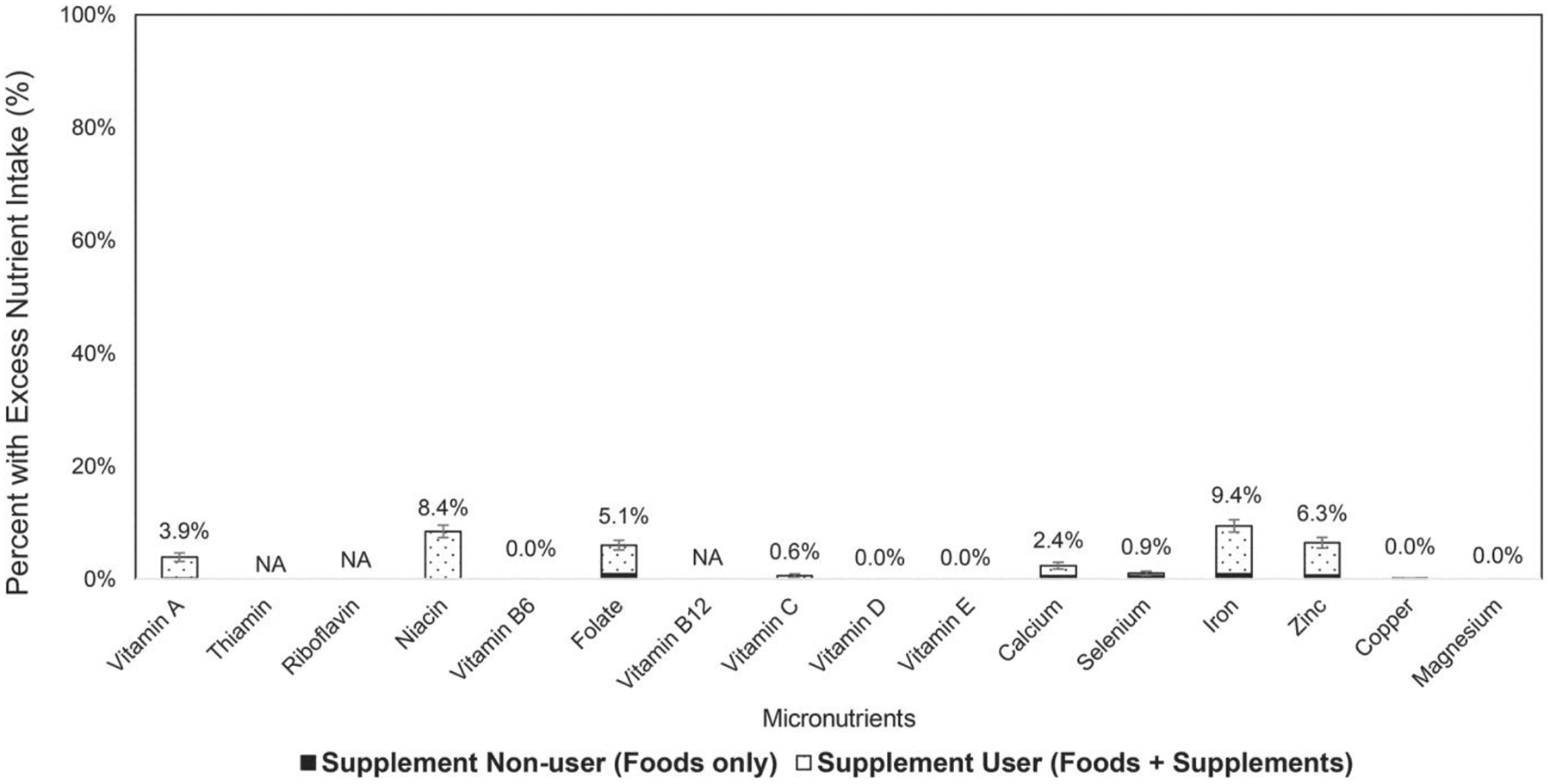
Percent of adult survivors of childhood cancer with excess nutrient intake (total intake level > tolerable upper intake level). Number above the bar represents the percent of excess nutrient among all adult survivors of childhood cancer, including both supplement users and nonusers. The bar in black corresponds to the percent of excess nutrient intake among supplement nonusers; the bar in white with dotted pattern corresponds to the percent of excess nutrient intake among supplement users. UL for vitamin A applies to preformed vitamin A only; UL for niacin and folate applies to synthetic forms obtained from supplements, fortified foods, or a combination of the two (niacin intake from fortified foods is not available in this analysis); vitamin E is assessed as α-tocopherol; and UL for vitamin E applies to any form of supplemental α-tocopherol (vitamin E intake from fortified foods is not available in this analysis); UL for magnesium represents intake from a pharmacological agent only and does not include intake from food and water; no UL is available for thiamin, riboflavin, and vitamin B12. UL, tolerable upper intake level.

References

    1. Zhang FF, Ojha RP, Krull KR, et al. Adult Survivors of Childhood Cancer Have Poor Adherence to Dietary Guidelines. The Journal of Nutrition. Dec 2016;146(12):2497–2505. doi:10.3945/jn.116.238261 - DOI - PMC - PubMed
    1. team TACSmaec. Risks and side effects of dietary supplements. Updated March 31, 2015. Accessed November 15, 2018, 2018. https://www.cancer.org/treatment/treatments-and-side-effects/complementa...
    1. Rock CL, Doyle C, Demark-Wahnefried W, et al. Nutrition and physical activity guidelines for cancer survivors. CA: a cancer journal for clinicians. Jul-Aug 2012;62(4):243–74. doi:10.3322/caac.21142 - DOI - PubMed
    1. Velicer CM, Ulrich CM. Vitamin and mineral supplement use among US adults after cancer diagnosis: a systematic review. Journal of clinical oncology : official journal of the American Society of Clinical Oncology. Feb 01 2008;26(4):665–73. doi:10.1200/jco.2007.13.5905 - DOI - PubMed
    1. Patterson RE, Neuhouser ML, Hedderson MM, Schwartz SM, Standish LJ, Bowen DJ. Changes in diet, physical activity, and supplement use among adults diagnosed with cancer. Journal of the American Dietetic Association. Mar 2003;103(3):323–8. doi:10.1053/jada.2003.50045 - DOI - PubMed

Publication types