Review
. 2023 May;29(5):190-212.
doi: 10.1089/mdr.2021.0424. Epub 2023 Feb 21.

Molecular Mechanisms of MmpL3 Function and Inhibition

Affiliations
Review

Molecular Mechanisms of MmpL3 Function and Inhibition

John T Williams et al. Microb Drug Resist. 2023 May.

Abstract

Mycobacteria species include a large number of pathogenic organisms such as Mycobacterium tuberculosis, Mycobacterium leprae, and various non-tuberculous mycobacteria. Mycobacterial membrane protein large 3 (MmpL3) is an essential mycolic acid and lipid transporter required for growth and cell viability. In the last decade, numerous studies have characterized MmpL3 with respect to protein function, localization, regulation, and substrate/inhibitor interactions. This review summarizes new findings in the field and seeks to assess future areas of research in our rapidly expanding understanding of MmpL3 as a drug target. An atlas of known MmpL3 mutations that provide resistance to inhibitors is presented, which maps amino acid substitutions to specific structural domains of MmpL3. In addition, chemical features of distinct classes of Mmpl3 inhibitors are compared to provide insights into shared and unique features of varied MmpL3 inhibitors.

Keywords: MmpL3; Mycobacterium tuberculosis; phenotypic drug discovery.


Conflict of interest statement

R.B.A. is the founder and owner of Tarn Biosciences, Inc., a company that is working to develop new antimycobacterial drugs.

Figures
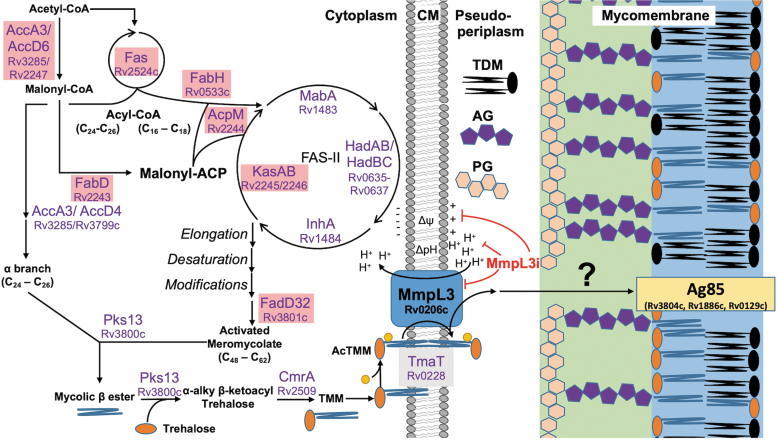
FIG. 1.
FIG. 1.
The biosynthetic pathway of TMM and TDM. The illustration of the biosynthetic route of TMM and TDM in mycobacteria. Gene names of each step include corresponding gene numbers from Mycobacterium tuberculosis H37Rv. Enzymes highlighted in red are genes that are downregulated following MmpL3 disruption. Δψ, membrane potential; AG, arabinogalactan; CM, cytoplasmic membrane; MmpL3i, unspecified MmpL3 inhibitor; PG, peptidoglycan; yellow sphere attached to TMM is an acetyl group.?—an unknown transport system that shuttles TMM to the mycomembrane. MmpL3, mycobacterial membrane protein large 3; TDM, trehalose dimycolate; TMM, trehalose monomycolate.
FIG. 2.
FIG. 2.
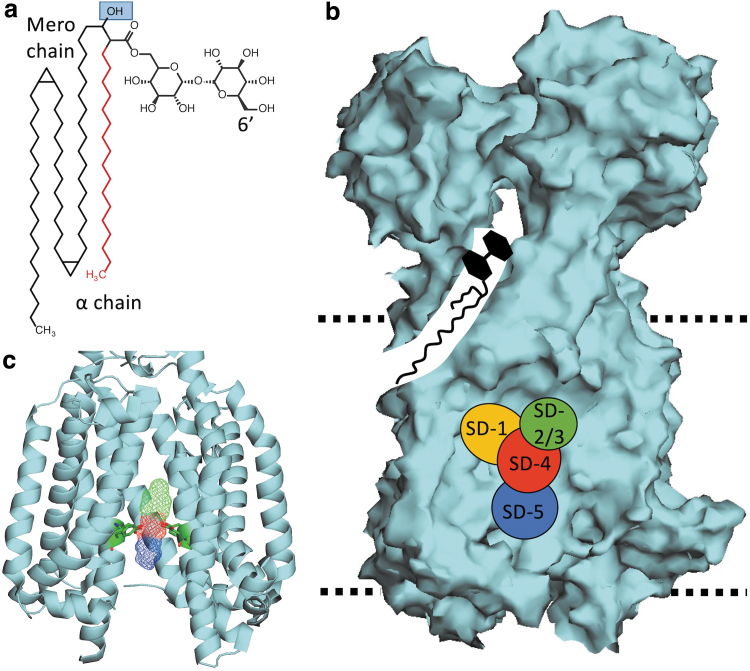
TMM and MmpL3 Structures. (a) The structure of a simple TMM. The α-chain is illustrated in red; the blue square indicates the site of acetylation by TmaT. The site of the acyl transferase reaction carried out by the Ag85 complex, 6′C, is also labeled. (b) A surface illustration of MmpL3 (PDB: 6AJH). The illustration shows a simple model of TMM shuttling form the CM toward the periplasmic porter domains. The binding domains SD-1 to SD-5 are superimposed onto this model. The dotted lines indicate the approximate position of the CM. (c) An illustration of the transmembrane region of MmpL3 (PDB: 6JAH) bound to a model MmpL3 inhibitor shown in wire form. TMD 10 has been removed to show binding of the model inhibitor. The amino acids illustrated show the Tyr-Asp pairs required for proton relay. PDB, protein data bank.
FIG. 3.
FIG. 3.
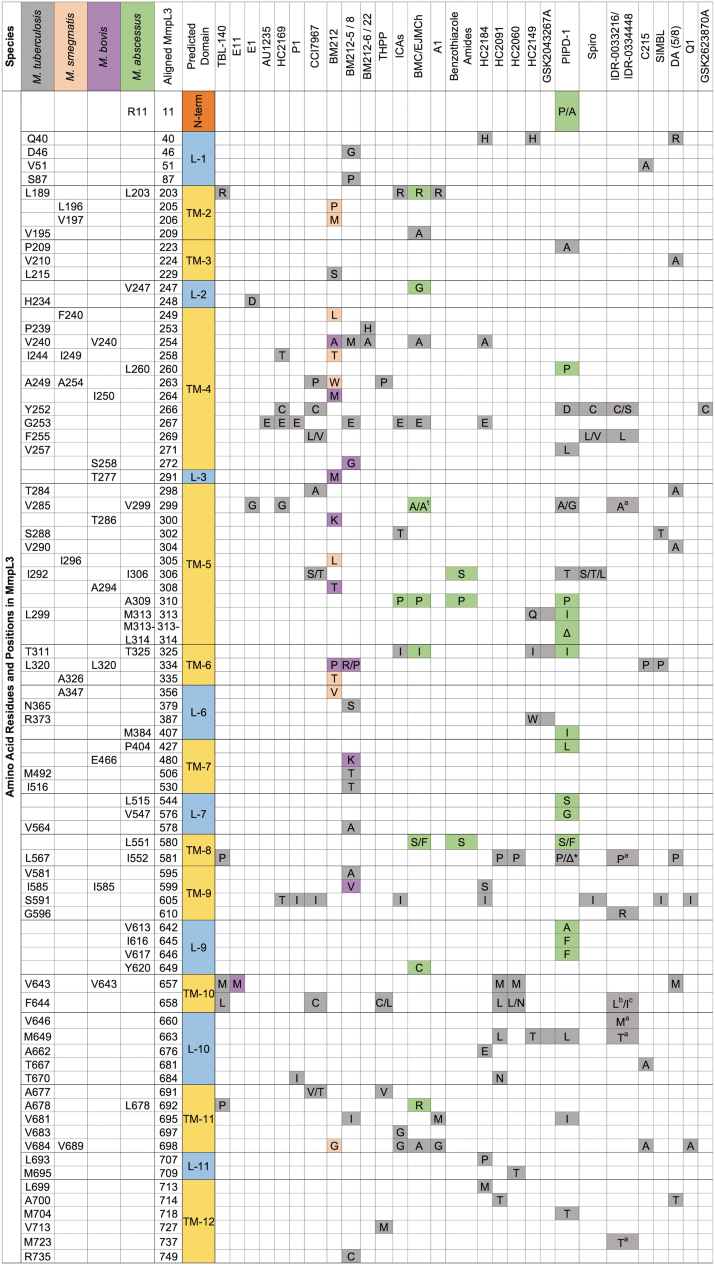
Amino acid substitution localization for MmpL3 inhibitor-resistant mutants. A matrix that demonstrates the amino acid position and substitution for nonsynonymous mutations found in MmpL3 inhibitor-resistant mutants. The matrix includes inhibitors for which resistant mutants have been identified in four species, including Mycobacterium tuberculosis (gray), Mycobacterium smegmatis (orange), Mycobacterium bovis BCG (purple), and Mycobacterium abscessus (green). MmpL3 protein sequences were aligned and indicate orthologous positions between species. *Substitutions in position 581 of the aligned protein for PIPD-1 were discovered in either the M. tuberculosis (P) or M. abscessus (Δ), A indicates substitution in M. tuberculosis background at the 299 position of the aligned sequence (M. tuberculosis—V285). aIndicates secondary substitutions made in the M. tuberculosis F255L background isolated from IDR-0033216, b,cIndicate tertiary substitutions sequenced from AU1235 resistant mutants in M. tuberculosis F255L/L567P and F255L/V646M backgrounds, respectively. BCG, Bacillus Calmette-Guérin; L, loop; TM, transmembrane.
FIG. 4.
FIG. 4.
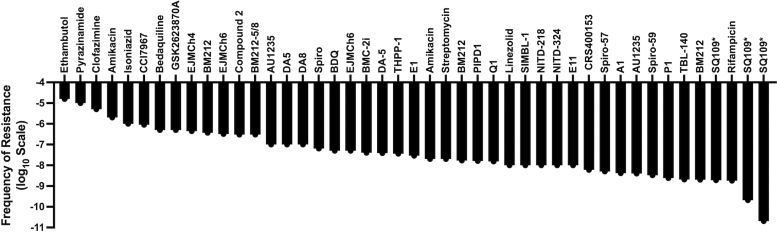
Mycobacteria have a moderate FoR to MmpL3 inhibitors. FoR plot for MmpL3 inhibitors as well as other TB drugs against mycobacteria.,,,,,,,,, *Indicates FoR for SQ109 measured in Helicobacter pylori. FoR, frequency of resistance; TB, tuberculosis.
FIG. 5.
FIG. 5.
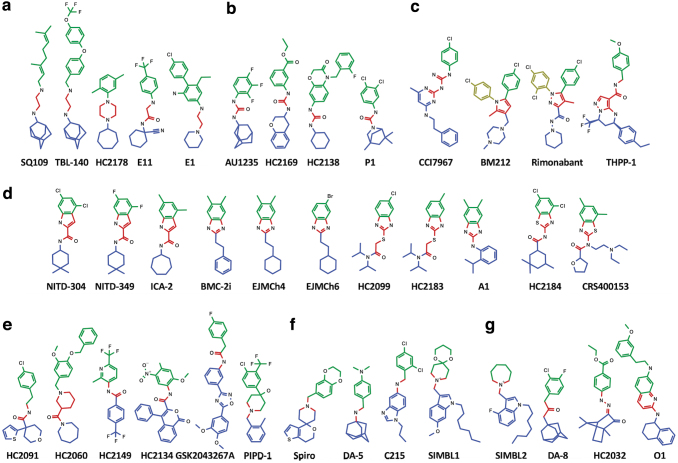
MmpL3 inhibitors share distinguishing and overlapping features. MmpL3 inhibitors fall into seven distinct classes of inhibitors based on shared Central core chemical groups, including diamines/acetamides (a), ureas/guanidines (b), pyrole/pyrazoles (c), indoles/imidazoles/thiazoles (d), amides (e), amines (f), and a seventh class of unshared core chemical groups (g). Colored structures indicate shared chemical groups found between all MmpL3 inhibitors, including the Central nucleophilic/basic core group (red), as well as the lipophilic/hydrophobic Northern (green) and Southern (blue) groups. Noted exceptions are the additional North-Western chemical groups (yellow) found in BM212 and Rimonabant. North, Central, and South chemical nomenclature is adopted from framework proposed by Guardia et al.

References

    1. WHO. Global Tuberculosis Report. WHO: Genava; 2021.
    1. Ding P, Li X, Jia Z, et al. . Multidrug-resistant tuberculosis (MDR-TB) disease burden in China: A systematic review and spatio-temporal analysis. BMC Infect Dis 2017l;17:57; doi: 10.1186/s12879-016-2151-5 - DOI - PMC - PubMed
    1. Shen Y, Wang X, Jin J, et al. . In Vitro susceptibility of Mycobacterium abscessus and Mycobacterium fortuitum isolates to 30 antibiotics. Biomed Res Int 2018;2018:4902941; doi: 10.1155/2018/4902941 - DOI - PMC - PubMed
    1. Pang H, Jiang Y, Wan K. Drug susceptibility of 33 reference strains of slowly growing mycobacteria to 19 antimicrobial agents. Biomed Res Int 2017;2017:1584658; doi: 10.1155/2017/1584658 - DOI - PMC - PubMed
    1. Wu ML, Aziz DB, Dartois V, et al. . NTM drug discovery: Status, gaps and the way forward. Drug Discov Today 2018;23:1502–1519; doi: 10.1016/j.drudis.2018.04.001 - DOI - PMC - PubMed

MeSH terms

LinkOut - more resources