. 2023 Feb 21;11(2):e0366122.
doi: 10.1128/spectrum.03661-22. Online ahead of print.

Synergy between Genome Mining, Metabolomics, and Bioinformatics Uncovers Antibacterial Chlorinated Carbazole Alkaloids and Their Biosynthetic Gene Cluster from Streptomyces tubbatahanensis sp. nov., a Novel Actinomycete Isolated from Sulu Sea, Philippines

Affiliations

Synergy between Genome Mining, Metabolomics, and Bioinformatics Uncovers Antibacterial Chlorinated Carbazole Alkaloids and Their Biosynthetic Gene Cluster from Streptomyces tubbatahanensis sp. nov., a Novel Actinomycete Isolated from Sulu Sea, Philippines

Chuckcris P Tenebro et al. Microbiol Spectr. .

Abstract

In this study, a novel actinomycete strain, DSD3025T, isolated from the underexplored marine sediments in Tubbataha Reefs Natural Park, Sulu Sea, Philippines, with the proposed name Streptomyces tubbatahanensis sp. nov., was described using polyphasic approaches and characterized using whole-genome sequencing. Its specialized metabolites were profiled using mass spectrometry and nuclear magnetic resonance analyses, followed by antibacterial, anticancer, and toxicity screening. The S. tubbatahanensis DSD3025T genome was comprised of 7.76 Mbp with a 72.3% G+C content. The average nucleotide identity and digital DNA-DNA hybridization values were 96.5% and 64.1%, respectively, compared with its closest related species, thus delineating the novelty of Streptomyces species. The genome encoded 29 putative biosynthetic gene clusters (BGCs), including a BGC region containing tryptophan halogenase and its associated flavin reductase, which were not found in its close Streptomyces relatives. The metabolite profiling unfolded six rare halogenated carbazole alkaloids, with chlocarbazomycin A as the major compound. A biosynthetic pathway for chlocarbazomycin A was proposed using genome mining, metabolomics, and bioinformatics platforms. Chlocarbazomycin A produced by S. tubbatahanensis DSD3025T has antibacterial activities against Staphylococcus aureus ATCC BAA-44 and Streptococcus pyogenes and showed antiproliferative activity against colon (HCT-116) and ovarian (A2780) human cancer cell lines. Chlocarbazomycin A exhibited no toxicity to liver cells but moderate and high toxicity to kidney and cardiac cell lines, respectively. IMPORTANCE Streptomyces tubbatahanensis DSD3025T is a novel actinomycete with antibiotic and anticancer activities from Tubbataha Reefs Natural Park, a United Nations Educational, Scientific and Cultural Organization World Heritage Site in Sulu Sea and considered one of the Philippines' oldest and most-well-protected marine ecosystems. In silico genome mining tools were used to identify putative BGCs that led to the discovery of genes involved in the production of halogenated carbazole alkaloids and new natural products. By integrating bioinformatics-driven genome mining and metabolomics, we unearthed the hidden biosynthetic richness and mined the associated chemical entities from the novel Streptomyces species. The bioprospecting of novel Streptomyces species from marine sediments of underexplored ecological niches serves as an important source of antibiotic and anticancer drug leads with unique chemical scaffolds.

Keywords: Streptomyces; antibiotic; anticancer; biosynthetic gene clusters; flavin reductase; halogenated carbazole alkaloids; specialized metabolites; tryptophan halogenase.


Conflict of interest statement

The authors declare no conflict of interest.

Figures

FIG 1
FIG 1
Maximum-likelihood tree showing phylogenetic relationships between S. tubbatahanensis DSD3025T and related Streptomyces species, based on 16S rRNA gene sequences (A) and concatenated five housekeeping genes (atpD, gyrB, rpoB, recA, and trpB) (B). Only bootstrap values above 50% (percentages of 1,000 replications) are indicated. Asterisks and crosses indicate branches that were also found using neighbor-joining and the maximum-parsimony method, respectively.
FIG 2
FIG 2
Taxonomic tools for the identification of novel Streptomyces species. (A) MLSA evolutionary distance and dDDH comparison between S. tubbatahanensis DSD3025T and phylogenetic neighbors. (B) orthoANI v0.93.1 analysis using OAT software for S. tubbatahanensis DSD3025T and related Streptomyces species.
FIG 3
FIG 3
Genome annotations of S. tubbatahanensis DSD3025T. (A) The circular map of the S. tubbatahanensis DSD3025T genome, displaying contig information in the outer circle, while the next adjacent circles show the distribution of COG genes in the forward and reverse strands, respectively. The next circle displays the rRNA and tRNA, followed by a circle for GC skew, with higher-than-average values displayed in green and lower-than-average values displayed in red. The next inner circle displays the GC ratios, with higher-than-average values in blue and lower-than-average values in yellow. (B) Clusters of Orthologous Groups (COGs) functional features. (C) Visualized locations of the 29 specialized metabolite BGC regions in the linearized genome of S. tubbatahanensis DSD3025T, as predicted by antiSMASH v.7.0. BGC regions ranged from 7,831 to 106,511 nucleotides.
FIG 4
FIG 4
Cultural morphology of S. tubbatahanensis DSD3025T on MM1 agar (A) and a scanning electron micrograph showing mycelial filaments and intertwining hyphal cells (B).
FIG 5
FIG 5
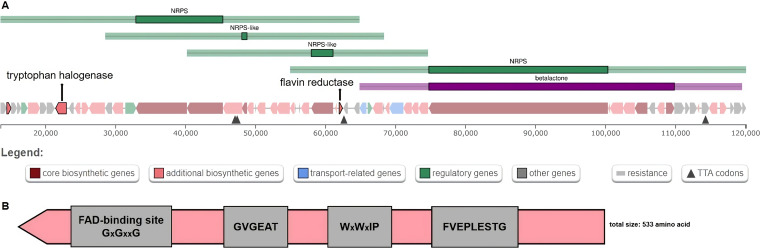
Biosynthetic gene cluster containing the halogenase gene and its conserved motifs encoded in the S. tubbatahanensis DSD3025T genome. (A) BGC region 1 in S. tubbatahanensis DSD3025T harbored the two-component halogenase/reductase system, the tryptophan halogenase, and its associated flavin reductase. (B) Amino acid sequence assembly of tryptophan halogenase in S. tubbatahanensis DSD3025T, showing the conserved motifs for FADH2-dependent halogenases.
FIG 6
FIG 6
Structures of chlorinated carbazole alkaloids, namely, chlocarbazomycin A (1), chlocarbazomycin B (2a) or C (2b), chlocarbazomycin E (3), brocarbazomycin A (4), thiocarbazomycins A (5) and B (6), and a new compound (7) from Streptomyces tubbatahanensis DSD3025T.
FIG 7
FIG 7
Proposed biosynthetic pathway of chlocarbazomycin A compound 1.
FIG 8
FIG 8
Distribution of biosynthetic gene machineries for carbazole formation in Streptomyces. The BGCs for the biosynthesis of neocarazostatin A by Streptomyces sp. MA37, carquinostatin A by S. exfoliatus 2419-SVT2, carbazomycin B by S. luteoverticillatus CGMMC 15060, and chlocarbazomycins by S. diacarni LHW51701T and S. tubbatahanensis DSD3025T are displayed as key features of carbazole metabolites.
FIG 9
FIG 9
Effects of S. tubbatahanensis DSD3025T extract (5 mg/mL) on the cell viability and membrane integrity of S. aureus ATCC BAA-44 after 6-h treatment exposure. (A) Fluorescence microscope images of multidrug-resistant S. aureus ATCC BAA-44 cells at ×100 magnification. Cells were stained with calcein-AM (green; live cells)-PI (red; dead cells) for live and dead cell differentiation. Scale bar, 20 μm. (B) Flow cytometric scatterplot profile of c-AM–PI-stained multidrug-resistant S. aureus ATCC BAA-44 cells. Regions R1 and R2 represent dead and live cells, respectively. (C) Total CFU in each treatment (n = 9) after 24 h of incubation.
FIG 10
FIG 10
Antiproliferation (MTT) and toxicity assays of S. tubbatahanensis DSD3025T. (A) Antiproliferative activity of S. tubbatahanensis DSD3025T extract against MCF-7, HCT-116, and A2780 cell lines. (B) Toxicity results of S. tubbatahanensis DSD3025T extract against kidney (HK-2), liver (Hep G2), and cardiac (H9c2 [2-1]) cell lines. (C) Antiproliferative activity of 1 isolated from of S. tubbatahanensis DSD3025T versus the positive control (tamoxifen, cisplatin, and 5-fluorouracil) against MCF-7, HCT-116, and A2780 cell lines, respectively. (D) Toxicity results for 1 versus positive control, doxorubicin HCl (HK-2, H9c2 [2-1]), and tamoxifen (Hep G2) cell lines.

References

    1. World Health Organization. 2021. Antimicrobial resistance. https://www.who.int/news-room/fact-sheets/detail/antimicrobial-resistance.
    1. Kalkreuter E, Pan G, Cepeda AJ, Shen B. 2020. Targeting bacterial genomes for natural product discovery. Trends Pharmacol Sci 41:13–26. doi: 10.1016/j.tips.2019.11.002. - DOI - PMC - PubMed
    1. Lo Grasso L, Chilura-Martino D, Alduina R. 2016. Production of antibacterial compounds from Actinomycetes, p 272–282. In Dhanasekaran D, Jiang Y (ed), Actinobacteria: basics and biotechological applications. IntechOpen. doi: 10.5772/60457. - DOI
    1. Olano C, Méndez C, Salas JA. 2011. Molecular insights on the biosynthesis of antitumour compounds by actinomycetes. Microb Biotechnol 4:144–164. doi: 10.1111/j.1751-7915.2010.00231.x. - DOI - PMC - PubMed
    1. Nett M, Ikeda H, Moore BS. 2009. Genomic basis for natural product biosynthetic diversity in the actinomycetes. Nat Prod Rep 26:1362–1384. doi: 10.1039/b817069j. - DOI - PMC - PubMed

LinkOut - more resources