


Kinless Older Adults With Dementia: Qualitative Analysis of Data From the Adult Changes in Thought Study
- PMID: 36809476
- PMCID: PMC10214647
- DOI: 10.1093/geronb/gbad030
Kinless Older Adults With Dementia: Qualitative Analysis of Data From the Adult Changes in Thought Study
Abstract
Objectives: To examine the circumstances and needs of older adults who were "kinless," defined as having no living spouse or children, when they developed dementia.
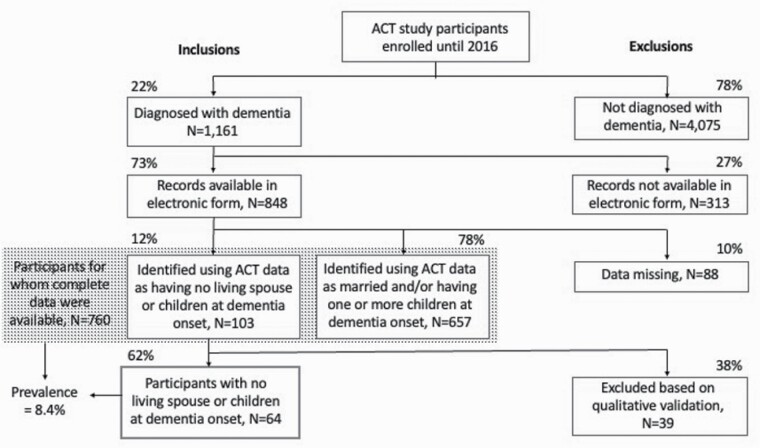
Methods: We conducted a secondary analysis of information from the Adult Changes in Thought study. Among 848 participants diagnosed with dementia between 1994 and 2016, we identified 64 who had no living spouse or child at dementia onset. We then conducted a qualitative analysis of administrative documents pertaining to these participants: handwritten comments recorded after each study visit, and medical history documents containing clinical chart notes from participants' medical records.
Results: In this community-dwelling cohort of older adults diagnosed with dementia, 8.4% were kinless at dementia onset. Participants in this sample had an average age of 87 years old, half lived alone, and one third lived with unrelated persons. Through inductive content analysis, we identified 4 themes that describe their circumstances and needs: (1) life trajectories, (2) caregiving resources, (3) care needs and gaps, and (4) turning points in caregiving arrangements.
Discussion: Our qualitative analysis reveals that the life trajectories that led members of the analytic cohort to be kinless at dementia onset were quite varied. This research highlights the importance of nonfamily caregivers and participants' own roles as caregivers. Our findings suggest that clinicians and health systems may need to work with other parties to directly provide dementia caregiving support rather than rely on family, and address factors such as neighborhood affordability that particularly affect older adults who have limited family support.
Keywords: Caregiving; Dementia; Family; Kinless; Qualitative research.
© The Author(s) 2023. Published by Oxford University Press on behalf of The Gerontological Society of America.
Conflict of interest statement
None declared.
Figures
References
-
- Abreu, W., Tolson, D., Jackson, G. A., Staines, H., & Costa, N. (2019). The relationship between frailty, functional dependence, and healthcare needs among community-dwelling people with moderate to severe dementia. Health & Social Care in the Community, 27(3), 642–653. doi: 10.1111/hsc.12678 - DOI - PubMed
-
- Allen, S. M., Piette, E. R., & Mor, V. (2014). The adverse consequences of unmet need among older persons living in the community: Dual-eligible versus Medicare-only beneficiaries. The Journals of Gerontology, Series B: Psychological Sciences and Social Sciences, 69(Suppl 1), S51–S58. doi: 10.1093/geronb/gbu124 - DOI - PMC - PubMed
-
- American Psychiatric Association Task Force on DSM-IV & American Psychiatric Association. (1994). Diagnostic and statistical manual of mental disorders: DSM-IV (4th ed.). American Psychiatric Association.
-
- Anderson, R. T., Bradham, D. D., Jackson, S., Heuser, M. D., Wofford, J. L., & Colombo, K. A. (2000). Caregivers’ unmet needs for support in caring for functionally impaired elderly persons: A community sample. Journal of Health Care for the Poor and Underserved, 11(4), 412–429. doi: 10.1353/hpu.2010.0776 - DOI - PubMed
Publication types
MeSH terms
Grants and funding
LinkOut - more resources
Full Text Sources
Medical
