


Clinical features and long-term management of cats with primary hypoadrenocorticism using desoxycorticosterone pivalate and prednisolone
- PMID: 36809682
- PMCID: PMC10061202
- DOI: 10.1111/jvim.16658
Clinical features and long-term management of cats with primary hypoadrenocorticism using desoxycorticosterone pivalate and prednisolone
Abstract
Background: Primary hypoadrenocorticism (PH) is rare in cats and knowledge about treatment is sparse.
Objective: To describe cats with PH with a focus on long-term treatment.
Animals: Eleven cats with naturally occurring PH.
Methods: Descriptive case series with data on signalment, clinicopathological findings, adrenal width, and doses of desoxycorticosterone pivalate (DOCP) and prednisolone during a follow-up period of >12 months.
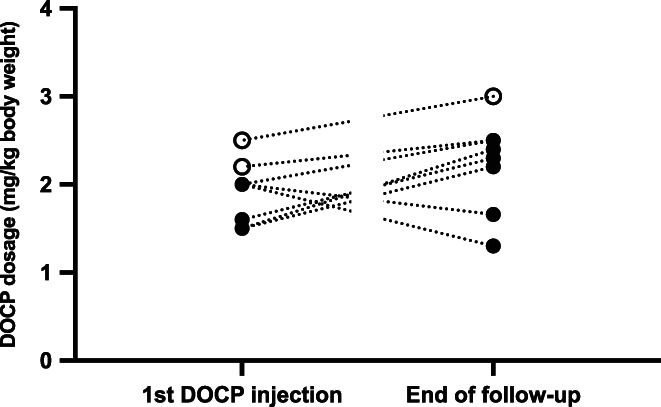
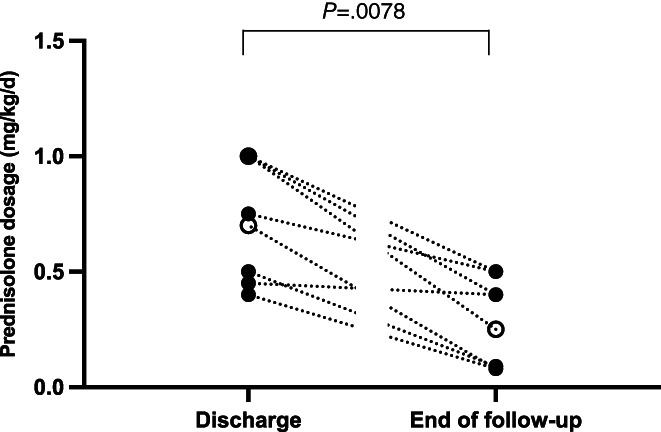
Results: Cats ranged from 2 to 10 years (median 6.5); 6 cats were British Shorthair. Most common signs were reduced general condition and lethargy, anorexia, dehydration, obstipation, weakness, weight loss, and hypothermia. Adrenal glands on ultrasonography were judged small in 6. Eight cats could be followed for 14 to 70 months (median: 28). Two were started on DOCP doses ≥2.2 mg/kg (2.2; 2.5) and 6 < 2.2 mg/kg (1.5-2.0 mg/kg, median 1.8) q28 days. Both high-dose cats and 4 low-dose cats needed a dose increase. Desoxycorticosterone pivalate and prednisolone doses at the end of the follow-up period were 1.3 to 3.0 mg/kg (median: 2.3) and 0.08 to 0.5 mg/kg/day (median: 0.3), respectively.
Conclusions and clinical importance: Desoxycorticosterone pivalate and prednisolone requirements in cats were higher than what is currently used in dogs; thus, a DOCP starting dose of 2.2 mg/kg q28 days and a prednisolone maintenance dose of 0.3 mg/kg/day titrated to the individual need seems warranted. Small adrenal glands (width < 2.7 mm) on ultrasonography in a cat suspected of hypoadrenocorticism can be suggestive of the disease. The apparent predilection of British Shorthaired cats for PH should be further evaluated.
Keywords: Addison's disease; feline; mineralocorticoid; therapy.
© 2023 The Authors. Journal of Veterinary Internal Medicine published by Wiley Periodicals LLC on behalf of American College of Veterinary Internal Medicine.
Conflict of interest statement
Authors declare no conflict of interest.
Figures
References
-
- Bell R, Mellor DJ, Ramsey I, et al. Decreased sodium:potassium ratios in cats: 49 cases. Vet Clin Pathol. 2005;34:110‐114. - PubMed
-
- Peterson ME, Greco DS, Orth DN. Primary hypoadrenocorticism in ten cats. J Vet Intern Med. 1989;3:55‐58. - PubMed
-
- Stonehewer J, Tasker S. Hypoadrenocorticism in a cat. J Small Anim Pract. 2001;42:186‐190. - PubMed
MeSH terms
Substances
LinkOut - more resources
Full Text Sources
Medical
Miscellaneous