Human-Centered Design of a Clinical Decision Support for Anemia Screening in Children with Inflammatory Bowel Disease
- PMID: 36809791
- PMCID: PMC10171996
- DOI: 10.1055/a-2040-0578
Human-Centered Design of a Clinical Decision Support for Anemia Screening in Children with Inflammatory Bowel Disease
Abstract
Background: Inflammatory bowel disease (IBD) commonly leads to iron deficiency anemia (IDA). Rates of screening and treatment of IDA are often low. A clinical decision support system (CDSS) embedded in an electronic health record could improve adherence to evidence-based care. Rates of CDSS adoption are often low due to poor usability and fit with work processes. One solution is to use human-centered design (HCD), which designs CDSS based on identified user needs and context of use and evaluates prototypes for usefulness and usability.
Objectives: this study aimed to use HCD to design a CDSS tool called the IBD Anemia Diagnosis Tool, IADx.
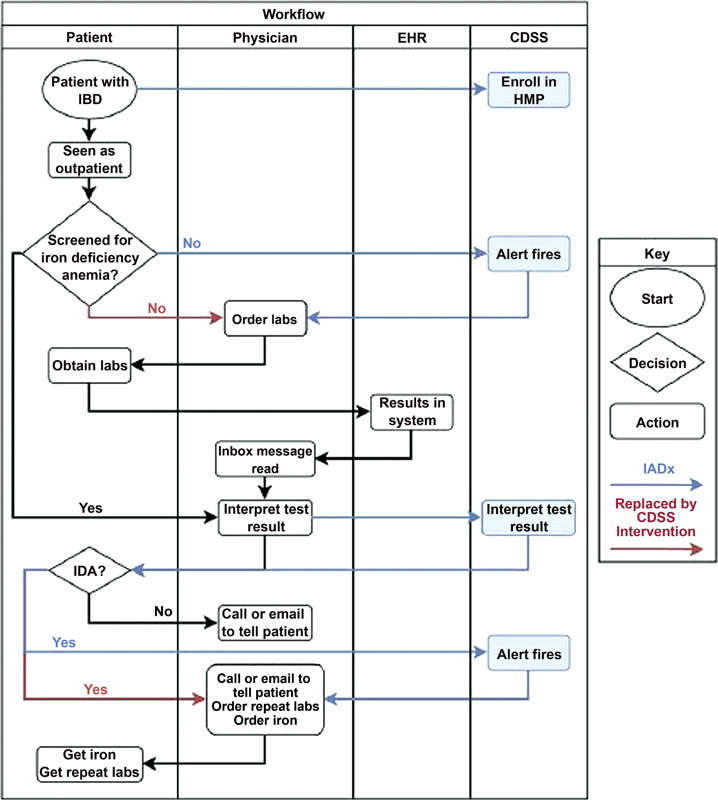
Methods: Interviews with IBD practitioners informed creation of a process map of anemia care that was used by an interdisciplinary team that used HCD principles to create a prototype CDSS. The prototype was iteratively tested with "Think Aloud" usability evaluation with clinicians as well as semi-structured interviews, a survey, and observations. Feedback was coded and informed redesign.
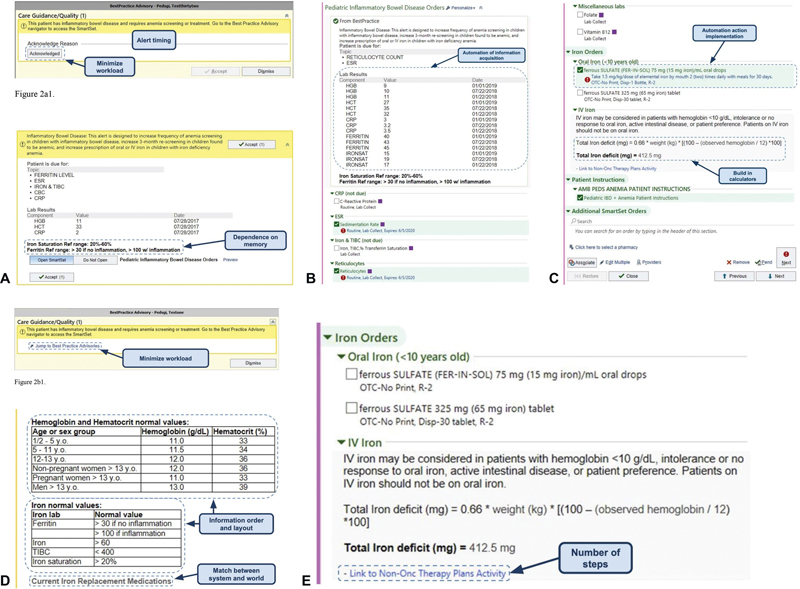
Results: Process mapping showed that IADx should function at in-person encounters and asynchronous laboratory review. Clinicians desired full automation of clinical information acquisition such as laboratory trends and analysis such as calculation of iron deficit, less automation of clinical decision selection such as laboratory ordering, and no automation of action implementation such as signing medication orders. Providers preferred an interruptive alert over a noninterruptive reminder.
Conclusion: Providers preferred an interruptive alert, perhaps due to the low likelihood of noticing a noninterruptive advisory. High levels of desire for automation of information acquisition and analysis with less automation of decision selection and action may be generalizable to other CDSSs designed for chronic disease management. This underlines the ways in which CDSSs have the potential to augment rather than replace provider cognitive work.
Thieme. All rights reserved.
Conflict of interest statement
The authors have no financial or personal relationships with people or organizations that could inappropriately influence or bias the objectivity of the submitted content. The authors have no conflicts of interest.
Figures
References
-
- Pigneur B, Seksik P, Viola S. Natural history of Crohn's disease: comparison between childhood- and adult-onset disease. Inflamm Bowel Dis. 2010;16(06):953–961. - PubMed
-
- Goodhand J R, Kamperidis N, Rao A. Prevalence and management of anemia in children, adolescents, and adults with inflammatory bowel disease. Inflamm Bowel Dis. 2012;18(03):513–519. - PubMed
-
- Danese S, Hoffman C, Vel S. Anaemia from a patient perspective in inflammatory bowel disease: results from the European Federation of Crohn's and Ulcerative Colitis Association's online survey. Eur J Gastroenterol Hepatol. 2014;26(12):1385–1391. - PubMed
-
- McCann J C, Ames B N. An overview of evidence for a causal relation between iron deficiency during development and deficits in cognitive or behavioral function. Am J Clin Nutr. 2007;85(04):931–945. - PubMed
MeSH terms
LinkOut - more resources
Full Text Sources
Medical