


Effectiveness of a Smartphone App (MINISTOP 2.0) integrated in primary child health care to promote healthy diet and physical activity behaviors and prevent obesity in preschool-aged children: randomized controlled trial
- PMID: 36810069
- PMCID: PMC9942425
- DOI: 10.1186/s12966-023-01405-5
Effectiveness of a Smartphone App (MINISTOP 2.0) integrated in primary child health care to promote healthy diet and physical activity behaviors and prevent obesity in preschool-aged children: randomized controlled trial
Abstract
Background: Childhood overweight and obesity is a public health priority. We have previously reported the efficacy of a parent-oriented mobile health (mHealth) app-based intervention (MINISTOP 1.0) which showed improvements in healthy lifestyle behaviors. However, the effectiveness of the MINISTOP app in real-world conditions needs to be established.
Objective: To evaluate the real-world effectiveness of a 6-month mHealth intervention (MINISTOP 2.0 app) on children's intake of fruits, vegetables, sweet and savory treats, sweet drinks, moderate-to-vigorous physical activity, and screen time (primary outcomes), and on parental self-efficacy (PSE) for promoting healthy lifestyle behaviors, and children's body mass index (BMI) (secondary outcomes).
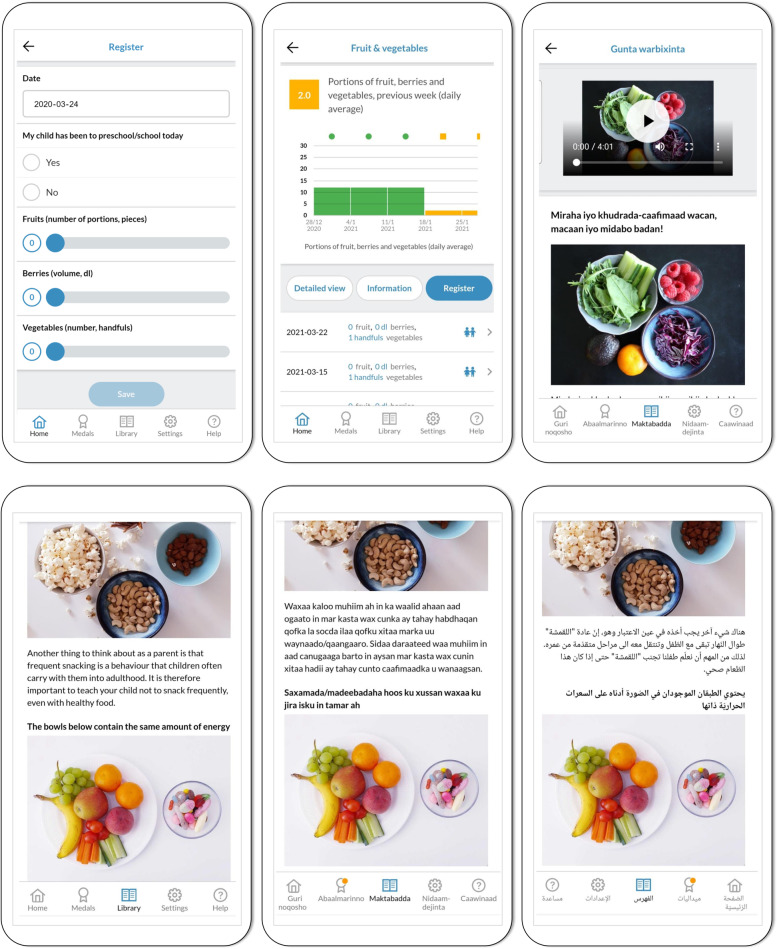
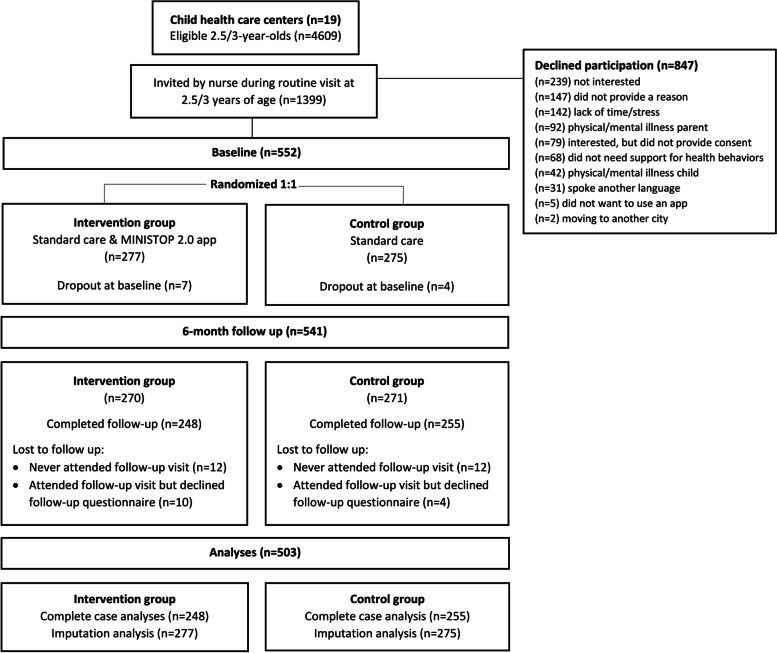
Methods: A hybrid type 1 effectiveness-implementation design was utilized. For the effectiveness outcomes, a two-arm, individually randomized controlled trial was conducted. Parents (n = 552) of 2.5-to-3-year-old children were recruited from 19 child health care centers across Sweden, and, randomized to either a control (standard care) or intervention group (MINISTOP 2.0 app). The 2.0 version was adapted and translated into English, Somali and Arabic to increase reach. All recruitment and data collection were conducted by the nurses. Outcomes were assessed at baseline and after six months, using standardized measures (BMI) and a questionnaire (health behaviors, PSE).
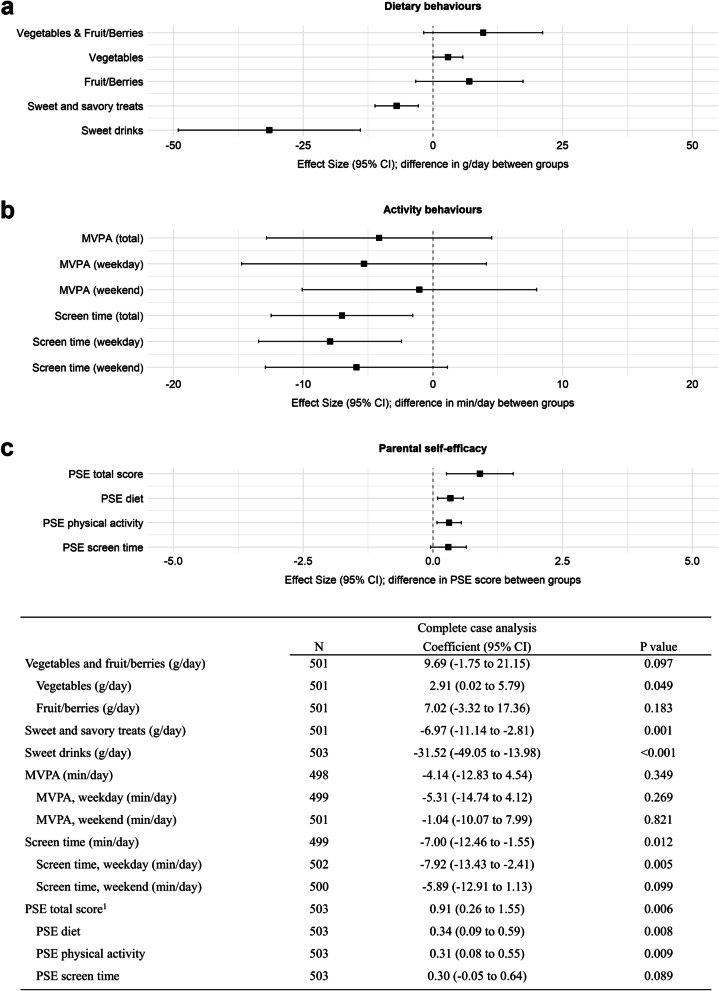
Results: Among the participating parents (n = 552, age: 34.1 ± 5.0 years), 79% were mothers and 62% had a university degree. Twenty-four percent (n = 132) of children had two foreign-born parents. At follow-up, parents in the intervention group reported lower intakes of sweet and savory treats (-6.97 g/day; p = 0.001), sweet drinks (-31.52 g/day; p < 0.001), and screen time (-7.00 min/day; p = 0.012) in their children compared to the control group. The intervention group reported higher total PSE (0.91; p = 0.006), PSE for promoting healthy diet (0.34; p = 0.008) and PSE for promoting physical activity behaviors (0.31; p = 0.009) compared to controls. No statistically significant effect was observed for children's BMI z-score. Overall, parents reported high satisfaction with the app, and 54% reported using the app at least once a week.
Conclusion: Children in the intervention group had lower intakes of sweet and savory treats, sweet drinks, less screen time (primary outcomes) and their parents reported higher PSE for promoting healthy lifestyle behaviors. Our results from this real-world effectiveness trial support the implementation of the MINISTOP 2.0 app within Swedish child health care.
Trial registration: Clinicaltrials.gov NCT04147039; https://clinicaltrials.gov/ct2/show/NCT04147039.
Keywords: Childhood overweight and obesity; Diet; Early prevention; Physical activity; Preschool; Primary child health care; Randomized controlled trial; Smartphone app; mHealth.
© 2023. The Author(s).
Conflict of interest statement
The authors declare no competing interests. MB owns a private company (Alexit AB) that develops and distributes lifestyle interventions for health care professionals and settings, however, this company was not involved in any part of the study.
Figures
References
-
- World Health Organization. World Obesity Day 2022 - Accelerating action to stop obesity. Accessed 24 May 2022. https://www.who.int/news/item/04-03-2022-world-obesity-day-2022-accelera...
-
- Obesity Fact Sheet. World obesity day (4 March 2022). Accessed 24 May 2022. https://www.worldobesityday.org/assets/downloads/Factsheet_2022_-_Englis...
-
- Public Health Agency of Sweden. Living Conditions and Lifestyle. Overweight and obesity in children aged 0–5 years. Accessed 24 May 2022. https://www.folkhalsomyndigheten.se/livsvillkor-levnadsvanor/fysisk-akti...
-
- Public Health Agency of Sweden. Living Conditions and Lifestyle. Overweight and obesity in children aged 6–10 years. Accessed 24 May 2022. https://www.folkhalsomyndigheten.se/livsvillkor-levnadsvanor/fysisk-akti...
