Review
. 2022 Jun 30;1(6):e0000064.
doi: 10.1371/journal.pdig.0000064. eCollection 2022 Jun.

The potential of digital molecular diagnostics for infectious diseases in sub-Saharan Africa

Collaborators
Review

The potential of digital molecular diagnostics for infectious diseases in sub-Saharan Africa

Digital Diagnostics for Africa Network. PLOS Digit Health. .

Erratum in

Abstract

There is a large gap between diagnostic needs and diagnostic access across much of sub-Saharan Africa (SSA), particularly for infectious diseases that inflict a substantial burden of morbidity and mortality. Accurate diagnostics are essential for the correct treatment of individuals and provide vital information underpinning disease surveillance, prevention, and control strategies. Digital molecular diagnostics combine the high sensitivity and specificity of molecular detection with point-of-care format and mobile connectivity. Recent developments in these technologies create an opportunity for a radical transformation of the diagnostic ecosystem. Rather than trying to emulate diagnostic laboratory models in resource-rich settings, African countries have the potential to pioneer new models of healthcare designed around digital diagnostics. This article describes the need for new diagnostic approaches, highlights advances in digital molecular diagnostic technology, and outlines their potential for tackling infectious diseases in SSA. It then addresses the steps that will be necessary for the development and implementation of digital molecular diagnostics. Although the focus is on infectious diseases in SSA, many of the principles apply to other resource-limited settings and to noncommunicable diseases.


Conflict of interest statement

I have read the journal’s policy and the authors of this manuscript have the following competing interests: P.G., J.R-M., and N.M, have a start-up company, ProtonDx Ltd, producing a digital diagnostic for detection of SARS-CoV-2. P.G., J.R.-M. and J.B. are named authors on a patent that covers methodology for detection of single nucleotide polymorphisms that can be used in a digital diagnostic for malaria. All other authors declare no conflicts of interest.

Figures
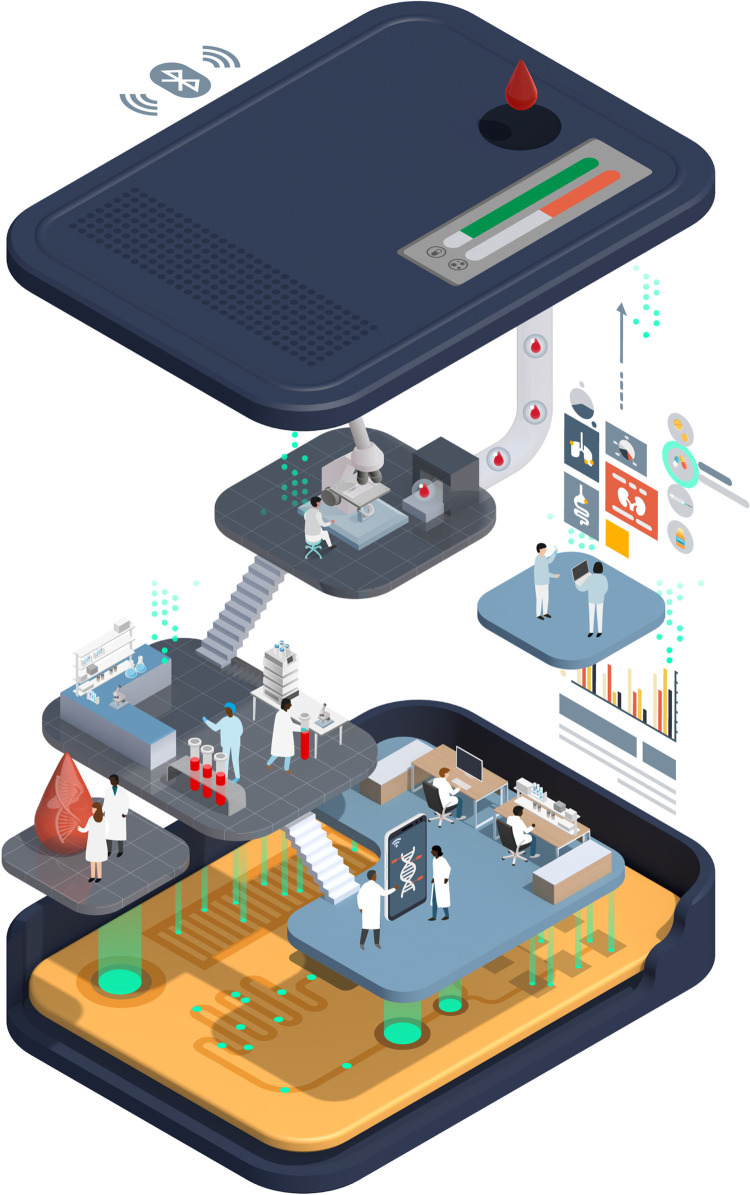
Fig 1
Fig 1. What is a digital molecular diagnostic?
Throughout this article, the term “digital molecular diagnostic” describes a small electronic device, providing a sample-to-answer solution to a diagnostic problem, in a portable, easy-to-use, robust, and cheap format. Any processing of a biological sample would ideally be integrated into the device, before allowing quantitative detection of the molecules used to make the diagnosis. The molecules detected are typically nucleic acids (DNA or RNA), but could also include proteins, or small chemical molecules. Such digital diagnostics will often use lab-on-chip technology, with their defining features being the generation, processing, and storage of data. Signals from the detection of molecules undergo processing within the device, so that actionable results are reported to the user without the need for further analysis. Results may be displayed on the device itself, or linked to other interfaces such as smartphones, and decision support may be integrated. Quantitative data generated by the device can be easily and immediately transmitted to facilitate patient care and contribute to disease surveillance.
Fig 2
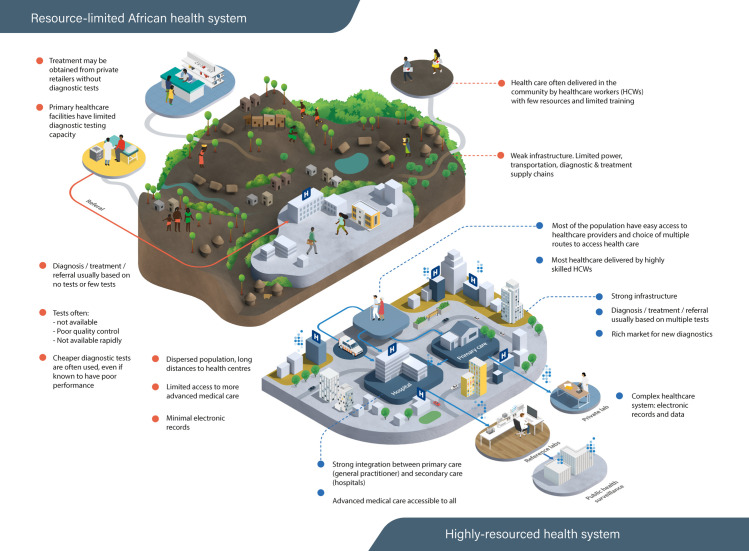
Fig 2. Contrasting access to healthcare and diagnostics between low-resourced SSA settings and highly resourced healthcare settings.
In countries with highly resourced health systems, most of the population have easy access to health care services, often through multiple different routes. A wide range of diagnostic tests can be accessed through most healthcare providers, even if the samples need to be sent elsewhere for analysis. Strong infrastructure allows rapid transport, testing, and feedback of results, and diagnostic information can be shared between providers and patients with relative ease. Healthcare providers are often highly skilled and able to interpret the results of many different tests. In contrast, access to healthcare facilities and skilled healthcare workers in SSA is more heterogeneous and often limited, sometimes involving long journeys or incurring high costs to patients and their families. In rural and remote areas, the only accessible healthcare may be delivered by less skilled community healthcare workers, equipped with a limited range of point-of-care diagnostic tests. Healthcare facilities with high-quality laboratories do exist, but their capacity and the infrastructure to transport samples from distant facilities to these laboratories and return results in a timely fashion is often insufficient for the needs of the population, and results in further gaps in their linkage to appropriate and timely patient care. SSA, sub-Saharan Africa.
Fig 3
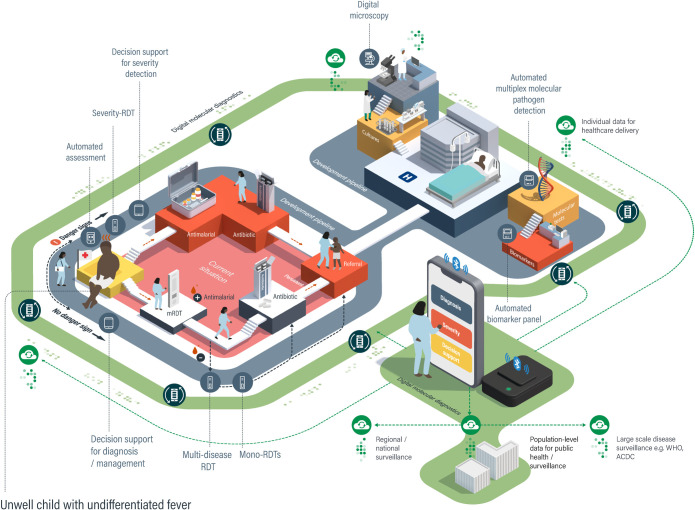
Fig 3. Current and future diagnostics in the integrated management of childhood febrile illness.
One of the most common and important diagnostic challenges in SSA is the management of fever in young children. WHO recommends that primary healthcare workers in resource-limited settings use a syndromic approach for managing childhood febrile illness, incorporating a mRDT in malaria endemic countries (current situation, pink area). Initial management involves a triage step to establish if the child is seriously ill, based on clinical danger signs; if these are present, the child is given antimalarial treatment, antibiotics, and referred urgently to a facility where additional diagnostic tests and treatments are available. If a child is not seriously ill, then a mRDT is performed and, if positive, the child is treated with antimalarials. If the mRDT is negative, the child is evaluated for clinical signs indicating a bacterial infection (there are currently no RDTs to confirm this at the point of care) and receives antibiotics if these are present. If symptoms are persistent, then the child is referred to a higher-level facility for further assessment. Many new diagnostics and decision support tools are currently being developed to improve outcomes by addressing weaknesses at each stage in this process (grey track). Additional diagnostics are in development to improve the speed or accuracy of diagnosis in the referral healthcare facilities with clinical laboratories. New digital molecular diagnostic devices (green track) have the potential to integrate accurate diagnosis, evaluation of severity, and decision support in a single device and, through modular design of diagnostic cartridges, could provide solutions throughout the patient journey. Connectivity means that data can be shared between facilities to support patient care and for public health decision-making. mRDT, malaria rapid diagnostic test; RDT, rapid diagnostic test.
Fig 4
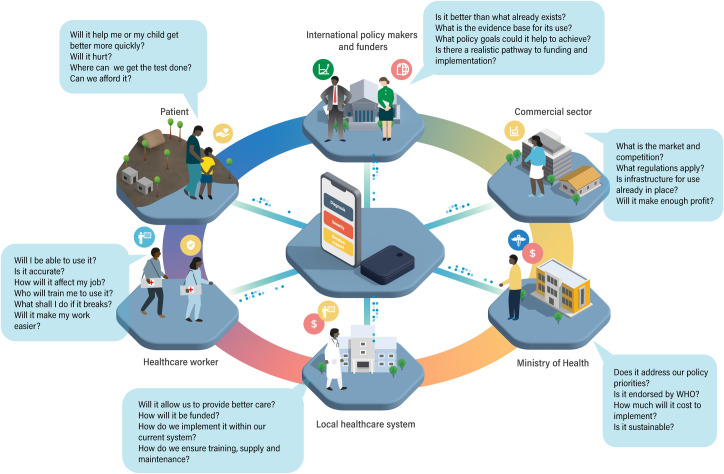
Fig 4. Understanding the perspective of users and stakeholders.
To produce new digital diagnostics that will be widely used, it is important to understand the perspectives of all stakeholders involved in and impacted by their implementation. Understanding the perspectives of patients and healthcare workers is important, but consideration must also be given to the broader health system, government organisations, the commercial sector, international funders, and policy makers. This may start with mapping who the stakeholders are, identifying their needs, discussing their expectations for a new diagnostic, and engaging them throughout product design, development and evaluation in a codesign process.
Fig 5
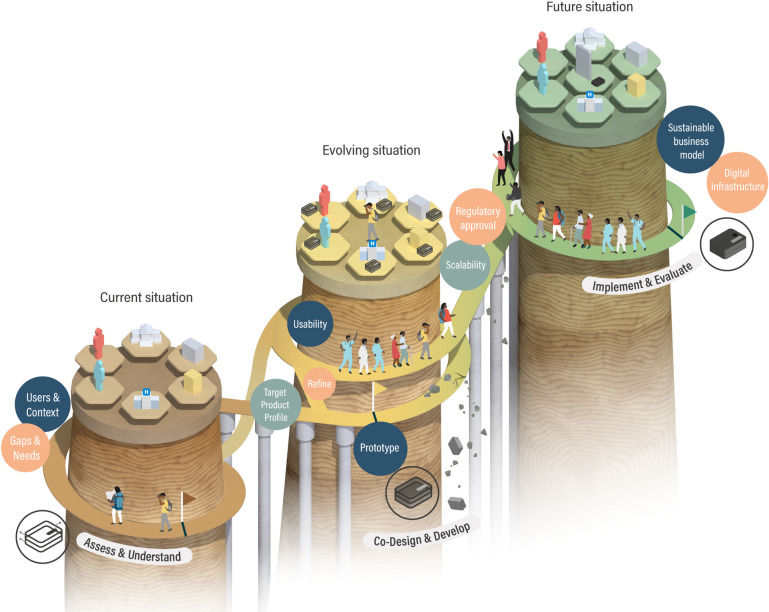
Fig 5. A roadmap for digital molecular diagnostic development.
The development of new diagnostics is not linear, although it can be imagined as a progressive and staged process. At the outset, the current gaps and needs should be assessed and use cases developed. Context-appropriate TPPs should be developed in partnership with the potential users. Desirability (will people want to use it?), feasibility (is it technically possible?), viability (what is affordable?), and sustainability (long-term funding, readiness of and integration into the health system) should also be considered from the start of development. Prototype devices meeting the TPP are tested and refined through an iterative codevelopment and codesign process with users and an increasing number of other stakeholders who influence the diagnostic ecosystem. To bridge from prototype to implementation, scalability must be addressed, regulatory approvals gained, and continuous evaluation should ensure sustainable business models and compatibility with the evolving digital infrastructure. TPP, target product profile.

References

    1. Azevedo MJ. The State of Health System(s) in Africa: Challenges and Opportunities. In: Historical Perspectives on the State of Health and Health Systems in Africa, Volume II. Cham: Palgrave Macmillan; 2017. pp. 1–73.
    1. World Health Organisation. Tracking Universal Health Coverage: 2017 Global Monitoring Report: executive summary. 2017. [cited 2020 Nov 10]. Available from: https://apps.who.int/iris/bitstream/handle/10665/259817/9789241513555-en....
    1. Fleming KA, Horton S, Wilson ML, Atun R, DeStigter K, Flanigan J, et al.. The Lancet Commission on diagnostics: transforming access to diagnostics. Lancet. 2021. Nov 27;398(10315):1997–2050. doi: 10.1016/S0140-6736(21)00673-5 - DOI - PMC - PubMed
    1. Pai M, Walia K, Boehme CC. Essential medicines and essential diagnostics: a package deal. Lancet Public Health. 2019. Oct;4(10):e492. doi: 10.1016/S2468-2667(19)30165-3 - DOI - PubMed
    1. Plianbangchang S. Universal Health Coverage (UHC). J Heal Res. 2018. Aug 3;32(4):322–4.

LinkOut - more resources