Review
. 2023 Jan 11;3(1):100384.
doi: 10.1016/j.crmeth.2022.100384. eCollection 2023 Jan 23.

Applications of deep learning in understanding gene regulation

Affiliations
Review

Applications of deep learning in understanding gene regulation

Zhongxiao Li et al. Cell Rep Methods. .

Abstract

Gene regulation is a central topic in cell biology. Advances in omics technologies and the accumulation of omics data have provided better opportunities for gene regulation studies than ever before. For this reason deep learning, as a data-driven predictive modeling approach, has been successfully applied to this field during the past decade. In this article, we aim to give a brief yet comprehensive overview of representative deep-learning methods for gene regulation. Specifically, we discuss and compare the design principles and datasets used by each method, creating a reference for researchers who wish to replicate or improve existing methods. We also discuss the common problems of existing approaches and prospectively introduce the emerging deep-learning paradigms that will potentially alleviate them. We hope that this article will provide a rich and up-to-date resource and shed light on future research directions in this area.

Keywords: deep learning; gene regulation; neural network; omics.


Conflict of interest statement

The authors declare no competing interests.

Figures

Figure 1
Figure 1
Deep-learning applications in gene regulation at various omics levels
Figure 2
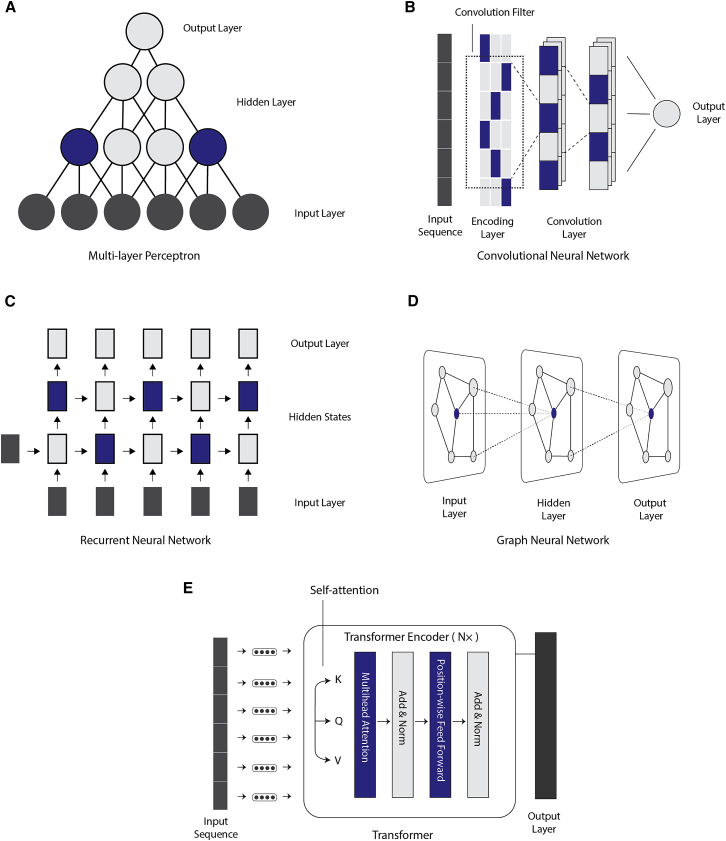
Figure 2
Common deep-learning architectures used in gene regulation studies (A) Multi-layer perceptron. (B) Convolutional neural network. (C) Recurrent neural network. (D) Graph neural network. (E) Transformer.
Figure 3
Figure 3
New deep-learning paradigms for gene regulation studies (A) Self-supervised pre-trained models. (B) Few-shot and meta-learning models. (C) Incorporation of structural information. (D) Multi-omics models. (E) Single-cell omics models.

References

    1. Kharchenko P.V., Tolstorukov M.Y., Park P.J. Design and analysis of ChIP-seq experiments for DNA-binding proteins. Nat. Biotechnol. 2008;26:1351–1359. - PMC - PubMed
    1. Ule J., Jensen K., Mele A., Darnell R.B. CLIP: a method for identifying protein–RNA interaction sites in living cells. Methods. 2005;37:376–386. doi: 10.1016/j.ymeth.2005.07.018. - DOI - PubMed
    1. Licatalosi D.D., Mele A., Fak J.J., Ule J., Kayikci M., Chi S.W., Clark T.A., Schweitzer A.C., Blume J.E., Wang X., et al. HITS-CLIP yields genome-wide insights into brain alternative RNA processing. Nature. 2008;456:464–469. doi: 10.1038/nature07488. - DOI - PMC - PubMed
    1. Song L., Crawford G.E. DNase-seq: a high-resolution technique for mapping active gene regulatory elements across the genome from mammalian cells. Cold Spring Harb. Protoc. 2010;2010 pdb.prot5384. - PMC - PubMed
    1. Buenrostro J.D., Giresi P.G., Zaba L.C., Chang H.Y., Greenleaf W.J. Transposition of native chromatin for fast and sensitive epigenomic profiling of open chromatin, DNA-binding proteins and nucleosome position. Nat. Methods. 2013;10:1213–1218. doi: 10.1038/nmeth.2688. - DOI - PMC - PubMed

Publication types

MeSH terms